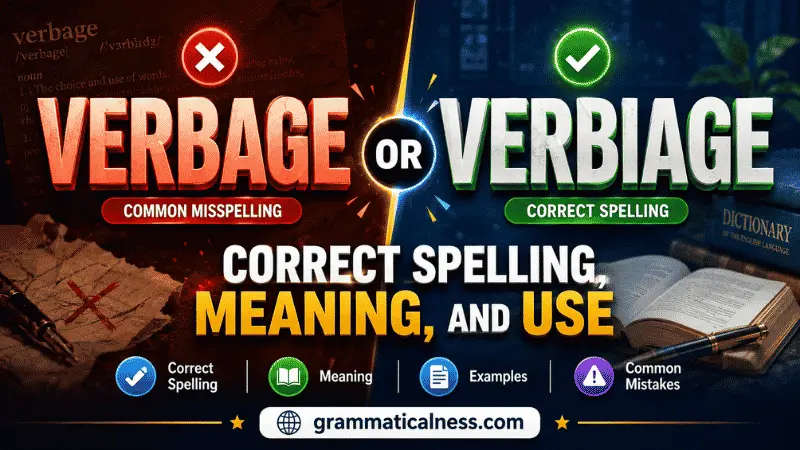
The correct choice in modern American English is verbiage. The form verbage appears often enough online to create doubt, but it is not the standard form used in careful present-day writing.
The confusion is easy to understand. When people say verbiage quickly, the middle i may be hard to hear. Some speakers also use a shortened pronunciation that sounds close to verbage. That sound can lead writers to leave out a letter.
The difference is mainly one of accepted usage. Verbiage is an established noun with two recognized meanings. It can describe language that uses too many words, or it can refer more neutrally to wording or manner of expression. Verbage has appeared historically, but it is now treated as nonstandard and should usually be corrected.
Quick Answer
Use verbiage, not verbage, in modern US English.
Verbiage is a noun. It commonly means excessive, complicated, or unnecessary language. It can also mean the particular wording used in speech or writing.
Verbage is not the accepted modern spelling for these meanings. Although rare historical records exist, that history does not make it a suitable choice for current school, workplace, academic, legal, or published writing.
A practical memory aid is to keep the i in the middle: verb-i-age.
Why People Confuse Them
The main cause is pronunciation. Verbiage is commonly pronounced VUR-bee-ij, with three syllables. A shorter accepted pronunciation, close to VUR-bij, can make the middle letter difficult to notice.
The ending also contributes to the mistake. Writers may connect the word with familiar words ending in -age, such as garbage, and assume that verbage follows the same pattern.
Online repetition strengthens the confusion. Once a misspelling appears in emails, captions, meeting notes, or business documents, other writers may copy it without checking.
This is not a normal American-versus-British spelling difference. For standard current writing, verbiage is the dependable form in both varieties.
Key Differences At A Glance
| Feature | verbage | verbiage |
| Modern status | Nonstandard in careful current writing | Standard English word |
| Part of speech | Usually an attempted noun form | Noun |
| Main meaning | Usually intended to mean verbiage | Excessive wording or manner of wording |
| Professional use | Avoid | Acceptable, though sometimes formal or critical |
| Spoken form | Often reflects a shortened hearing of the word | Commonly VUR-bee-ij; also heard as VUR-bij |
Meaning and Usage Difference
Verbiage has two established senses.
The first and most familiar sense is negative. It refers to an unnecessary abundance of words, especially language that feels inflated, confusing, technical, or difficult to follow.
The policy was buried under pages of legal verbiage.
Here, verbiage suggests that the policy uses more words or more complicated language than necessary.
The second sense is neutral. It means the wording, phrasing, or manner in which something is expressed.
The team approved the final verbiage for the announcement.
This use does not automatically criticize the wording. It simply identifies the language chosen for the message. The neutral sense is well established in American English, although some readers may still hear a mildly negative tone.
Verbage does not provide a separate modern meaning. In most current contexts, it is a misspelling or nonstandard form used where the writer intends verbiage.
Grammatically, verbiage is usually an uncountable noun. Writers normally say “the verbiage is unclear,” not “the verbiage are unclear.”
Tone, Context, and Formality
Verbiage often sounds more formal than everyday choices such as wording or phrasing. It appears frequently in discussions of contracts, policies, technical documents, speeches, and official messages.
Its tone depends on context:
- Critical: “The report contains too much verbiage.”
- Neutral: “Please review the updated contract verbiage.”
- Technical or workplace-focused: “The compliance team changed the disclosure verbiage.”
Because the negative meaning is common, the word can sound judgmental even when a writer intends a neutral sense. In a friendly message, wording may sound clearer and less stiff.
Verbage usually creates a different impression. In polished writing, it looks like an error. It may appear in casual notes or speech-based writing, but informality does not make it the standard choice.
Which One Should You Use?
| Context | Best Choice | Why |
| School essay or assignment | verbiage | It is the accepted form |
| Professional email | verbiage | It avoids a noticeable spelling error |
| Contract or policy discussion | verbiage | It can mean the wording used in the document |
| Criticism of wordy writing | verbiage | It accurately describes excessive language |
| Casual text message | verbiage | The standard spelling still applies |
| Exact historical quotation containing the older form | verbage | Preserve the original only when quotation accuracy matters |
| Deliberate joke or wordplay | verbage, with clear intent | Readers should be able to see that the altered form is intentional |
In nearly every ordinary writing situation, choose verbiage. Use verbage only when reproducing an exact source or creating obvious wordplay.
When One Choice Sounds Wrong
Verbage sounds wrong in most current writing because readers generally expect verbiage. A sentence such as “Please revise the contract verbage” may distract readers and weaken the writer’s credibility.
Verbiage can also sound awkward when the context is very simple. Although “Send me the new verbiage” can mean “Send me the new wording,” it may sound overly corporate in a casual exchange.
The problem in that case is not grammar. It is tone. The word is correct, but a plainer choice may fit the situation better.
Verbiage also sounds mismatched when a writer uses it as praise without enough context. Since many readers associate it with wordiness, “I loved your verbiage” may sound sarcastic. A more specific compliment, such as “I liked your phrasing,” communicates the intended meaning more clearly.
Common Mistakes (and Quick Fixes)
Mistake: Dropping the middle i
Incorrect: The proposal contains confusing verbage.
Correct: The proposal contains confusing verbiage.
Mistake: Treating the forms as equal alternatives
Incorrect idea: Either spelling is fine.
Quick fix: Use verbiage in modern edited English.
Mistake: Using verbiage as a verb
Awkward: Can you verbiage this paragraph differently?
Better: Can you reword this paragraph?
Major current dictionaries classify verbiage as a noun, so verb use is best avoided in careful writing.
Mistake: Assuming verbiage must always be negative
The word often criticizes excessive language, but it can also neutrally mean wording or diction.
Mistake: Using a plural verb
Incorrect: The verbiage are unclear.
Correct: The verbiage is unclear.
Mistake: Calling “excess verbiage” automatically redundant
The phrase can be reasonable when verbiage means wording and excess identifies the unnecessary portion.
Everyday Examples
- The editor removed unnecessary verbiage from the introduction.
- We need to approve the final verbiage before the email goes out.
- The warranty uses technical verbiage that many customers may not understand.
- Her answer was direct and free of empty verbiage.
- The attorney suggested changing the verbiage in the last clause.
- The app notification needs friendlier verbiage.
- The teacher corrected verbage to verbiage in the draft.
- I nearly wrote verbage, but I remembered the middle i.
- The speaker’s formal verbiage did not match the relaxed audience.
- Clear instructions work better than pages of confusing verbiage.
These examples show both recognized senses: unnecessary wordiness and neutral wording.
Dictionary-Style Word Details
Verb
- verbage: Not commonly used as a verb in standard US English.
- verbiage: Not commonly used as a verb in standard US English. Use word, reword, phrase, or rephrase when an action is intended.
Noun
- verbage: A rare historical or nonstandard form. In current writing, it usually appears as an attempted spelling of verbiage and is best avoided.
- verbiage: An uncountable noun meaning excessive or obscure language, or the wording and manner used to express something.
Synonyms
- verbage: No separate modern synonym set is useful because the form is generally nonstandard. The intended standard word is usually verbiage.
- verbiage, negative sense: wordiness, verbosity, long-windedness, circumlocution, diffuseness.
- verbiage, neutral sense: wording, phrasing, diction, expression.
- Helpful opposites for the negative sense: brevity, concision, directness, plainness.
Example Sentences
- verbage: The proofreader marked verbage and replaced it with verbiage.
- verbage: The historical passage used an uncommon form spelled verbage.
- verbiage: The instructions lost readers in unnecessary verbiage.
- verbiage: The communications team revised the announcement’s verbiage.
- verbiage: Avoid technical verbiage when plain language will work.
Word History
- verbage: Historical references record this form as an older variant or separate formation, but it did not become the normal modern spelling. Its past existence should not be confused with present-day standard acceptance.
- verbiage: English borrowed the word from French in the early eighteenth century. Its history is connected with a French verb meaning to chatter or warble and with the French word for “word.”
Phrases Containing
- verbage: No established standard modern phrases depend on this form. Most appearances reflect misspelling, quotation, or deliberate wordplay.
- verbiage: Common combinations include legal verbiage, technical verbiage, contract verbiage, official verbiage, unnecessary verbiage, and excess verbiage.
FAQs
In practical modern US writing, treat verbage as nonstandard and use verbiage instead. Historical references record verbage, so saying it never appeared anywhere is too absolute. Still, schools, editors, and professional readers normally expect verbiage today.
No. They may point to the same intended idea, but they do not have equal status. Verbiage is the accepted modern noun. Verbage usually looks like a misspelling, except in an exact quotation, historical discussion, or deliberate joke.
No. In many contexts, verbiage means excessive, complicated, or unnecessary language, which gives it a negative tone. It can also neutrally mean wording or manner of expression, especially in American workplace, legal, policy, and communications contexts.
The clearest pronunciation is VUR-bee-ij, with three syllables and stress on the first. A compressed pronunciation close to VUR-bij is also heard and recognized. That shorter sound likely helps explain why writers sometimes omit the middle i.
Verbiage is a noun in standard English, usually an uncountable one. Say “the verbiage is confusing” or “we changed the verbiage.” In careful writing, avoid using it as a verb. Choose word, reword, phrase, or rephrase instead.
Yes, when its meaning fits. Use verbiage to discuss excessive language or a document’s wording. Remember that it can sound formal or mildly critical. In a simple email, wording may communicate the same idea more directly and warmly.
Conclusion
Choose verbiage for modern American English. It is the standard noun for excessive language and, in a neutral sense, for wording or manner of expression.
Avoid verbage in ordinary writing. Historical evidence shows that the form has existed, but modern readers usually see it as nonstandard or mistaken.
The easiest rule is simple: keep the middle i. When verbiage feels too formal or carries an unwanted critical tone, use a plainer word such as wording or phrasing.