
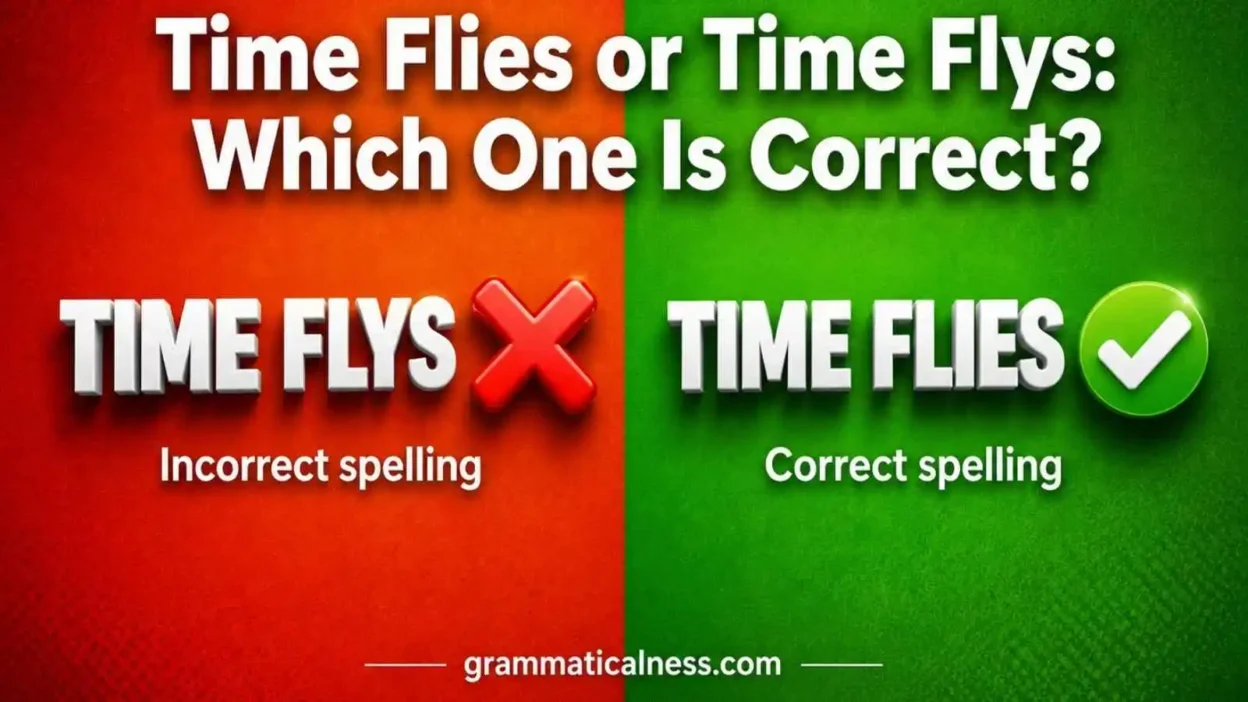
The correct phrase is time flies.
Time flys is not correct in standard US English. It is a common spelling mistake.
The phrase means that time seems to pass quickly. You might say it when a weekend ends fast, a child grows up, or a year feels like it disappeared.
Quick Answer
Use time flies.
Do not write time flys.
In this phrase, time is a singular noun. The verb is flies, the correct present-tense form of fly with a singular subject.
Correct: Time flies when you’re having fun.
Incorrect: Time flys when you’re having fun.
Why People Confuse Them
People confuse time flies and time flys because the base verb is fly.
Many English verbs add s in this kind of sentence:
She walks.
He talks.
It works.
So it may seem natural to write flys.
But verbs ending in a consonant plus y usually change y to ies:
try → tries
cry → cries
fly → flies
That is why time flies is correct.
Key Differences At A Glance
| Context | Best Choice | Why |
| Saying time passes quickly | time flies | This is the standard phrase. |
| Writing an email or text | time flies | It sounds natural and correct. |
| School or work writing | time flies | It follows standard grammar. |
| Social media caption | time flies | Casual writing still uses the correct form. |
| Writing “time flys” | neither | This is a spelling error. |
Meaning and Usage Difference
Time flies means time seems to pass very fast.
It does not mean time is literally flying. It is a common expression.
Examples:
Time flies during summer break.
I can’t believe your son is in college now. Time flies.
We’ve worked together for five years already? Time flies.
Time flys has no standard meaning in this phrase. Readers will usually see it as a mistake.
A compact comparison:
- time flies: correct phrase meaning time passes quickly
- time flys: incorrect spelling in standard US English
- flies: correct verb form after singular time
- flys: not the correct verb form here
Pronunciation does not add much to this comparison. Both forms would sound the same if spoken, which is one reason the error happens in writing.
Tone, Context, and Formality
Time flies works in casual and polished writing.
It can sound warm, reflective, surprised, or light, depending on the sentence.
Casual:
Time flies. I can’t believe it’s Friday.
Warm:
Your baby is walking already? Time flies.
Professional:
It has been three years since we opened this office. Time flies.
Formal writing can use time flies, but use it with care. It is a familiar expression, so it may sound too casual in very serious reports or legal writing.
Time flys does not have a separate tone. It simply looks wrong.
Which One Should You Use?
Use time flies every time you mean that time passes quickly.
Use it in texts, emails, captions, cards, speeches, and everyday conversation.
Do not use time flys unless you are showing an error on purpose.
Best choice:
Time flies when you’re busy.
Time flies when the kids are growing up.
Time flies during a good vacation.
Wrong choice:
Time flys when you’re busy.
Time flys when the kids are growing up.
Time flys during a good vacation.
Confused about the correct plural spelling of “fly”? Our detailed guide on whether it’s “flies” or “flys” clears up the grammar rule with simple examples and common mistakes.
When One Choice Sounds Wrong
Time flys sounds wrong because the spelling does not match the verb form.
The subject is time. In this sentence, time acts like it:
It flies.
Time flies.
You would not write:
It flys.
So you should not write:
Time flys.
The same pattern appears in other sentences:
The plane flies over Denver.
The bird flies south.
The weekend flies by.
Common Mistakes (and Quick Fixes)
Mistake: Time flys when we’re together.
Fix: Time flies when we’re together.
Mistake: I guess time really flys.
Fix: I guess time really flies.
Mistake: How fast time flys!
Fix: How fast time flies!
Mistake: Summer always flys by.
Fix: Summer always flies by.
A simple memory tip: if you would write it flies, write time flies.
Everyday Examples
Time flies when you’re having fun.
I can’t believe the trip is over. Time flies.
Your daughter is starting high school already? Time flies.
We moved here six years ago? Wow, time flies.
Time flies during the holidays.
The afternoon flies by when I’m busy.
It feels like May just started, but time flies.
Time flies when the whole family is together.
Dictionary-Style Word Details
Verb
- time flies: The word flies is a verb. It is the present-tense form of fly used with a singular subject. In this phrase, time is the subject.
- time flys: Not commonly used as a correct verb phrase in standard US English.
Noun
- time flies: As a full phrase, it is not a noun. The word time is a noun, and flies is the verb.
- time flys: Not commonly used as a noun phrase in standard US English.
Synonyms
- time flies: Closest plain alternatives include time passes quickly, time goes by fast, and time slips away.
- time flys: No true synonyms, because it is not the standard form.
Clear opposites are hard to match exactly. A plain opposite idea would be time drags, meaning time seems to pass slowly.
Example Sentences
- time flies: Time flies when you’re doing work you enjoy.
- time flies: I can’t believe it has been ten years. Time flies.
- time flies: The weekend always flies by too fast.
- time flys: This is not the correct spelling in standard US English.
Word History
- time flies: The phrase is tied to the older idea that time moves quickly. Exact details are not needed to use it correctly.
- time flys: No useful standard word history applies to this comparison. It is best treated as a modern spelling error in this phrase.
Phrases Containing
- time flies: time flies when you’re having fun, how time flies, time really flies
- time flys: No standard phrases use this spelling in normal US English.
FAQs
Time flies is the correct expression. In this phrase, flies is the third-person singular form of the verb fly. Because time is a singular subject, we say, “Time flies.” The spelling time flys is incorrect in standard English.
When a verb ends in a consonant followed by y, English usually changes the y to i before adding -es. Therefore, fly becomes flies, just as try becomes tries and cry becomes cries.
Time flies means that time seems to pass very quickly. People often use this expression when they are surprised by how much time has passed, especially during enjoyable, busy, or memorable experiences.
Yes. You might say, “Time flies when you are having fun,” or “I cannot believe we have been friends for ten years—time flies.” Both examples show that time seems to have passed faster than expected.
Yes, time flies is commonly treated as an idiomatic expression because time does not literally fly. The phrase uses figurative language to describe the feeling that days, months, or years are passing unusually quickly.
Flies can be the plural noun for the insect fly or the present-tense verb used with a singular subject, as in “The bird flies.” Flys is generally incorrect as the plural or verb form of fly. In the expression time flies, always use flies.
Conclusion
The correct choice is time flies.
Time flys is a spelling mistake.
Use time flies when you mean time passes quickly or seems to move fast. The rule is simple: time is singular, and the correct verb form is flies.