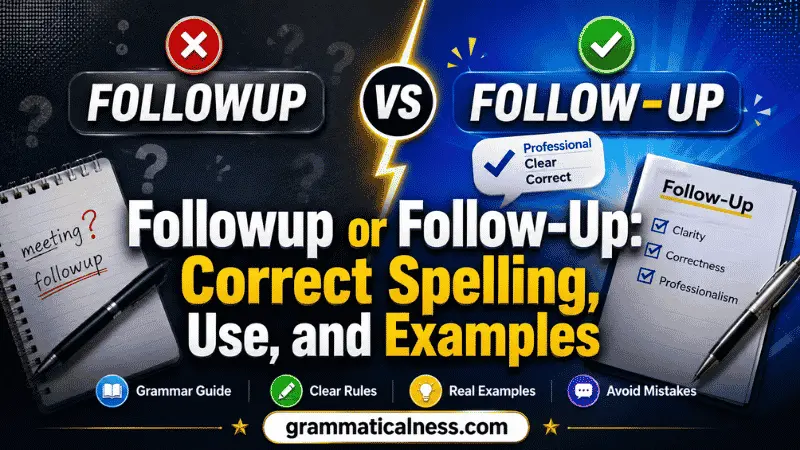
When choosing between followup or follow-up, use follow-up in standard edited American English when the term works as a noun or adjective. The closed form followup appears in some dictionaries, informal writing, software labels, and brand names, but it is not the safest general spelling.
A separate two-word form, follow up, is the verb. That distinction matters because the hyphen is not decorative. It signals the grammatical job the expression performs.
Quick Answer
Use follow-up for a later action, event, message, appointment, or question.
- Noun: “We scheduled a follow-up.”
- Adjective: “She sent a follow-up email.”
Avoid followup in polished general writing unless you are preserving an official name or following a required house style. When you need a verb, write follow up as two words: “I will follow up tomorrow.”
Why People Confuse Them
The two compared forms sound alike, and the difference is visible only in writing. English compounds also vary: some stay open, some use hyphens, and some eventually close into one word. That makes followup look plausible.
Digital forms, file names, database labels, and company branding often remove punctuation for convenience. Readers therefore see the closed form frequently enough to wonder whether it has become standard everywhere. It has not gained that level of consistent acceptance.
Key Differences At A Glance
- follow-up: The broadly accepted noun and adjective spelling.
- followup: A less common closed variant that may appear informally or in proper names.
- Meaning: Usually the same when both forms name or describe a later action.
- Best default: Choose follow-up in school, workplace, medical, and published writing.
- Verb warning: Neither compared form is the standard verb spelling; use follow up.
Meaning and Usage Difference
Follow-up can name something done after an earlier action. A follow-up may be a call after an interview, a visit after treatment, or a report that adds new information. It can also modify another noun, as in follow-up care or follow-up questions.
Followup usually carries the same basic meaning where it appears. The difference is mainly acceptance and style, not a separate definition. Some references recognize the closed noun, but many prominent American references and editorial guides favor the hyphenated form.
Both forms are commonly pronounced “FOL-oh-up,” so pronunciation does not help a writer choose between them.
Tone, Context, and Formality
Follow-up looks standard, careful, and natural in professional American writing. It fits emails, reports, medical instructions, academic papers, news copy, and customer communication.
Followup can look compressed or informal. It may be acceptable inside a company’s interface, internal field label, hashtag, username, or official product name. Outside those limited settings, it can distract readers or appear to be a spelling error.
The choice does not usually change the tone of the message itself. It changes how polished and conventional the spelling appears.
Which One Should You Use?
| Context | Best Choice | Why |
| Naming a later action | follow-up | It functions as a noun. |
| Describing a later email, call, or visit | follow-up | It functions as an adjective. |
| Professional, medical, or academic prose | follow-up | It is the safest widely accepted form. |
| Casual texting or notes | follow-up | It remains clear and standard. |
| Describing the action of contacting again | Neither; use follow up | The verb is written as two words. |
| Official brand or product name | Follow the official spelling | Proper names may intentionally use followup. |
When no special branding rule applies, choose follow-up. It is less likely to be questioned by readers, editors, instructors, or clients.
When One Choice Sounds Wrong
Followup sounds acceptable when spoken because nobody hears the missing hyphen. On the page, however, it may look unfinished or nonstandard:
- Less suitable: “Please send a followup email.”
- Standard: “Please send a follow-up email.”
Follow-up sounds wrong when it is forced into a verb position:
- Incorrect: “I will follow-up tomorrow.”
- Correct: “I will follow up tomorrow.”
A quick test helps. If you can place a, the, or another before it, use the noun follow-up. If it directly describes a noun, also use follow-up.
Common Mistakes (and Quick Fixes)
Mistake: Writing followup meeting in a formal document.
Fix: Write follow-up meeting.
Mistake: Writing I need to follow-up with her.
Fix: Write I need to follow up with her because the expression is a verb.
Mistake: Leaving spaces around the hyphen.
Fix: Write follow-up, not follow – up.
Mistake: Forming the plural as follows-up or followup’s.
Fix: Write follow-ups.
Mistake: Changing an official name to match ordinary spelling.
Fix: Keep the organization’s chosen spelling inside the proper name, then return to standard follow-up in general prose.
Everyday Examples
- The recruiter promised a follow-up by Friday.
- I sent a follow-up email after the interview.
- Her doctor arranged two follow-ups during recovery.
- The reporter published a follow-up story with new details.
- Our manager asked three follow-up questions.
- The support team scheduled a follow-up call.
- Please follow up with the vendor this afternoon.
- The app labels the feature “Followup,” but the instructions call it a follow-up reminder.
These examples show that the hyphenated form works naturally as both a noun and an adjective. The closed form is best reserved for a deliberate proper-name or interface choice.
Dictionary-Style Word Details
Verb
- followup: Not commonly accepted as a verb in standard US English.
- follow-up: Not normally used as a verb. Use the two-word phrasal verb follow up instead.
Noun
- followup: A less common closed spelling for a later action, continuation, review, or contact. Acceptance varies by reference and context.
- follow-up: The standard choice for a later action or item that continues something earlier: “The editor requested a follow-up.”
Synonyms
For either form’s noun meaning, the closest plain alternatives depend on context: check-in, continuation, review, update, sequel, additional contact, or later visit. These are not exact replacements in every sentence.
There is no single useful antonym that fits all meanings.
Example Sentences
- followup: The dashboard uses “followup” as an internal status label.
- follow-up: We need a follow-up before closing the case.
- followup: FollowupPro is the official product name shown on the invoice.
- follow-up: She prepared a follow-up presentation for the board.
Word History
The hyphenated noun and adjective developed from the older verb phrase follow up. English compounds sometimes move from open to hyphenated to closed forms over time, but followup has not become the consistently preferred spelling across edited American English.
Phrases Containing
- followup: Most often seen in brand names, software labels, usernames, or compressed internal text.
- follow-up: follow-up email, follow-up appointment, follow-up question, follow-up call, follow-up meeting, follow-up care, follow-up study, and follow-up interview.
FAQs
Followup appears as a closed variant in some dictionaries, informal writing, and brand names. Still, follow-up is the safest standard choice for a noun or adjective. Use the one-word form only when a required house style or official name uses it.
Write follow-up email. Here, follow-up describes the noun email, so it functions as an adjective and keeps the hyphen. The same pattern applies to follow-up call, follow-up meeting, follow-up question, and follow-up appointment in edited American English.
No, not in standard edited usage. Use the two-word verb follow up when describing an action: “I will follow up tomorrow.” The hyphenated form names or describes the later action, as in “a follow-up” or “a follow-up message.”
The plural is follow-ups. Add the regular plural ending to the end of the hyphenated noun: “We scheduled two follow-ups.” Do not write follows-up, follow’s-up, or followups when you want the broadly accepted edited spelling.
No. Medical and business writing commonly use follow-up as a noun or adjective, as in follow-up care and follow-up email. These fields also use follow up as a verb. The one-word followup remains less suitable unless an organization requires it.
Yes, preserve an official spelling when followup forms part of a registered company, product, feature, or service name. Proper names may intentionally break ordinary spelling conventions. In your surrounding general prose, however, use follow-up for the common noun or adjective.
Conclusion
Between followup or follow-up, choose follow-up for the standard noun or adjective in American English. It correctly fits a follow-up email, a follow-up visit, or simply a follow-up.
Treat followup as a limited variant rather than the general default. Keep it when an official name or required style uses it. For an action, use the separate verb follow up without a hyphen.