
Complain or complaint is a common word-choice problem because the two words look almost the same and share the same basic idea. Both connect to unhappiness, dissatisfaction, or a problem that someone wants to mention.
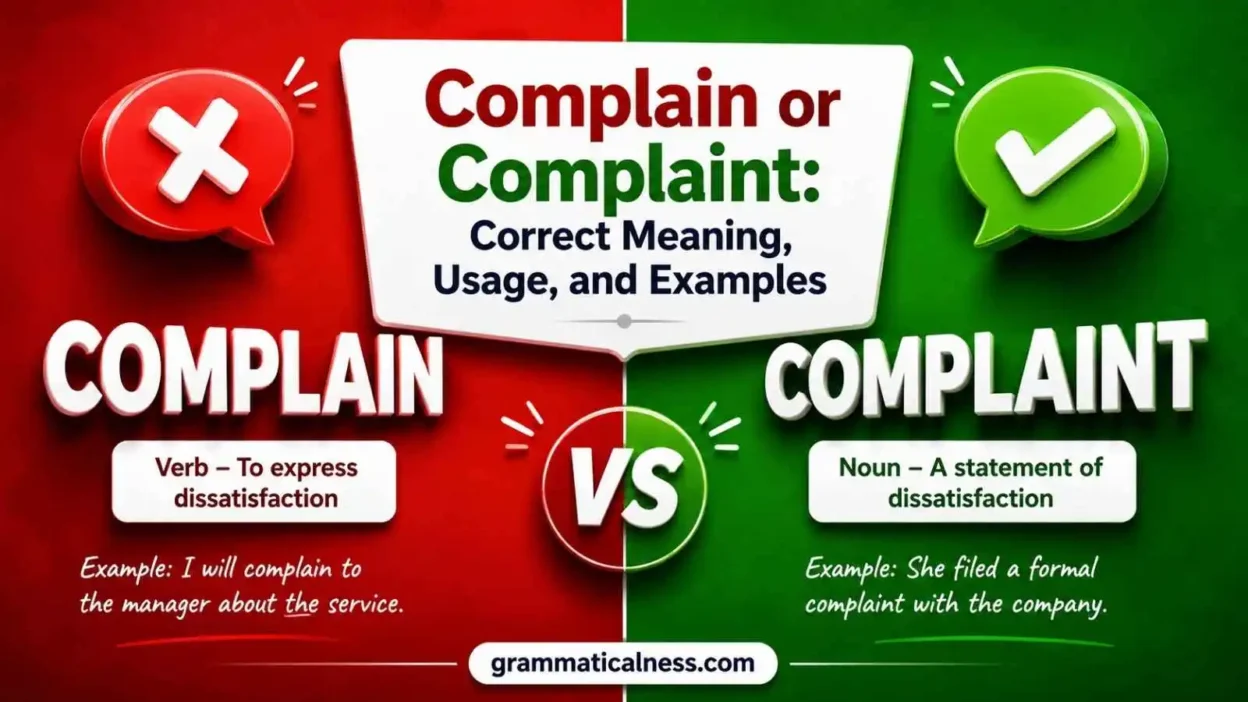
The difference is grammar. Complain is usually a verb. It shows the action of speaking up about a problem. Complaint is a noun. It names the problem, statement, report, or formal claim. Once you know the sentence job, the choice becomes much easier.
Quick Answer
Use complain when someone is doing the action of saying that something is wrong, unfair, painful, or unsatisfactory. Use complaint when you need a noun that names the problem or the statement about the problem.
Correct: “I want to complain about the service.”
Correct: “I have a complaint about the service.”
Why People Confuse Them
People confuse these words because they are closely related. They also appear in many of the same situations, such as customer service, work emails, school offices, medical visits, and legal writing.
The spelling difference is small, but the grammar difference is important. Complain works like an action word. Complaint works like a thing, idea, statement, or formal record.
A simple test helps: if you can replace the word with “speak up,” use complain. If you can replace it with “issue” or “grievance,” use complaint.
Key Differences At A Glance
| Context | Best Choice | Why |
|---|---|---|
| You are describing an action | complain | It is the verb. |
| You are naming a problem | complaint | It is the noun. |
| After “a,” “an,” “the,” or “my” | complaint | These words usually introduce nouns. |
| After “want to,” “will,” or “did” | complain | These words often come before a verb. |
| Customer service report | complaint | It names the issue or report. |
| Speaking to a manager | complain | It describes what the person does. |
| Legal filing | complaint | It can name a formal legal document. |
| Casual frustration | complain | It shows someone expressing dissatisfaction. |
Extra comparison block:
• Complain = action: “They complain about the noise.”
• Complaint = thing or statement: “They filed a complaint about the noise.”
• Complain changes forms: complain, complains, complained, complaining.
• Complaint changes number: complaint, complaints.
Meaning and Usage Difference
Complain means to say that something is wrong, unfair, painful, annoying, or not satisfactory. It is usually a verb.
Example: “Customers complain when delivery takes too long.”
Complaint means a statement, report, issue, grievance, or formal claim that something is wrong. It is a noun.
Example: “The company received a complaint about the delayed delivery.”
Pronunciation can also help. Complain sounds like “kuhm-PLAYN.” Complaint sounds like “kuhm-PLAYNT.” The final “t” in complaint helps signal that it is the noun.
Tone, Context, and Formality
Both words work in everyday and formal US English, but they appear in different sentence patterns.
Complain often sounds conversational when it means someone is expressing frustration. It can sound negative if the person complains too often or without a clear reason.
Example: “He complains about traffic every morning.”
Complaint can sound more official, especially in customer service, workplace, school, medical, or legal settings.
Example: “She submitted a written complaint to the office.”
Still, complaint is not always formal. You can say, “My only complaint is that the room was too cold.” That sentence is natural and common.
Which One Should You Use?
Use complain when the sentence needs a verb.
Examples:
“I need to complain about the charge.”
“Several neighbors complained about the noise.”
“She may complain if the deadline changes again.”
Use complaint when the sentence needs a noun.
Examples:
“I need to make a complaint about the charge.”
“The office reviewed several complaints.”
“Her main complaint was the lack of notice.”
Here is the easiest rule: people complain, but they make, file, submit, receive, or handle a complaint.
When One Choice Sounds Wrong
Complain sounds wrong when you use it as a noun.
Wrong: “I have a complain.”
Correct: “I have a complaint.”
Wrong: “The manager received my complain.”
Correct: “The manager received my complaint.”
Complaint sounds wrong when you use it as the main verb.
Wrong: “She complaint about the bill.”
Correct: “She complained about the bill.”
Wrong: “They will complaint tomorrow.”
Correct: “They will complain tomorrow.”
The sentence around the word usually tells you what you need. If the word names the issue, choose complaint. If the word shows the action, choose complain.
Common Mistakes (and Quick Fixes)
Mistake 1: Using complain after “a.”
Wrong: “I made a complain.”
Correct: “I made a complaint.”
Quick fix: after “a,” use the noun complaint.
Mistake 2: Using complaint after “to.”
Wrong: “I want to complaint.”
Correct: “I want to complain.”
Quick fix: after “want to,” use the base verb complain.
Mistake 3: Mixing up complaints and complains.
Wrong: “The customer complaints every week.”
Correct: “The customer complains every week.”
Wrong: “We received three complains.”
Correct: “We received three complaints.”
Quick fix: complains is a verb form. Complaints is the plural noun.
Mistake 4: Choosing the wrong phrase in formal writing.
Weak: “Please accept my complain.”
Better: “Please accept my complaint.”
Better still: “Please review my complaint about the billing error.”
Everyday Examples
“Please do not complain until we know the full story.”
“My complaint is about the broken checkout page.”
“Several employees complained about the new schedule.”
“The HR team reviewed the complaint on Monday.”
“I rarely complain, but this delay caused a real problem.”
“She made a complaint after the package arrived damaged.”
“Customers can complain by phone or send a written complaint online.”
“His only complaint was that the hotel room faced a busy street.”
“The patient complained of back pain during the visit.”
“The clinic listed stomach pain as the patient’s main complaint.”
Dictionary-Style Word Details
Verb
Complain: A verb meaning to express dissatisfaction, pain, annoyance, or concern. It often appears with about, to, or that.
Example: “They complained about the slow service.”
Complaint: Not commonly used as a verb in standard US English. Do not write “She complaint about the service.” Use complained for the past tense of complain.
Correct: “She complained about the service.”
Noun
Complain: Not standard as a noun in everyday US English. Do not write “a complain” when you mean a problem or grievance.
Correct: “a complaint”
Complaint: A noun. It can mean a statement of dissatisfaction, the problem being reported, a formal grievance, a legal filing, or a medical issue.
Example: “The company answered every customer complaint.”
Synonyms
Complain: Closest plain alternatives include object, protest, gripe, grumble, and speak up. These are not always exact. Protest can be stronger or more public. Gripe and grumble are more casual and can sound negative.
Complaint: Closest plain alternatives include grievance, objection, criticism, issue, report, and formal claim. In customer feedback, praise can work as an opposite. In legal or medical writing, the opposite depends on context, so it is better not to force one.
Example Sentences
Complain: “I do not want to complain, but the order is missing two items.”
Complaint: “I sent a complaint after the order arrived with two items missing.”
Complain: “Neighbors complained that the music was too loud.”
Complaint: “The landlord received a noise complaint.”
Complain: “You can complain to customer support if the charge is wrong.”
Complaint: “Customer support opened a complaint for the wrong charge.”
Word History
Complain and complaint are historically related. Both connect to older forms tied to lamenting, grief, or expressing pain. That background explains why both words involve dissatisfaction.
However, history is not the best way to choose between them today. Modern usage is simpler: complain is the verb, and complaint is the noun.
Phrases Containing
Complain:
• complain about something
• complain to someone
• complain that something happened
• complain of pain
• can’t complain
Complaint:
• make a complaint
• file a complaint
• submit a complaint
• lodge a complaint
• customer complaint
• written complaint
• complaint about something
• complaint against someone
FAQs
Is it complain or complaint?
Both words are correct, but they are not used the same way. Use complain as a verb when someone is saying that something is wrong. Use complaint as a noun when you are naming the problem, issue, or report. Correct: “I want to complain.” Correct: “I have a complaint.”
Is “I have a complain” correct?
No. “I have a complain” is not correct in standard US English. After “a,” you need a noun, so the correct word is complaint. Write: “I have a complaint about my order.” Use complain only when you need an action word.
Do you make a complaint or make a complain?
The correct phrase is make a complaint. Complaint is the noun that names the issue. Complain is the verb, so it does not fit after “make a.” Correct: “She made a complaint about the late delivery.” You can also say, “She complained about the late delivery.”
What is the past tense of complain?
The past tense of complain is complained. Example: “The customer complained about the extra charge.” Do not use complaint as a past-tense verb. “She complaint yesterday” is wrong. Use “She complained yesterday.”
Can complaint be plural?
Yes. The plural form is complaints. Use it when talking about more than one issue or report. Example: “The office received several complaints about the new policy.” Do not use complains as the plural noun. Complains is a verb form.
What is the easiest way to remember the difference?
Remember this simple rule: people complain, but they make a complaint. If the word shows an action, choose complain. If the word names a thing, issue, report, or grievance, choose complaint.
Conclusion
Complain and complaint are both correct, but they do different jobs. Use complain when someone is taking the action of speaking up about a problem. Use complaint when you are naming the problem, report, grievance, or formal statement.
The fastest check is simple: people complain, but they make a complaint. Write “I want to complain” when you need a verb. Write “I have a complaint” when you need a noun.
Both words are correct, but they are not used the same way. Use complain as a verb when someone is saying that something is wrong. Use complaint as a noun when you are naming the problem, issue, or report. Correct: “I want to complain.” Correct: “I have a complaint.”
No. “I have a complain” is not correct in standard US English. After “a,” you need a noun, so the correct word is complaint. Write: “I have a complaint about my order.” Use complain only when you need an action word.
The correct phrase is make a complaint. Complaint is the noun that names the issue. Complain is the verb, so it does not fit after “make a.” Correct: “She made a complaint about the late delivery.” You can also say, “She complained about the late delivery.”
The past tense of complain is complained. Example: “The customer complained about the extra charge.” Do not use complaint as a past-tense verb. “She complaint yesterday” is wrong. Use “She complained yesterday.”
Yes. The plural form is complaints. Use it when talking about more than one issue or report. Example: “The office received several complaints about the new policy.” Do not use complains as the plural noun. Complains is a verb form.
Remember this simple rule: people complain, but they make a complaint. If the word shows an action, choose complain. If the word names a thing, issue, report, or grievance, choose complaint.