
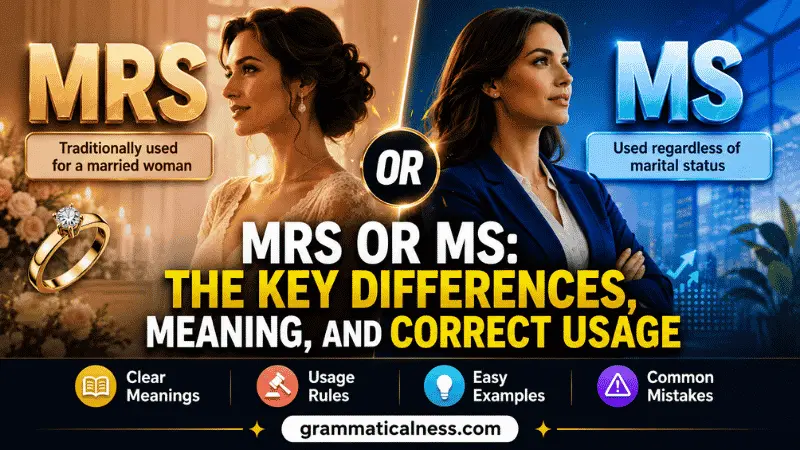
Mrs. and Ms. are both correct titles for women, but they do not communicate the same information.
Use Mrs. for a married woman who uses that title. Use Ms. for an adult woman without identifying whether she is married. When you do not know a woman’s preference or marital status, Ms. is usually the safest choice.
The keyword is often typed as “mrs or ms,” but standard American writing normally capitalizes the titles and adds periods: Mrs. and Ms.
Quick Answer
Choose Mrs. when you know that a married woman prefers to be addressed that way.
Choose Ms. when her marital status is unknown, irrelevant, or intentionally private. A married woman may also choose Ms., especially in professional settings.
The most important rule is simple: use the title the person uses for herself. Do not guess based on her age, surname, appearance, or relationship status.
Why People Confuse Them
Both words are courtesy titles placed before a woman’s surname or full name. They may appear in emails, letters, invitations, introductions, school settings, and formal conversations.
The confusion comes from the fact that Mrs. carries information about marriage, while Ms. does not. Some people mistakenly believe that Ms. means unmarried. It does not.
A woman named Elena Garcia could be Ms. Garcia whether she is single, married, divorced, or widowed. She would normally be Mrs. Garcia only if she is married and chooses that title.
Key Differences At A Glance
- Mrs.: Identifies a woman as married and should be used when that title matches her preference.
- Ms.: Identifies an adult woman without revealing or emphasizing her marital status.
Both titles usually come before a surname, as in Mrs. Parker or Ms. Parker. In American English, both are commonly written with a period.
Meaning and Usage Difference
Mrs. is a courtesy title traditionally used for a married woman. It may appear before her current surname, a retained surname, or another surname she personally uses.
For example:
“Please welcome Mrs. Andrea Collins.”
The title tells the listener that Andrea Collins is married or chooses to retain a married title.
Ms. is a courtesy title for an adult woman regardless of marital status. It is useful when marriage is unknown, unimportant, or unrelated to the situation.
For example:
“Please send the report to Ms. Andrea Collins.”
This sentence identifies the recipient respectfully without making a statement about her personal life.
The pronunciations are also different. Mrs. is usually pronounced “MISS-iz.” Ms. is pronounced “miz,” rhyming closely with “quiz.”
Tone, Context, and Formality
Both titles can sound polite and formal. The difference is not that one is more respectful than the other. The difference is the personal information each one communicates.
Mrs. can sound traditional, social, or personal because it identifies the woman as married. It is common when someone has clearly introduced herself that way or uses it on invitations, school materials, correspondence, or professional profiles.
Ms. sounds neutral and professional because it does not classify a woman by marriage. It is widely used in workplaces, business letters, formal emails, news writing, and situations where the writer does not know the recipient personally.
However, context does not override preference. If a married client signs her name as Ms. Taylor, continue using Ms. Taylor. If a teacher introduces herself as Mrs. Taylor, use Mrs. Taylor.
A professional title may take priority. For example, address a physician or professor as Dr. Taylor when that title is appropriate rather than choosing between Mrs. and Ms.
Which One Should You Use?
| Context | Best Choice | Why |
| You know she prefers Mrs. | Mrs. | It follows her stated title and identifies her as married. |
| You do not know whether she is married | Ms. | It avoids an unsupported assumption. |
| She is married but uses Ms. | Ms. | Marriage does not require a woman to use Mrs. |
| You are writing a professional email | Ms. | It is a neutral default unless another title is known. |
| She introduced herself as Mrs. | Mrs. | Her own form of address should guide you. |
| She has an applicable professional title | Professional title | A title such as Dr. may be more relevant than marital status. |
| She is divorced or widowed | Her preference | Either title may be used depending on her choice. |
When possible, check the person’s email signature, professional profile, business card, invitation, or previous correspondence. These often show the title she actually uses.
When One Choice Sounds Wrong
Mrs. sounds wrong when it is based only on a guess. A wedding ring, shared surname, age, or reference to children does not reliably tell you which title a woman prefers.
It is also inaccurate to use Mrs. automatically for every married woman. Many married women use Ms. because they do not want their title to communicate marital status.
Ms. is not grammatically wrong for a married woman. It may be the woman’s normal title. It becomes inappropriate only when you know that she specifically prefers another form of address and you ignore that preference.
Neither title should normally be placed before a first name alone in standard formal address. Write Ms. Bennett, not Ms. Olivia, unless a special local, cultural, or classroom practice supports the first-name form.
Common Mistakes (and Quick Fixes)
Mistake: Treating Ms. as a title only for unmarried women.
Quick fix: Remember that Ms. can refer to any adult woman.
Mistake: Assuming every married woman is Mrs.
Quick fix: Use Mrs. only when you know it is her chosen title.
Mistake: Guessing marital status from a surname.
Quick fix: A surname does not reveal whether someone is married or which title she uses.
Mistake: Writing mrs or ms in lowercase.
Quick fix: Capitalize both titles: Mrs. and Ms.
Mistake: Leaving out the period in American-style writing.
Quick fix: Write Mrs. Carter and Ms. Carter unless your organization follows a different house style.
Mistake: Ignoring an email signature.
Quick fix: Follow the title or name format the person uses in her own message.
Everyday Examples
You are emailing a hiring manager named Rachel Kim, but you do not know whether she is married:
“Dear Ms. Kim, thank you for reviewing my application.”
A neighbor introduces herself as Mrs. Rivera:
“It was nice meeting you, Mrs. Rivera.”
A married attorney signs her email as Dana Brooks without a social title. You can reply with her professional title when known or simply use her name:
“Dear Ms. Brooks” is reasonable if a formal social title is needed, but “Dear Dana Brooks” may also fit the setting.
A school notice identifies a teacher as Mrs. Allen:
“Students should submit the permission slip to Mrs. Allen by Friday.”
A customer’s account lists her as Ms. Jordan Reed:
“Ms. Reed, your appointment has been confirmed.”
These examples show why personal usage matters more than assumptions.
Dictionary-Style Word Details
Verb
Mrs.: Not used as a verb in standard American English. It functions as a courtesy title before a name.
Ms.: Not used as a verb in standard American English. It functions as a courtesy title before a name.
Noun
Mrs.: A noun used as a conventional title before the surname or full name of a married woman who uses that form of address.
Ms.: A noun used as a title before the surname or full name of an adult woman without indicating marital status.
Both words are also commonly described as honorifics or courtesy titles.
Synonyms
Neither word has a perfect synonym because each title carries a specific social function.
Mrs.: Closest plain alternative: “a married woman’s courtesy title.”
Ms.: Closest plain alternative: “a marital-status-neutral courtesy title for a woman.”
There are no useful direct antonyms. The two titles are contrasts, but they are not exact opposites because Ms. can also be used by a married woman.
Example Sentences
Mrs.: “Mrs. Thompson will lead the parent meeting tonight.”
Mrs.: “I addressed the invitation to Mrs. Elaine Thompson because that is the title she uses.”
Ms.: “Ms. Thompson will review the contract before Monday.”
Ms.: “When I could not confirm her preferred title, I used Ms. Thompson.”
Word History
Mrs.: The written title developed from an abbreviated form of mistress. Over time, its modern meaning became connected specifically with married women.
Ms.: The title was formed to provide a way of addressing a woman without identifying her as married or unmarried. It later became firmly established in professional and general American usage.
The histories are connected, but the two titles now serve different purposes.
Phrases Containing
Neither title commonly appears in fixed idioms. Instead, each occurs in standard naming and greeting patterns.
Mrs.: “Mrs. Johnson,” “Dear Mrs. Johnson,” and “Mr. and Mrs. Johnson.”
Ms.: “Ms. Johnson,” “Dear Ms. Johnson,” and “May I speak with Ms. Johnson?”
The title should match the person’s stated preference and the formality of the situation.
FAQs
Use Mrs. for a married woman who prefers that title. Use Ms. when her marital status is unknown, unimportant, or private. Ms. is usually the safest choice in professional communication when you do not know the person’s preference.
Yes. A married woman can correctly use Ms. Many women choose it because it does not identify them by marital status. Marriage does not automatically require someone to use Mrs. Always follow the title the woman uses for herself.
No. Ms. can be used for any adult woman, whether she is single, married, divorced, or widowed. It is different from Mrs. because it does not communicate whether the woman is married.
Use Ms. unless you know the recipient prefers Mrs. You can often find her preferred title in her email signature, company profile, or previous correspondence. When an appropriate professional title is available, such as Dr., use that instead.
Mrs. is usually pronounced “MISS-iz.” Ms. is pronounced “miz,” which rhymes closely with “quiz.” Although the titles may look similar in writing, their pronunciations are clearly different.
There is no single rule that applies to everyone. A divorced or widowed woman may use Mrs. or Ms., depending on her preference, surname, and personal circumstances. Do not assume that her title changed. Check how she introduces herself or signs her name.
In standard American English, both titles are commonly written with periods: Mrs. and Ms. Some British styles omit the periods, but American publications and professional correspondence generally include them.
Conclusion
Both Mrs. and Ms. are correct, but the right choice depends on what you know about the person.
Use Mrs. for a married woman who prefers that title. Use Ms. for any adult woman when marital status is unknown, irrelevant, or not meant to be emphasized.
A married woman can correctly use Ms., so never treat Ms. as another word for unmarried. When uncertain, start with Ms., check how the person identifies herself, and follow her preference.