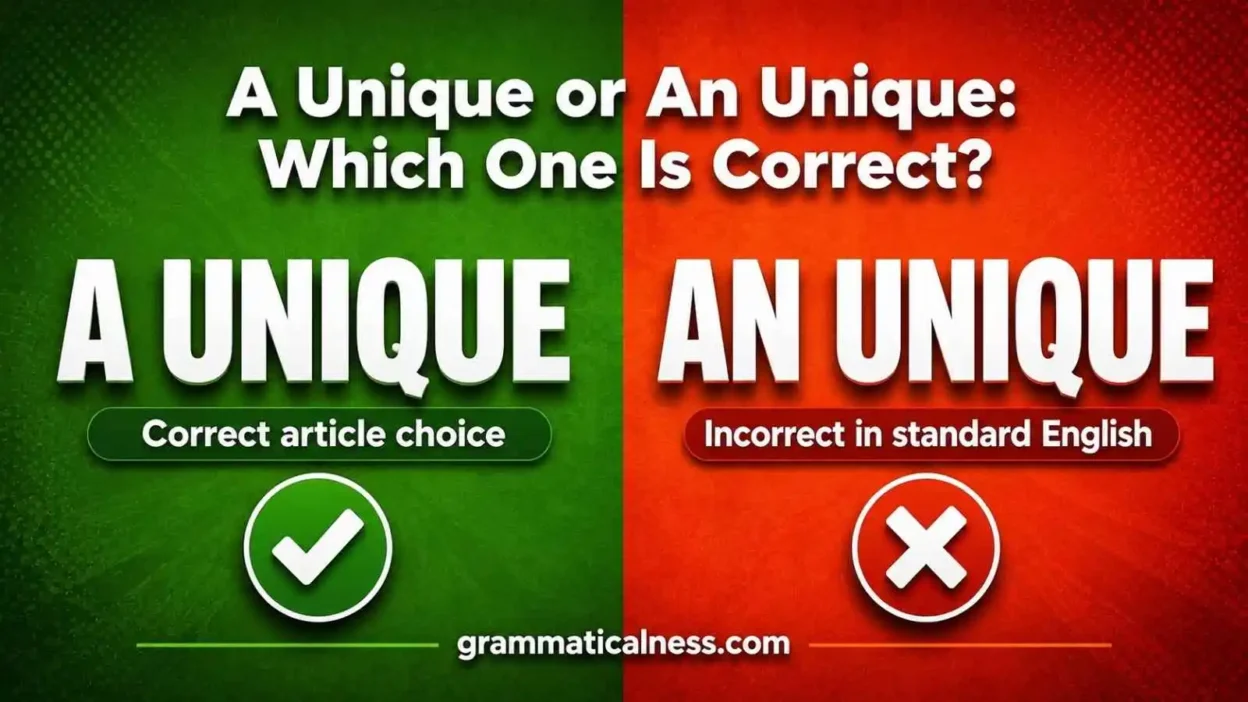
The correct phrase is a unique, not an unique. Even though unique starts with the letter u, it starts with the sound “you” in modern English.
That sound matters more than the first letter. Since unique begins with a consonant sound, it takes a. Use a unique idea, a unique style, and a unique opportunity.
Quick Answer
Use a unique in standard US English. Do not use an unique. The word unique starts with a “you” sound, like yoo-neek, so it behaves like a word that begins with a consonant sound. That is why a unique answer sounds natural, while an unique answer sounds incorrect.
Why People Confuse Them
People confuse a unique and an unique because they learn a simple rule first: use an before a vowel. That rule is incomplete.
The better rule is this: use an before a vowel sound, not simply before a vowel letter. The word unique begins with the letter u, but the first sound is like y in you.
That is why these examples use a:
• a unique design
• a unique reason
• a unique voice
• a unique chance
The spelling makes people expect an, but the sound calls for a.
Key Differences At A Glance
| Context | Best Choice | Why |
| Before unique in normal US writing | a unique | Unique starts with a “you” sound |
| Before unique in speech | a unique | It sounds smoother and correct |
| Before unique in school writing | a unique | It follows the sound-based article rule |
| Before unique in business writing | a unique | It is the standard professional form |
| Before unique in formal writing | a unique | An unique sounds old-fashioned or wrong today |
| Before a true vowel sound | an | Use an only when the next word starts with a vowel sound |
Meaning and Usage Difference
The difference between a unique and an unique is not a difference in meaning. Both try to point to one thing that is special, rare, or one of a kind.
However, only a unique is the correct modern form before unique.
Compact comparison:
• a unique: correct phrase
• an unique: incorrect in standard modern US English
• unique: an adjective meaning one of a kind, special, or unlike others
• first sound: “yoo,” which works like a consonant sound
Pronunciation matters here because it explains the article choice. Say unique as yoo-NEEK. Since the word starts with yoo, use a.
Correct: She has a unique way of solving problems.
Incorrect: She has an unique way of solving problems.
Tone, Context, and Formality
A unique works in every normal context: casual, academic, business, creative, and formal. It sounds natural because it follows the way the word is pronounced.
An unique does not sound more formal. In modern US English, it usually sounds like a mistake. A reader may still understand the sentence, but the phrase can distract from your point.
Use a unique in:
• emails
• essays
• resumes
• product descriptions
• captions
• reports
• school assignments
For example:
Correct: This role gave me a unique chance to lead a team.
Incorrect: This role gave me an unique chance to lead a team.
Which One Should You Use?
Use a unique whenever unique comes before a singular noun.
Write:
• a unique idea
• a unique person
• a unique sound
• a unique problem
• a unique result
• a unique story
Do not switch to an just because the word begins with u. Instead, listen to the first sound. If it starts like you, use a.
This same pattern appears in similar words:
• a university
• a user
• a uniform
• a unicorn
• a usual mistake
Each word starts with the same kind of “you” sound, so each one takes a.
When One Choice Sounds Wrong
An unique sounds wrong because it puts an before a consonant sound. The phrase may look tempting on the page, but it feels awkward when spoken.
Wrong: This is an unique solution.
Right: This is a unique solution.
Wrong: She brought an unique perspective to the meeting.
Right: She brought a unique perspective to the meeting.
Wrong: We found an unique way to save time.
Right: We found a unique way to save time.
Use an with words that truly begin with a vowel sound:
• an unusual idea
• an honest answer
• an urgent request
• an interesting result
Notice the difference: unique starts like you, but unusual starts with an uh sound. That is why the article changes.
Common Mistakes (and Quick Fixes)
Mistake 1: Choosing by the first letter only
Wrong: an unique design
Right: a unique design
Fix: Choose the article by sound, not by spelling. Unique begins with a “you” sound, so it takes a.
Mistake 2: Thinking an unique sounds formal
Wrong: an unique opportunity
Right: a unique opportunity
Fix: Formal writing still uses a unique. The phrase an unique sounds incorrect in both casual and formal English.
Mistake 3: Confusing unique with unusual
Correct: a unique feature
Correct: an unusual feature
Fix: Unique starts with a “you” sound, but unusual starts with an “uh” sound. That is why unique takes a and unusual takes an.
Mistake 4: Adding an before every u-word
Wrong: an user account
Right: a user account
Fix: Many u-words begin with a “you” sound.
Mistake 5: Overusing unique
Weak: This is a very unique plan.
Better: This is a unique plan.
Fix: If you mean one of a kind, unique often works best without extra emphasis.
Everyday Examples
Correct examples:
• Our team created a unique plan for the launch.
• That restaurant has a unique menu.
• She has a unique voice that stands out right away.
• This app offers a unique way to track expenses.
• The teacher gave us a unique assignment.
• He noticed a unique pattern in the data.
• We found a unique gift for her birthday.
• The neighborhood has a unique mix of old and new homes.
• That song has a unique sound.
• Each student brought a unique point of view.
Incorrect examples:
• She has an unique voice.
• This is an unique project.
• We need an unique plan.
• He found an unique solution.
Corrected versions:
• She has a unique voice.
• This is a unique project.
• We need a unique plan.
• He found a unique solution.
Dictionary-Style Word Details
Verb
• a unique: Not used as a verb. It is an article plus an adjective.
• an unique: Not used as a verb. It is an incorrect article phrase in standard modern US English.
Noun
• a unique: Not a noun by itself. The phrase usually comes before a singular noun, as in a unique idea or a unique case.
• an unique: Not a noun by itself. It is a mistaken article choice before the adjective unique.
Synonyms
• a unique: Closest plain alternatives depend on the noun and meaning. Useful options include a one-of-a-kind, a rare, a special, an unusual, or a distinctive.
• an unique: No true synonyms, because the phrase is not the standard form. Use a unique instead.
Helpful note: an unusual is correct because unusual begins with an “uh” sound. It is not a replacement for a unique in every sentence because unique can mean one of a kind, while unusual often means not common.
Example Sentences
• a unique: This internship gave her a unique chance to learn from senior designers.
• a unique: The museum has a unique collection of local art.
• a unique: Every small business faces a unique set of challenges.
• an unique: Avoid this form in standard US English. Write a unique instead.
• an unique: “An unique idea” should be corrected to a unique idea.
Word History
• a unique: The phrase follows the modern English article rule based on sound. Since unique is pronounced with a starting “you” sound, a is the natural article.
• an unique: This form may appear when writers focus on the starting letter u, but it is not the standard modern choice. No special meaning is gained by using an here.
Phrases Containing
• a unique: a unique idea, a unique opportunity, a unique voice, a unique design, a unique case, a unique feature, a unique experience
• an unique: Not recommended. Replace phrases such as an unique idea, an unique chance, and an unique feature with a unique idea, a unique chance, and a unique feature.
FAQs
Is it “a unique” or “an unique”?
The correct phrase is a unique. The word unique starts with the sound “you,” not a pure vowel sound. Because of that, it takes a, not an.
Why is “a unique” correct?
A unique is correct because English article choice depends on sound. Even though unique begins with the vowel letter u, it is pronounced yoo-NEEK, so it starts with a consonant sound.
Is “an unique” ever correct?
In standard modern US English, an unique is not correct. Readers may understand it, but it sounds awkward and looks like a grammar mistake.
What is the rule for a and an?
Use a before a consonant sound and an before a vowel sound. For example, write a unique idea but an unusual idea because the first sounds are different.
Why do people write “an unique”?
People often write an unique because they focus on the letter u. However, the sound matters more than the spelling when choosing between a and an.
Is “a unique opportunity” correct?
Yes, a unique opportunity is correct. The word unique begins with the “you” sound, so a is the right article.
Is “an unusual” the same rule?
Yes, but the sound is different. Unusual begins with an “uh” sound, so an unusual is correct. Unique begins with “you,” so a unique is correct.
Can I say “very unique”?
Many people say very unique, but it can sound unnecessary. Since unique often means one of a kind, unique alone is usually stronger and cleaner.
What should I write in formal English?
Use a unique in formal English, school writing, resumes, emails, and business content. Avoid an unique because it does not follow the standard sound rule.
Conclusion
Use a unique, not an unique. The choice depends on sound, and unique begins with the “you” sound. That makes a the correct article in standard US English.
The easiest memory trick is simple: if the word starts like you, use a. So write a unique idea, a unique person, and a unique opportunity. Avoid an unique in school, work, and everyday writing.
The correct phrase is a unique. The word unique starts with the sound “you,” not a pure vowel sound. Because of that, it takes a, not an.
A unique is correct because English article choice depends on sound. Even though unique begins with the vowel letter u, it is pronounced yoo-NEEK, so it starts with a consonant sound.
In standard modern US English, an unique is not correct. Readers may understand it, but it sounds awkward and looks like a grammar mistake.
Use a before a consonant sound and an before a vowel sound. For example, write a unique idea but an unusual idea because the first sounds are different.
People often write an unique because they focus on the letter u. However, the sound matters more than the spelling when choosing between a and an.
Yes, a unique opportunity is correct. The word unique begins with the “you” sound, so a is the right article.
Yes, but the sound is different. Unusual begins with an “uh” sound, so an unusual is correct. Unique begins with “you,” so a unique is correct.
Many people say very unique, but it can sound unnecessary. Since unique often means one of a kind, unique alone is usually stronger and cleaner.
Use a unique in formal English, school writing, resumes, emails, and business content. Avoid an unique because it does not follow the standard sound rule.