
Among and amongst can confuse careful writers because both words are real and both can appear in correct English. The problem is not basic meaning. The problem is which word sounds natural to a modern US reader.
In most American writing, among is the better choice. Amongst is not wrong, but it often sounds formal, old-fashioned, literary, or British. This guide explains the difference clearly, so you can choose the right word without making the sentence feel stiff.
Quick Answer
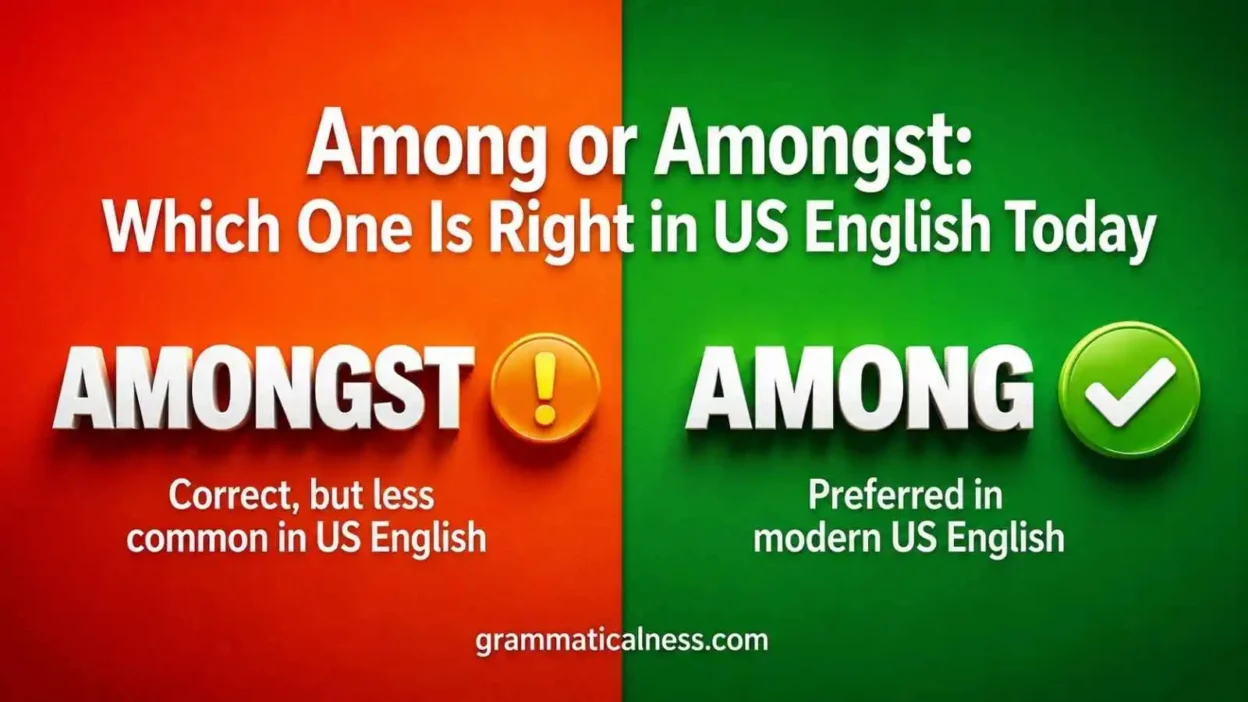
Use among in nearly all modern US writing. Amongst means the same thing, but it is less common and usually sounds more formal or old-fashioned. For everyday emails, school papers, business writing, articles, and clear instructions, among is the safer and more natural choice.
Why People Confuse Them
People confuse among and amongst because the words share the same core meaning. Both can mean in the middle of a group, included in a group, or shared by members of a group.
The extra -st in amongst does not create a new meaning. It mostly changes the tone. That is why the choice feels tricky: the grammar is almost the same, but the style is not.
Another reason is exposure. US readers may see amongst in novels, older writing, legal-sounding prose, or British English. As a result, some people assume it is more correct. It is not more correct. It is simply more marked.
Key Differences At A Glance
| Context | Best Choice | Why |
| Everyday US writing | among | It sounds natural and current. |
| Business email | among | It keeps the sentence clear and direct. |
| Academic writing in the US | among | It avoids an overly formal tone. |
| Fiction with an old-fashioned voice | amongst | It can support a period or literary style. |
| British-sounding prose | amongst | It may fit the voice better. |
| Clear instructions | among | It is easier and less distracting. |
| Formal phrase with a traditional feel | amongst | It can work if the tone is intentional. |
Meaning and Usage Difference
Among is a preposition. It connects a noun or pronoun to the rest of the sentence.
Example:
The manager divided the tasks among the team members.
Amongst is also a preposition. It can do the same job.
Example:
The old letters were hidden amongst the papers.
The meaning is the same in those sentences. The difference is tone. Among sounds normal in US English. Amongst sounds more formal or old-style.
Here is the compact comparison:
| Feature | among | amongst |
| Part of speech | Preposition | Preposition |
| Core meaning | In or within a group | In or within a group |
| US usage | Common and natural | Less common and marked |
| Tone | Clear, modern, neutral | Formal, literary, or old-fashioned |
| Best use | Most situations | Intentional style choices |
Pronunciation can help readers recognize the difference. Among sounds like uh-MUNG. Amongst sounds like uh-MUNGST. The final st sound is the only major sound difference.
Tone, Context, and Formality
Among is neutral. It works in casual, professional, academic, and public-facing writing.
Example:
The survey showed strong support among younger voters.
Amongst is more noticeable. In US English, it can make a sentence sound older, more dramatic, or more British than the writer may intend.
Example:
The rumor spread amongst the guests.
That sentence is understandable, but many US readers would expect among. The word amongst draws attention to itself. Use it only when that tone helps.
Which One Should You Use?
Choose among unless you have a specific reason to use amongst.
Use among when you want your writing to sound modern, direct, and natural. It fits emails, reports, essays, news-style writing, blog posts, captions, and instructions.
Use amongst when you want a literary or old-fashioned effect. It can also fit dialogue if a character would naturally speak that way. However, do not use it just to sound smarter. In many US sentences, it may sound less natural, not more polished.
When One Choice Sounds Wrong
Among rarely sounds wrong when the meaning is correct. It is the default form.
Amongst can sound wrong when the surrounding sentence is simple and modern.
Awkward:
Please choose one option amongst the list below.
Better:
Please choose one option among the list below.
Awkward:
We found several errors amongst the invoices.
Better:
We found several errors among the invoices.
Amongst works better when the full sentence supports that older or more formal sound.
Natural in a literary tone:
The cottage stood quietly amongst the pines.
Common Mistakes (and Quick Fixes)
Mistake 1: Thinking amongst is always more correct.
Fix: Use among for normal US writing.
Mistake 2: Using amongst to make a sentence sound formal.
Fix: Formal writing often sounds stronger when it is clear and simple.
Mistake 3: Switching between both words in the same article.
Fix: Pick among as your default and stay consistent unless tone demands a change.
Mistake 4: Believing the -st ending changes the meaning.
Fix: Treat the difference as style, not meaning.
Mistake 5: Using amongst in plain instructions.
Fix: Use among when readers need quick understanding.
Everyday Examples
Among:
She felt comfortable among her new coworkers.
Amongst:
The poet wandered amongst the ruins at dusk.
Among:
The prize money was split among the three finalists.
Amongst:
A silver key lay amongst the old coins.
Among:
There was growing concern among parents.
Amongst:
The phrase still appears amongst older documents.
Among:
He was among the first people to apply.
Amongst:
The rumor moved quietly amongst the guests.
Among:
The files are stored among the project folders.
Amongst:
The diary was found amongst a stack of letters.
Dictionary-Style Word Details
Verb
• among: Not used as a verb in standard US English. You would not say “to among something.”
• amongst: Not used as a verb in standard US English. It also does not work as an action word.
Noun
• among: Not used as a noun in standard US English. It names no person, place, thing, or idea by itself.
• amongst: Not used as a noun in standard US English. It functions as a preposition, not a naming word.
Synonyms
• among: Closest plain alternatives include amid, in the middle of, surrounded by, included in, and in the group of.
• amongst: The same closest plain alternatives apply: amid, in the middle of, surrounded by, included in, and in the group of.
No single antonym fits every use. In some sentences, outside, outside of, or apart from can work as the opposite idea.
Example Sentences
Among
Trust is important among team members.
The mistake was hidden among several correct answers.
She is among the best students in the class.
Amongst
Trust grew slowly amongst the villagers.
The ring was hidden amongst the folded scarves.
The old captain was respected amongst sailors.
Word History
• among: This is the older and more common form in modern English. For today’s US writers, its history is less important than its current natural sound.
• amongst: This form developed later and kept the same basic meaning. In current US writing, it often feels more formal, literary, or old-fashioned.
The key point is simple: history does not make amongst more correct. Modern context decides which word works better.
Phrases Containing
• among: among friends, among other things, among themselves, among the first, divided among, popular among, counted among.
• amongst: amongst friends, amongst themselves, hidden amongst, scattered amongst, found amongst.
In US writing, many fixed or familiar phrases sound smoother with among. For example, among other things is far more natural than amongst other things for most American readers.
FAQs
Is it among or amongst?
Both among and amongst are correct, but among is the better choice for most modern US writing. It sounds natural, clear, and current. Amongst has the same basic meaning, but it often sounds more formal, old-fashioned, literary, or British.
Is amongst wrong in American English?
No, amongst is not wrong. American readers can understand it, and it is a real word. However, it is less common in everyday US English. In emails, school writing, business content, and articles, among usually sounds smoother.
Do among and amongst mean the same thing?
Yes. Both words mean “in a group,” “surrounded by,” “included with,” or “shared by several people or things.” The main difference is not meaning. The difference is tone and usage. Among sounds neutral, while amongst sounds more marked.
Which word should I use in formal writing?
Use among in most formal US writing. Clear formal writing does not need older-sounding words. Amongst can work in literary writing or a traditional style, but it may sound too stiff in a modern report or essay.
Is amongst British English?
Amongst appears more often in British English than in American English, but it is not limited to Britain. US writers can use it, but they should use it carefully because it may sound unusual to American readers.
Can I use amongst in a sentence?
Yes. Example: “The old letter was hidden amongst the books.” That sentence is correct, especially if you want a literary tone. For everyday US writing, “The old letter was hidden among the books” sounds more natural.
What is the safest choice?
The safest choice is among. It works in nearly every normal sentence where you mean “in a group” or “included with others.”
Conclusion
Among and amongst mean the same thing, and both are standard prepositions. However, they do not feel the same to modern US readers. Among is the normal, neutral, and widely preferred choice in American English.
Use amongst only when you want a formal, literary, old-fashioned, or British-sounding effect. Otherwise, choose among. It keeps your sentence clear, modern, and easy to read.
Both among and amongst are correct, but among is the better choice for most modern US writing. It sounds natural, clear, and current. Amongst has the same basic meaning, but it often sounds more formal, old-fashioned, literary, or British.
No, amongst is not wrong. American readers can understand it, and it is a real word. However, it is less common in everyday US English. In emails, school writing, business content, and articles, among usually sounds smoother.
Yes. Both words mean “in a group,” “surrounded by,” “included with,” or “shared by several people or things.” The main difference is not meaning. The difference is tone and usage. Among sounds neutral, while amongst sounds more marked.
Use among in most formal US writing. Clear formal writing does not need older-sounding words. Amongst can work in literary writing or a traditional style, but it may sound too stiff in a modern report or essay.
Amongst appears more often in British English than in American English, but it is not limited to Britain. US writers can use it, but they should use it carefully because it may sound unusual to American readers.
Yes. Example: “The old letter was hidden amongst the books.” That sentence is correct, especially if you want a literary tone. For everyday US writing, “The old letter was hidden among the books” sounds more natural.
The safest choice is among. It works in nearly every normal sentence where you mean “in a group” or “included with others.”