
Disc and disk are both correct words, but writers do not use them in exactly the same places. That is why this choice can feel annoying. One spelling may look right in a music sentence, while the other looks right in a computer sentence.
In modern US English, disk is usually the safer general spelling for computer storage and many flat, round objects. However, disc is common in music, optical media, disc golf, brakes, and many anatomy uses. So the best answer depends on the subject, not only the country.
Quick Answer
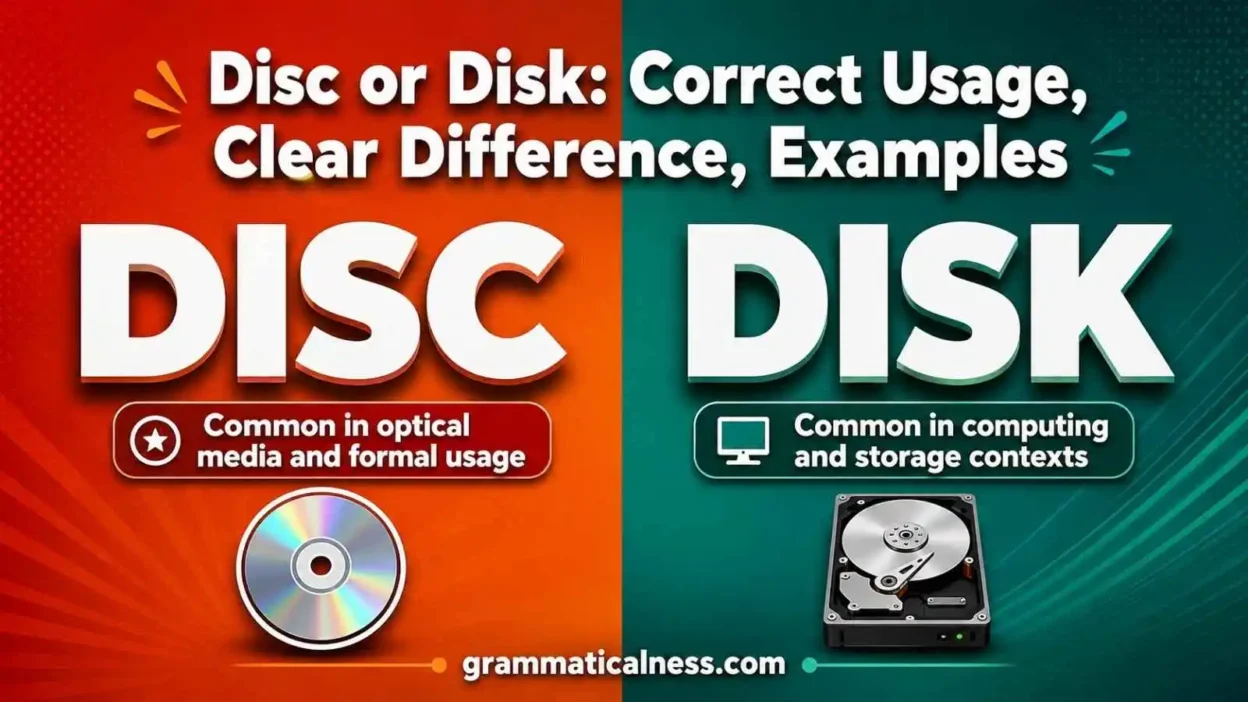
Use disk for computer storage: hard disk, disk drive, disk space, disk image, and floppy disk. Use disc for CDs, DVDs, music records, disc golf, and often brake discs or spinal discs. For a general flat, round object in US English, disk is usually natural, but disc is also a recognized spelling in several fixed phrases.
Why People Confuse Them
People confuse disc and disk because the words sound the same. Both are pronounced like “disk.” The spelling alone creates the difference.
They also share a basic meaning. Both can refer to something thin, flat, and round. A coin, a plate-shaped object, or the visible face of the sun can be described with either spelling in some contexts.
However, common phrases have pushed each spelling into different lanes. Computer writing strongly favors disk. Music and optical media usually favor disc. That creates the real choice for everyday writers.
Another reason is that older technology still shapes the language. We still say compact disc, even though many people stream music now. We also still say hard disk and disk space, even when we are talking about modern computers, cloud backups, or storage settings.
Key Differences At A Glance
| Context | Best Choice | Why |
| Computer storage | disk | Standard in phrases like hard disk, disk drive, disk space, and disk image |
| Magnetic storage | disk | Used for hard disks and floppy disks |
| CD, DVD, or Blu-ray style media | disc | Common for optical media and music releases |
| Music record or album copy | disc | Common in music and recording contexts |
| Disc golf | disc | The sport normally uses disc |
| General flat, round object in US writing | disk | Often the default US spelling |
| British general use | disc | Common for general non-computer senses |
| Medical spine or cartilage use | disc or house style | Disc is widely recognized, but disk also appears in US medical and editorial styles |
| Brake part | disc | Common in phrases like disc brake and brake disc |
| Formal technical writing | depends on field | Storage, optical media, medicine, and engineering may follow different conventions |
Compact comparison:
• Disc: Best for CDs, DVDs, music, disc golf, brake discs, and many anatomy references.
• Disk: Best for hard disks, disk drives, disk space, disk images, floppy disks, and general US use for flat round objects.
Meaning and Usage Difference
Disc usually means a flat, round object, but it appears most often in certain subject areas. You will see it in compact disc, disc jockey, disc golf, disc brake, and herniated disc. It also appears when writers want the spelling that looks familiar in music, sports, or some medical contexts.
Disk also means a flat, round object, but it is the normal choice in computer storage. Write disk when you mean a storage device, a storage area, or a computer-related unit. Common phrases include hard disk, disk drive, disk space, disk cleanup, disk image, and startup disk.
For general objects, US writers often choose disk. For example, “Shape the dough into a flat disk” sounds natural in American writing. Still, “disc” would not shock readers in that basic shape sense, especially if the writer follows a British style or a design style that prefers the c spelling.
Pronunciation does not help here. Disc and disk sound the same. The choice is visual and contextual.
Tone, Context, and Formality
Neither word is more formal by itself. The difference comes from the field.
Disk sounds technical when it appears with computer words. It fits software instructions, storage warnings, tech support pages, and device settings. For example, “The update needs more disk space” sounds normal. “Disc space” looks unusual in that sentence.
Disc sounds natural in entertainment and physical media. “The movie is available on disc” sounds correct when you mean a DVD or Blu-ray copy. In music, disc also fits phrases like “disc jockey,” “discography,” and “bonus disc.”
In medical writing, the choice can depend on the publication. Many readers know herniated disc, spinal disc, and slipped disc. However, some US style rules and medical references use disk. When writing for a clinic, school, publisher, or news outlet, follow its preferred spelling.
For everyday writing, choose the spelling your reader expects in that context. That keeps the sentence clean and avoids a distracting spelling choice.
Which One Should You Use?
Use disk when the sentence is about computer storage. This is the clearest rule in modern US English.
Write disk in these phrases:
hard disk
disk drive
disk space
disk image
startup disk
floppy disk
magnetic disk
Use disc when the sentence is about optical media, music, disc golf, or common fixed phrases.
Write disc in these phrases:
compact disc
disc jockey
disc golf
bonus disc
Blu-ray Disc
brake disc
disc brake
For medical writing, use the spelling your audience expects. If you do not have a required style, disc will look familiar in phrases like herniated disc and spinal disc. Still, disk is not automatically wrong in medical contexts.
For a plain round shape in US English, disk is usually the safer choice. You can write, “Cut the dough into a disk,” “The moon looked like a pale disk,” or “The artist painted a red disk in the center.”
When One Choice Sounds Wrong
Disc can sound wrong when you are talking about computer storage. “My laptop is low on disc space” looks off to many US readers. The expected phrase is disk space.
Disk can sound wrong when you are talking about CDs, DVDs, or music releases. “The album came on two disks” may be understood, but “two discs” fits the usual music and optical-media spelling better.
Disk golf also looks wrong because the sport uses disc golf. The object is a disc, not usually a disk, in that context.
Compact disk is understandable, but compact disc is the standard phrase behind CD. Since the phrase has a fixed spelling, changing it can make the writer look careless.
In medical sentences, do not assume only one spelling can ever be correct. “Herniated disc” is common and reader-friendly, while “herniated disk” can also appear in US medical or editorial writing. The wrong move is mixing both spellings in the same article without a reason.
Common Mistakes (and Quick Fixes)
Mistake: The computer has no free disc space.
Fix: The computer has no free disk space.
Mistake: I bought a compact disk at the store.
Fix: I bought a compact disc at the store.
Mistake: She plays disk golf every weekend.
Fix: She plays disc golf every weekend.
Mistake: The DJ packed several old disks for the set.
Fix: The DJ packed several old discs for the set.
Mistake: The system created a new disc image.
Fix: The system created a new disk image.
Mistake: The article uses “spinal disc” in one paragraph and “spinal disk” in the next.
Fix: Pick one medical style and use it consistently.
Everyday Examples
Please clear enough disk space before you install the update.
The repair shop replaced the laptop’s hard disk.
Save the backup as a disk image.
I found an old floppy disk in a desk drawer.
The movie is still available on disc.
The deluxe album includes a bonus disc.
She keeps her favorite CDs in a soft disc case.
We played disc golf at the park after work.
The mechanic checked the front disc brakes.
He missed work because of a herniated disc.
Shape the dough into a flat disk before chilling it.
The sun looked like a bright orange disk through the haze.
My console still reads physical game discs.
The file was copied from the startup disk.
Dictionary-Style Word Details
Verb
• Disc: Not commonly used as a verb in standard everyday US English. In specialized farm or soil contexts, disced can appear as a spelling variant of disked, meaning to work soil with a disc harrow.
• Disk: Can work as a verb in farming contexts. To disk a field means to cultivate or loosen soil with a disc harrow. This verb is specialized and uncommon in ordinary writing.
Noun
• Disc: A noun meaning a flat, round object. It is common for music records, CDs, DVDs, disc golf objects, brake parts, and many body-structure references.
• Disk: A noun meaning a flat, round object. It is especially common for computer storage, magnetic storage, and general US references to flat round shapes.
Synonyms
• Disc: Closest plain alternatives include round plate, circular object, record, CD, DVD, and optical medium. The right alternative depends on the sentence.
• Disk: Closest plain alternatives include round plate, circular object, storage device, drive, hard drive, and storage medium. In computer writing, “drive” may fit in some sentences, but it is not always the same thing.
Clear antonyms do not really fit either word. A square, cube, or noncircular object may contrast with the shape, but those are not true word-choice antonyms.
Example Sentences
Examples With Disc
The film is available on disc for collectors.
She threw the disc across the field during practice.
The mechanic replaced the worn brake disc.
The doctor discussed treatment for a herniated disc.
Examples With Disk
The laptop needs more disk space before the update.
Store the backup on an external hard disk.
The system created a disk image overnight.
Cut the clay into a thin disk before it dries.
Word History
• Disc: The spelling with c reflects the Latin-influenced form. English has used both spellings for a long time, and different fields later favored different forms.
• Disk: The spelling with k reflects the Greek-influenced form. It became especially strong in US English and in computer-related terms.
The history is not a clean story where one spelling replaced the other. Both survived, and modern usage now depends heavily on context.
Phrases Containing
• Disc: compact disc, disc jockey, disc golf, disc brake, brake disc, bonus disc, optical disc, spinal disc, herniated disc.
• Disk: hard disk, floppy disk, disk drive, disk space, disk image, startup disk, magnetic disk, external disk, disk cleanup.
FAQs
Is disc or disk correct?
Both disc and disk are correct, but they fit different contexts. In US English, disk is the usual choice for computer storage, such as hard disk, disk drive, and disk space. Disc is common for CDs, DVDs, music, disc golf, brake parts, and many anatomy uses.
Should I write compact disc or compact disk?
Write compact disc. That is the standard phrase behind CD. Even though disk is common in computer writing, compact disc belongs to optical media, so the spelling with c looks more natural and accurate.
Is it hard disc or hard disk?
Write hard disk. In computer storage, disk is the expected spelling. You should also write disk drive, disk space, disk image, startup disk, and floppy disk. Using disc in these phrases can look unusual to many US readers.
Is it disc golf or disk golf?
Write disc golf. The sport uses disc, not disk. The same spelling also fits the object used in the game: a disc. “Disk golf” may be understood, but it looks nonstandard.
Is it herniated disc or herniated disk?
Both forms appear, especially in US medical writing, but herniated disc is very common and familiar to general readers. The best choice depends on the style guide or medical source you are following. Whichever form you choose, use it consistently.
Do disc and disk sound different?
No. Disc and disk sound the same. Both are pronounced like “disk.” Because pronunciation does not show the difference, writers need to choose the spelling based on context.
What is the easiest way to remember disc vs disk?
Use disk for computers and storage. Use disc for music, CDs, DVDs, disc golf, and many body-related uses. When the phrase is fixed, follow the familiar spelling: compact disc, disc golf, hard disk, and disk space.
Conclusion
Disc and disk are both correct, but they are not always the best choice in the same sentence. Use disk for computer storage and many general US references to flat, round objects. Use disc for CDs, DVDs, music, disc golf, brake parts, and many anatomy uses.
The easiest rule is context first. If your sentence is about storage, choose disk. If it is about music, optical media, or disc golf, choose disc. For medical writing, stay consistent and follow the style your audience expects.
Both disc and disk are correct, but they fit different contexts. In US English, disk is the usual choice for computer storage, such as hard disk, disk drive, and disk space. Disc is common for CDs, DVDs, music, disc golf, brake parts, and many anatomy uses.
Write compact disc. That is the standard phrase behind CD. Even though disk is common in computer writing, compact disc belongs to optical media, so the spelling with c looks more natural and accurate.
Write hard disk. In computer storage, disk is the expected spelling. You should also write disk drive, disk space, disk image, startup disk, and floppy disk. Using disc in these phrases can look unusual to many US readers.
Write disc golf. The sport uses disc, not disk. The same spelling also fits the object used in the game: a disc. “Disk golf” may be understood, but it looks nonstandard.
Both forms appear, especially in US medical writing, but herniated disc is very common and familiar to general readers. The best choice depends on the style guide or medical source you are following. Whichever form you choose, use it consistently.
No. Disc and disk sound the same. Both are pronounced like “disk.” Because pronunciation does not show the difference, writers need to choose the spelling based on context.
Use disk for computers and storage. Use disc for music, CDs, DVDs, disc golf, and many body-related uses. When the phrase is fixed, follow the familiar spelling: compact disc, disc golf, hard disk, and disk space.