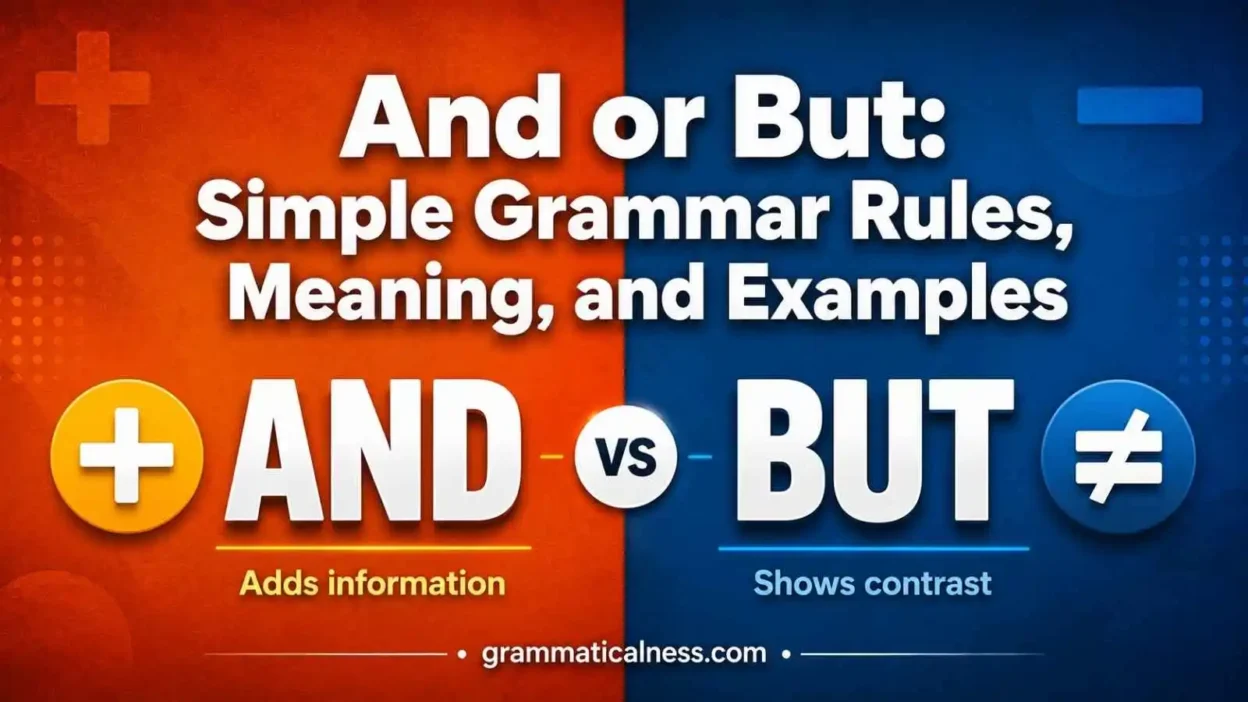
And and but are both common connecting words, but they do different jobs. Use and when you want to add related information. Use but when the second idea contrasts with, limits, or surprises the first idea.
The difference matters because one word can change the meaning of the whole sentence. “The job is remote and demanding” does not feel the same as “The job is remote but demanding.” The first adds two facts. The second shows a contrast between a benefit and a drawback.
Quick Answer
Use and to join similar, related, or added ideas. Use but to join ideas that contrast. Write “I ordered coffee and a muffin” when both items belong together. Write “I ordered coffee, but it was cold” when the second idea pushes against the first.
Why People Confuse Them
People confuse and and but because both words can connect the same kinds of sentence parts. Each can join words, phrases, or complete clauses.
For example, both sentences are grammatical:
“I liked the design and the price was fair.”
“I liked the design, but the price was high.”
The grammar pattern is similar, but the meaning is not. And adds another idea. But changes the reader’s expectation.
Another reason is that casual speech often uses and loosely. Someone might say, “I wanted to go, and I was too tired.” In careful writing, but would usually be clearer because the second idea explains why the first action did not happen.
Key Differences At A Glance
| Context | Best Choice | Why |
| Adding one similar idea to another | and | It shows addition or connection. |
| Joining items in a list | and | It links related items. |
| Showing contrast | but | It signals a shift or opposition. |
| Adding a limitation | but | It narrows or qualifies the first idea. |
| Showing an unexpected result | but | It tells the reader the second idea changes the direction. |
| Connecting two independent clauses | and or but | The meaning decides the choice. |
The easiest test is this: choose and when the second part continues the same direction. Choose but when the second part turns the sentence in a different direction.
Meaning and Usage Difference
And means “also,” “in addition,” or “together with.” It connects ideas that belong side by side.
Examples:
“She bought apples and oranges.”
“The report is clear and useful.”
“We cleaned the kitchen and started dinner.”
In each sentence, and adds something. It does not warn the reader that a contrast is coming.
But means “however,” “yet,” or “on the other hand” in many contrast sentences. It connects ideas that push against each other.
Examples:
“The report is clear but too long.”
“I wanted to join, but I had another meeting.”
“The phone is cheap but reliable.”
In these examples, but introduces a contrast, limit, or surprise.
Both words are usually conjunctions. More specifically, they often work as coordinating conjunctions. That means they connect sentence parts with the same grammatical weight, such as word to word, phrase to phrase, or clause to clause.
Tone, Context, and Formality
And is neutral. It usually sounds smooth, simple, and additive. It does not create tension between ideas.
But is also standard, but it sounds more direct because it marks contrast. It can correct, limit, or challenge the first idea.
Compare:
“Your draft is detailed and needs a stronger ending.”
“Your draft is detailed, but it needs a stronger ending.”
The first sentence sounds like two equal notes. The second sentence makes the weak ending feel like the main issue.
In formal writing, but is acceptable. However, use it carefully when tone matters. A sentence that begins with praise and then uses but can make the praise feel less important.
Example:
“Your presentation was strong, but the slides were hard to read.”
That sentence is clear, but it may feel more critical than:
“Your presentation was strong, and the slides could be easier to read.”
The second version is softer because and adds the suggestion instead of setting it against the praise.
Which One Should You Use?
Choose and when you mean addition.
Use it for lists:
“We need chairs, tables, and signs.”
Use it for related descriptions:
“The office is quiet and bright.”
Use it for actions that happen together or in sequence:
“She logged in and checked the dashboard.”
Choose but when you mean contrast.
Use it for a problem after a positive point:
“The apartment is spacious, but the rent is high.”
Use it for a different result than expected:
“I called twice, but no one answered.”
Use it for a limit:
“The coupon works online, but only through Friday.”
A simple editing test can help. Ask yourself, “Am I adding, or am I turning?” If you are adding, use and. If you are turning, use but.
When One Choice Sounds Wrong
And sounds wrong when the second idea clearly conflicts with the first.
Weak: “I wanted to attend and I was sick.”
Better: “I wanted to attend, but I was sick.”
The sickness explains why the person could not attend. That is contrast, so but fits better.
But sounds wrong when there is no contrast.
Weak: “She bought notebooks but pens.”
Better: “She bought notebooks and pens.”
Notebooks and pens are simply two items in a list. There is no contrast.
Sometimes both words are possible, but they create different meanings.
“The course is short and challenging.”
This means the course has two qualities.
“The course is short but challenging.”
This suggests that a short course might seem easy, yet this one is not.
Common Mistakes (and Quick Fixes)
Mistake 1: Using and when the meaning is contrast.
Incorrect: “The team worked hard and missed the deadline.”
Correct: “The team worked hard, but missed the deadline.”
The missed deadline contrasts with the hard work.
Mistake 2: Using but for a normal list.
Incorrect: “The package includes a charger but a case.”
Correct: “The package includes a charger and a case.”
A list needs and unless one item is being excluded or contrasted.
Mistake 3: Forgetting the comma between two complete clauses.
Incorrect: “I emailed the client but she has not replied.”
Correct: “I emailed the client, but she has not replied.”
Use a comma before but when it joins two complete thoughts.
Mistake 4: Adding a comma when joining two simple words.
Incorrect: “The room was clean, and quiet.”
Correct: “The room was clean and quiet.”
Do not add a comma just because you see and. The comma depends on sentence structure.
Mistake 5: Using but after although in the same clause pattern.
Incorrect: “Although it was late, but we kept working.”
Correct: “Although it was late, we kept working.”
Correct: “It was late, but we kept working.”
Although and but can both show contrast, but they do not usually work together in that pattern.
Everyday Examples
Use and for added ideas:
“I packed my laptop and charger.”
“She is friendly and easy to work with.”
“We stopped for gas and grabbed coffee.”
“The store is open late and offers curbside pickup.”
Use but for contrast:
“I packed my laptop, but I forgot the charger.”
“She is friendly, but she can be hard to reach.”
“We stopped for gas, but the station was closed.”
“The store is open late, but curbside pickup ends at 6 p.m.”
Here is the main difference in a compact form:
| Feature | and | but |
| Main job | Adds information | Shows contrast |
| Sentence feeling | Smooth and connected | Shifted or limited |
| Best use | Lists, related ideas, sequences | Exceptions, problems, surprises |
| Common replacement | also, plus | however, yet |
Dictionary-Style Word Details
Verb
• And: Not commonly used as a verb in standard US English. It is usually a conjunction.
• But: Not commonly used as a verb in standard US English. It is usually a conjunction, though it can also work in other roles.
Noun
• And: Can be treated as a noun when someone refers to the word itself, as in “too many ands in the sentence.” It can also appear in logic or technical contexts, but that is not the main everyday use.
• But: Can be a noun meaning an objection or excuse, usually in the plural. Example: “No buts. Finish the assignment first.”
Synonyms
• And: Closest plain alternatives include “also,” “plus,” “as well as,” and “along with.” These are not always exact replacements because sentence structure may need to change.
• But: Closest plain alternatives include “yet,” “however,” “though,” and “except.” Use care because some alternatives need different punctuation or word order.
Clear antonyms do not fit well for either word. These are function words, so their opposites depend on the sentence.
Example Sentences
• And: “The app is simple and fast.”
• And: “We reviewed the invoice and approved the payment.”
• And: “She ordered soup and a salad.”
• But: “The app is simple, but it still needs a few updates.”
• But: “We reviewed the invoice, but we did not approve the payment.”
• But: “She ordered soup, but the restaurant forgot her salad.”
Word History
• And: And is an old English function word. Its history is less important than its current job: connecting added or related ideas.
• But: But is also an old English function word. In modern writing, its most useful role is showing contrast, exception, or limitation.
Phrases Containing
• And: Common phrases include “and so on,” “and then,” “and yet,” “again and again,” and “you and I.”
• But: Common phrases include “but not,” “all but,” “anything but,” “nothing but,” “but for,” and “no ifs, ands, or buts.”
FAQs
What is the difference between and and but?
And adds information. But shows contrast. Use and when two ideas go in the same direction, as in “The room is clean and bright.” Use but when the second idea changes or limits the first, as in “The room is clean, but it is small.”
Can and and but start a sentence?
Yes, both can start a sentence. Example: “The plan looked simple. But one detail caused a problem.” Use this style carefully in formal writing.
Do I need a comma before but?
Use a comma before but when it joins two complete thoughts. Example: “I called the office, but no one answered.” Do not use a comma when but joins short words or phrases. Example: “small but powerful.”
Do I need a comma before and?
Use a comma before and when it joins two complete sentences. Example: “She opened the file, and I reviewed the notes.” In a simple pair, do not use a comma. Example: “fast and easy.”
Is but more negative than and?
But is not always negative, but it often adds a limit, problem, or contrast. That can make it sound more critical than and.
Can I use and instead of but?
Use and to add similar ideas. Use but to show contrast.
“The laptop is light and powerful.”
“The laptop is light but expensive.”
Conclusion
And and but are both correct, but they do not mean the same thing. Use and when you want to add related information. Use but when the second idea contrasts with the first, limits it, or creates a surprise.
The best choice depends on the relationship between the ideas. If the sentence moves forward in the same direction, use and. If the sentence turns, corrects, or pushes back, use but.
And adds information. But shows contrast. Use and when two ideas go in the same direction, as in “The room is clean and bright.” Use but when the second idea changes or limits the first, as in “The room is clean, but it is small.”
Yes, both can start a sentence. Example: “The plan looked simple. But one detail caused a problem.” Use this style carefully in formal writing.
Use a comma before but when it joins two complete thoughts. Example: “I called the office, but no one answered.” Do not use a comma when but joins short words or phrases. Example: “small but powerful.”
Use a comma before and when it joins two complete sentences. Example: “She opened the file, and I reviewed the notes.” In a simple pair, do not use a comma. Example: “fast and easy.”
But is not always negative, but it often adds a limit, problem, or contrast. That can make it sound more critical than and.
Use and to add similar ideas. Use but to show contrast.
“The laptop is light and powerful.”
“The laptop is light but expensive.”