
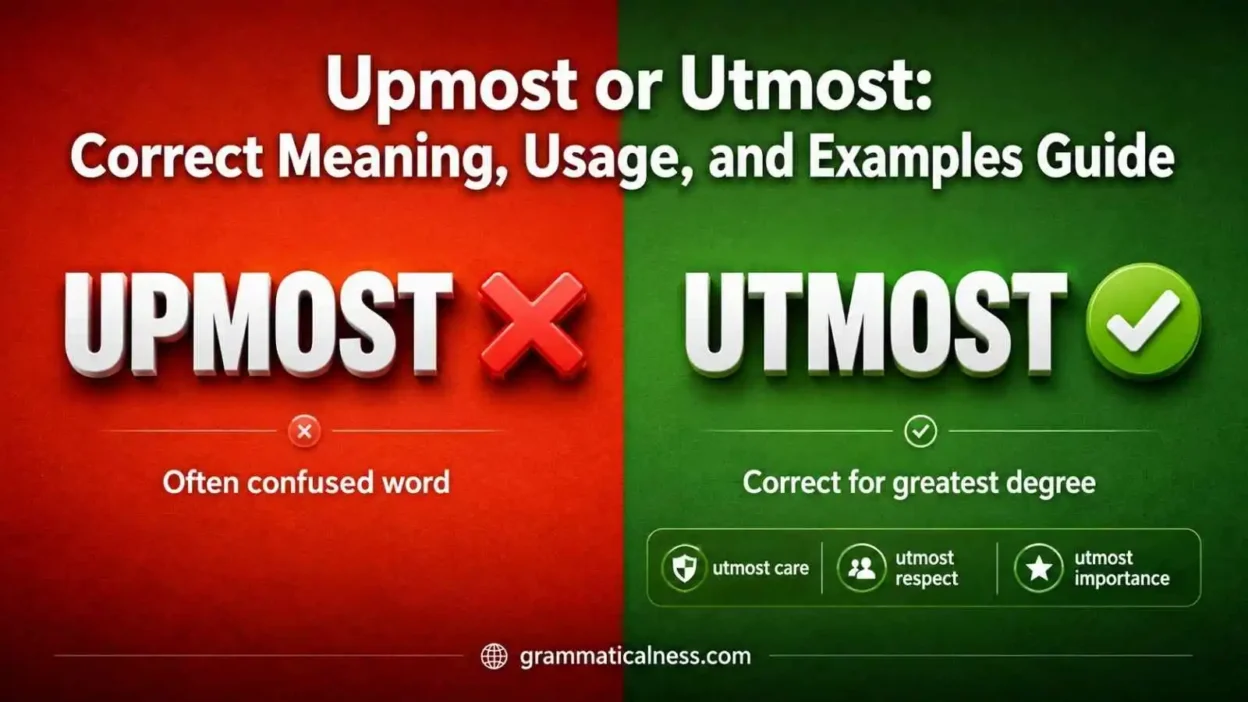
Upmost or utmost is a common word-choice problem because the two words look and sound almost the same. The correct choice depends on what you mean.
In most situations, utmost is the word you need. It means the greatest degree, highest level, or strongest effort. That is why phrases like utmost importance, utmost respect, utmost care, and do your utmost are standard.
Upmost is much less common. It can mean highest in physical position, similar to uppermost or topmost. However, many readers will find uppermost or top clearer than upmost.
The main difference is simple: utmost is about degree or effort. Upmost is about physical position.
Quick Answer
Choose utmost when you mean the greatest level of importance, respect, care, effort, or seriousness.
Correct: This matter deserves the utmost attention.
Incorrect: This matter deserves the upmost attention.
Use upmost only when you truly mean highest in position, such as the upmost layer or upmost shelf. Even there, uppermost often sounds more natural in modern writing.
Why People Confuse Them
People confuse upmost and utmost because both words suggest something high, extreme, or top-level. Their spelling also looks very similar.
The word upmost includes up, so it may seem right when someone wants to describe something as very important. However, importance is not physical height. When the meaning is “greatest degree,” the standard word is utmost.
Sound also causes confusion. In fast speech, utmost and upmost can sound close. A listener may hear one word and write the other.
This mistake often appears in formal phrases. Writers may type upmost importance, upmost respect, or upmost care, but those phrases should almost always use utmost.
Key Differences At A Glance
Here is the simple comparison:
- Upmost means highest in physical position.
- Utmost means greatest in degree, amount, effort, or importance.
- Upmost is rare in modern American English.
- Utmost is common in formal, business, academic, and everyday polished writing.
- Uppermost is often clearer than upmost.
- Utmost is the correct word in phrases like utmost respect and utmost importance.
A helpful memory trick is this: upmost has up, so think “up high.” For the greatest level or strongest degree, choose utmost.
Meaning and Usage Difference
Upmost is an adjective. It describes something at the highest place or position.
Example: The bird landed on the upmost branch of the tree.
That sentence means the bird landed on the branch nearest the top. Still, uppermost branch or top branch would usually sound clearer.
Utmost can work as an adjective or a noun. As an adjective, it means greatest, highest in degree, or most extreme.
Examples:
Utmost care means the greatest possible care.
When someone shows utmost respect, they show the highest level of respect.
Something of utmost importance has the greatest importance or urgency.
As a noun, utmost can mean the greatest possible effort or limit.
Example: We did our utmost to finish on time.
In that sentence, utmost means the best effort possible.
Tone, Context, and Formality
Utmost sounds polished, serious, and slightly formal. It fits business writing, school essays, customer messages, workplace notes, and careful explanations.
Example: Your privacy is handled with the utmost care.
That sentence sounds professional and natural.
By contrast, upmost sounds unusual in modern American English. It can be correct when it means “highest in position,” but many readers may pause because the word is uncommon.
In everyday writing, simpler choices often work better.
Better: Place the box on the top shelf.
Also clear: Place the box on the uppermost shelf.
Less common: Place the box on the upmost shelf.
When the topic is seriousness, effort, quality, respect, care, or importance, utmost is the better choice.
Which One Should You Use?
| Context | Best Choice | Why |
|---|---|---|
| Importance | Utmost | It means the greatest degree of importance. |
| Respect | Utmost | Respect is a level or degree, not a physical position. |
| Care or caution | Utmost | It describes the highest level of care. |
| Personal effort | Utmost | The noun form means the best someone can do. |
| Highest shelf or layer | Upmost or uppermost | It refers to physical position, though uppermost is clearer. |
| Formal writing | Utmost | It is the expected word in serious phrases. |
| Casual directions | Top or highest | These usually sound more natural than upmost. |
For most writing, utmost is the safer choice. Select upmost only when the sentence clearly refers to height or physical position.
When One Choice Sounds Wrong
Upmost sounds wrong when it replaces utmost in phrases about degree, effort, or importance.
Wrong: This is of upmost importance.
Right: This is of utmost importance.
Wrong: I have the upmost respect for her.
Right: I have the utmost respect for her.
Wrong: Please use upmost caution.
Right: Please use utmost caution.
The opposite problem can also happen. Utmost may sound awkward when the sentence is clearly about physical location.
Awkward: The cat sat on the utmost shelf.
Better: The cat sat on the uppermost shelf.
Also simple: The cat sat on the top shelf.
Ask one quick question before choosing: does the sentence mean “greatest degree” or “highest position”? Use utmost for degree. Use top, highest, or uppermost for position.
Common Mistakes and Quick Fixes
The most common mistake is writing upmost in serious phrases where utmost is required.
For formal meaning, write utmost importance, not upmost importance.
Use utmost respect when you mean the highest level of respect.
The correct phrase is utmost care, not upmost care.
Choose utmost confidence when you mean complete or maximum confidence.
In the phrase do my utmost, the word utmost means “do my very best.” Avoid writing do my upmost.
Another common issue is using upmost when a simpler word would sound better. In American English, many readers expect top shelf, highest floor, or uppermost layer instead.
Clear writing does not need a rare word when a common word says the same thing better.
Everyday Examples
Here are natural examples with utmost:
Customer information must be handled with the utmost care.
This deadline is of the utmost importance.
She responded to the complaint with the utmost professionalism.
I have the utmost respect for teachers who stay patient under pressure.
Our team did its utmost to keep the event running smoothly.
Now compare a few limited examples with upmost:
The bird landed on the upmost branch of the tree.
A thin layer of dust covered the upmost box in the stack.
Someone placed the old folder in the upmost section of the cabinet.
Even in those examples, many writers would choose clearer wording:
The bird landed on the top branch of the tree.
A thin layer of dust covered the uppermost box in the stack.
Someone placed the old folder in the highest section of the cabinet.
Dictionary-Style Word Details
Verb
Upmost: This word is not commonly used as a verb in standard US English.
Utmost: This word is also not commonly used as a verb in standard US English.
Both words usually work as adjectives. Utmost can also work as a noun in phrases like do your utmost.
Noun
For upmost, noun use is not common in standard US English.
As for utmost, the word can be a noun. It means the greatest possible effort, amount, degree, or limit.
Example: We did our utmost to solve the issue before Friday.
In that sentence, utmost means the best effort possible.
Synonyms
For upmost, the closest plain alternatives are uppermost, topmost, highest, and top. These fit when the meaning is physical position.
For utmost, the closest plain alternatives are greatest, maximum, highest degree, most extreme, and best effort.
Helpful opposites include:
Upmost: lowest, bottom, lowermost
Utmost: least, minimum, lowest degree
Do not swap these words automatically. The right choice depends on the meaning of the sentence.
Example Sentences
The upmost branch shook in the wind.
A label was placed on the upmost box in the stack.
For most readers, “uppermost” would sound clearer than “upmost” in that sentence.
Please handle this file with the utmost care.
Guest safety is of the utmost importance.
Before the meeting ended, we did our utmost to answer every question.
Word History
Upmost is built from up and most, which matches its meaning: highest or nearest the top.
Utmost is connected to the idea of being farthest out or most extreme. In modern use, it usually points to the greatest degree, level, amount, or effort.
For today’s writer, the practical difference matters most. Upmost points upward in position, while utmost points to the greatest degree.
Phrases Containing
Common modern phrases with upmost are limited. You may see phrases like upmost layer, upmost shelf, or upmost branch, but uppermost, top, or highest often reads better.
Frequent phrases with utmost include utmost importance, utmost respect, utmost care, utmost caution, utmost confidence, utmost effort, to the utmost, and do one’s utmost.
When the phrase sounds serious or formal, utmost is usually the word you need.
FAQs
Both words exist, but utmost is the correct choice in most common phrases. Use utmost when you mean the greatest degree, highest level, or strongest effort. Use upmost only when you mean highest in physical position.
The correct phrase is utmost importance. Importance is a level or degree, not a physical location. For example: This issue is of the utmost importance.
No, upmost respect is not the standard phrase. The correct wording is utmost respect because respect is about degree. Example: I have the utmost respect for her work.
Yes, upmost is a real word, but it is rare. It means highest in position, similar to uppermost or topmost. In modern writing, uppermost usually sounds clearer.
Utmost means the greatest, highest, or most extreme degree of something. It appears in phrases like utmost care, utmost respect, utmost importance, and do your utmost.
Do your utmost means to try as hard as possible. For example: We did our utmost to finish the project on time. The phrase refers to your best possible effort.
You should usually avoid upmost in formal writing unless you clearly mean highest in position. Even then, uppermost, top, or highest may sound more natural and easier to understand.
Think of upmost as “up high” and utmost as “greatest degree.” If the sentence is about importance, respect, care, effort, or seriousness, choose utmost.
Utmost is much more common in everyday, business, school, and formal writing. Upmost is uncommon and often appears by mistake when writers mean utmost.
Write utmost care. Care refers to the highest level of attention or caution, not physical height. Example: Please handle the package with the utmost care.
Conclusion
The choice between upmost or utmost becomes simple once you separate position from degree.
Use utmost for the greatest level of importance, respect, care, effort, or seriousness. It is the correct word in common phrases such as utmost importance, utmost respect, and utmost care.
Choose upmost only when you mean highest in physical position. Even then, uppermost, top, or highest often sounds clearer.
Final rule: if you mean “greatest,” write utmost. If you mean “highest up,” consider uppermost before using upmost.