
The choice between therefore or therefor is not just a tiny spelling issue. These are two real words, but they do different jobs.
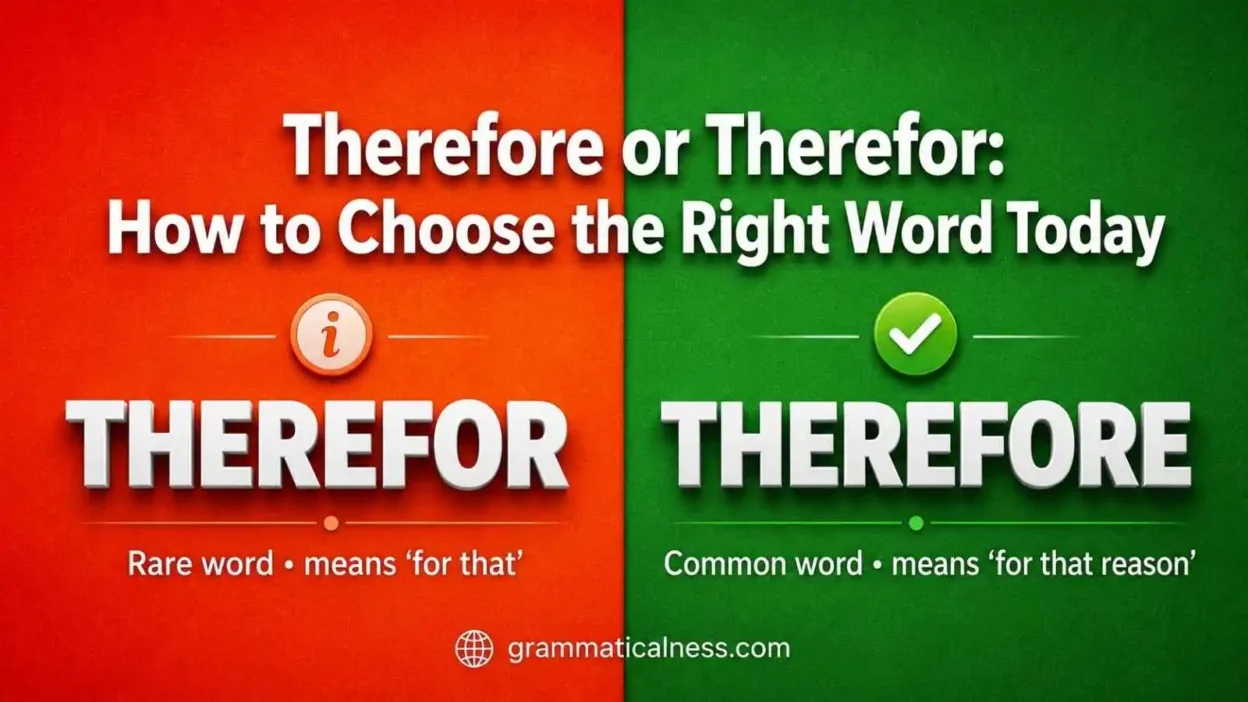
Therefore is the word most people need. It means “for that reason,” “because of that,” or “as a result.” You use it when one idea leads to another.
Therefor is much rarer. It means “for that,” “for it,” or “in return for that.” Today, it mostly appears in legal, financial, or very formal writing.
So, if you are writing a school essay, business email, article, report, or everyday message, you probably want therefore. Use therefor only when you truly mean “for that” or “in exchange for that.”
Quick Answer
Use therefore when you mean “as a result” or “for that reason.”
Use therefor when you mean “for that,” “for it,” or “in return for that.”
Examples:
Correct: The road was closed; therefore, we took another route.
Correct but formal: The tenant paid the fee and received a receipt therefor.
In modern US English, therefore is common. Therefor is real, but it sounds formal, legal, or old-fashioned.
Why People Confuse Them
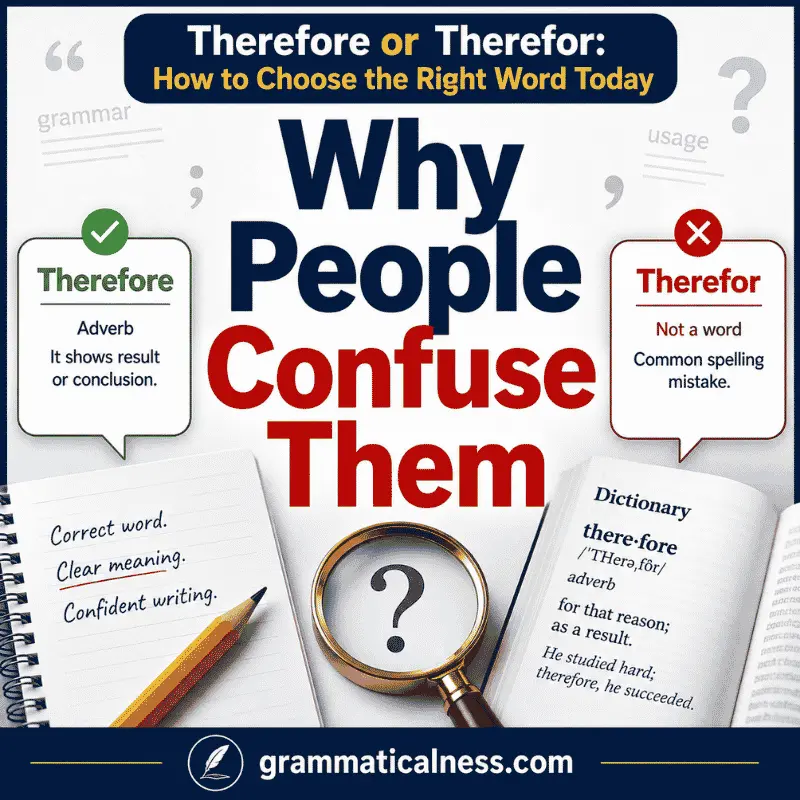
People confuse these words because they look almost the same. The only spelling difference is the final e in therefore.
They also share a similar base idea. Both point back to something already mentioned. That makes them easy to mix up.
The real difference is what they point toward.
Therefore points toward a result:
The meeting ran late; therefore, dinner started late.
Therefor points back to a thing, service, payment, reason, or action:
The contractor completed the work and received payment therefor.
Most readers rarely see therefor outside formal documents. Because of that, many people assume it is a typo. It is not a typo, but it is usually not the word you need.
Key Differences At A Glance
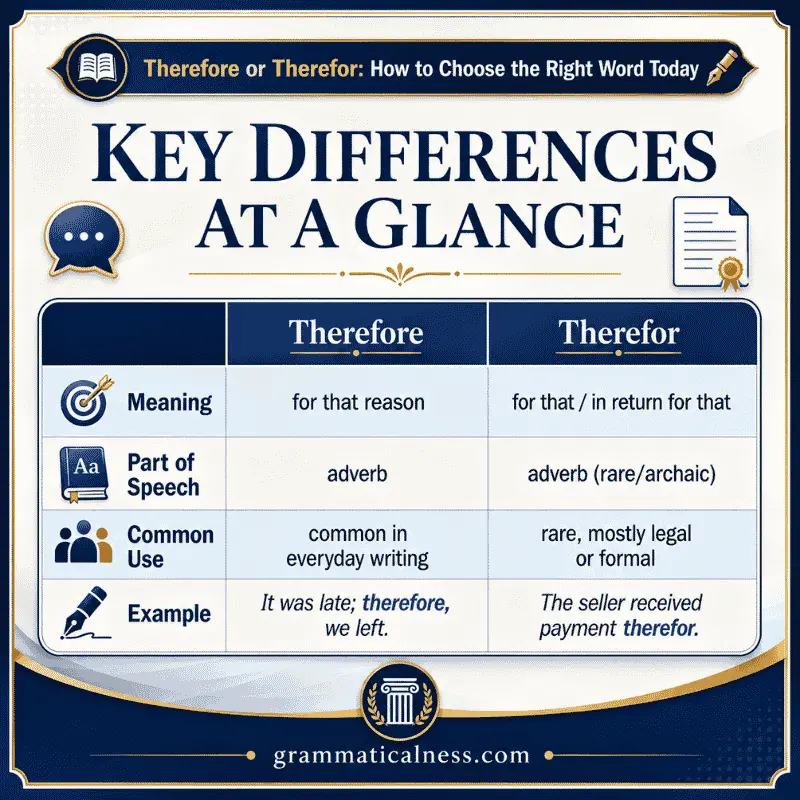
Here is the cleanest way to remember the difference:
• therefore = for that reason, so, as a result
• therefor = for that, for it, in return for that
• therefore introduces a result or conclusion
• therefor refers back to something already named
• therefore is common in everyday and formal writing
• therefor is rare and mostly legal or highly formal
• therefore can join ideas like a linking adverb
• therefor does not work as a normal result connector
A quick test helps: replace the word with so. If the sentence still makes sense, use therefore. If the sentence means for that thing or in exchange for that, use therefor.
Meaning and Usage Difference
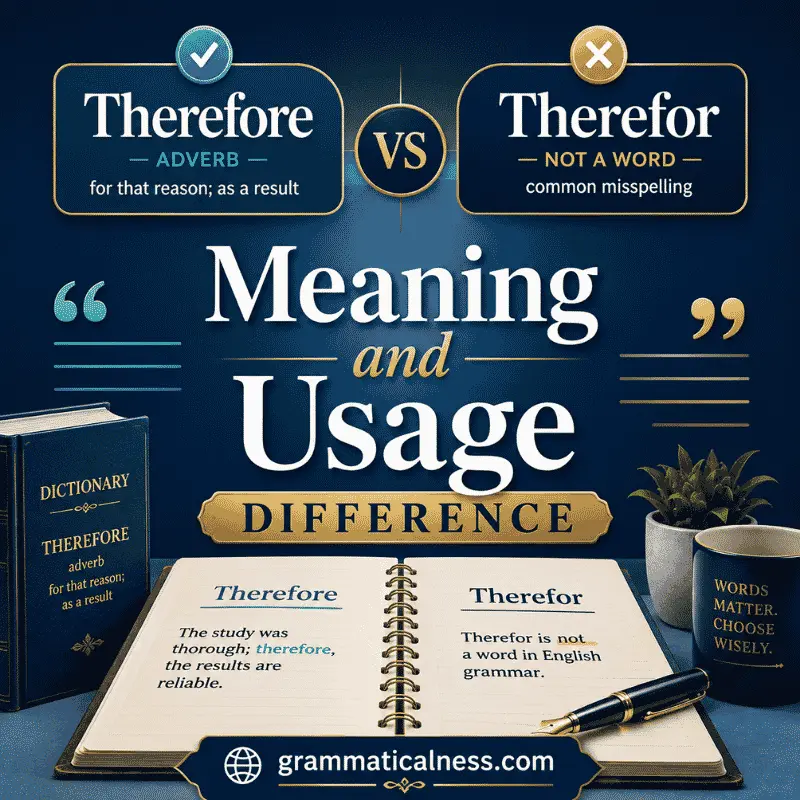
Therefore is an adverb. It introduces a result, conclusion, or logical outcome.
Example:
The store was out of milk; therefore, I bought oat milk instead.
The first idea explains the second idea. The store had no milk. As a result, the speaker bought something else.
Therefor is also an adverb, but it does not introduce a normal result. It refers back to something already mentioned and means “for that” or “in return for that.”
Example:
The company delivered the equipment and received payment therefor.
Here, therefor means “for that equipment” or “for that delivery.”
Pronunciation can also help. Therefore usually stresses the first part: THERE-fore. Therefor usually stresses the second part: there-FOR. In everyday speech, though, people rarely say therefor at all.
Tone, Context, and Formality
Therefore sounds clear, polished, and widely accepted. It works in school writing, workplace emails, reports, essays, articles, and formal explanations.
Examples:
The numbers changed; therefore, the estimate changed.
She missed the deadline; therefore, the application was not reviewed.
Therefor sounds much more formal. In ordinary writing, it may feel stiff or outdated. Readers may pause because they are not used to seeing it.
Example:
The buyer shall pay the purchase price and receive title therefor.
That sentence sounds like contract language. It would feel strange in a casual email.
In most modern US writing, clarity matters more than sounding legal. Instead of therefor, you can often write for it, for that, or in return. Those choices usually sound clearer to a general reader.
Which One Should You Use?
Use this table when you are unsure:
| Context | Best Choice | Why |
| Showing a result | therefore | It means “as a result” or “for that reason.” |
| Giving a conclusion | therefore | It introduces what follows from the previous idea. |
| Writing a school essay | therefore | It is standard and clear. |
| Writing a business email | therefore | It sounds professional without sounding legalistic. |
| Referring to payment for something | therefor | It can mean “in return for that.” |
| Writing contract-style language | therefor | It appears in formal legal phrasing. |
| Replacing “so” in a sentence | therefore | It shows cause and effect. |
| Replacing “for it” in a formal phrase | therefor | It points back to a thing already named. |
For nearly all everyday writing, choose therefore.
Choose therefor only when the sentence truly means “for that” or “in return for that.”
When One Choice Sounds Wrong
Therefore sounds wrong when the sentence is not showing a result.
Wrong: The customer returned the item and received a refund therefore.
Better: The customer returned the item and received a refund therefor.
Clearer: The customer returned the item and received a refund for it.
The first sentence sounds wrong because therefore would mean “as a result.” But the sentence needs “for it.”
Therefor sounds wrong when the sentence needs a result connector.
Wrong: The road was icy; therefor, school opened late.
Correct: The road was icy; therefore, school opened late.
The second sentence works because the icy road caused the late opening.
A good habit is to ask: Am I showing a result, or am I referring back to a thing? Result means therefore. “For that thing” means therefor.
Common Mistakes (and Quick Fixes)
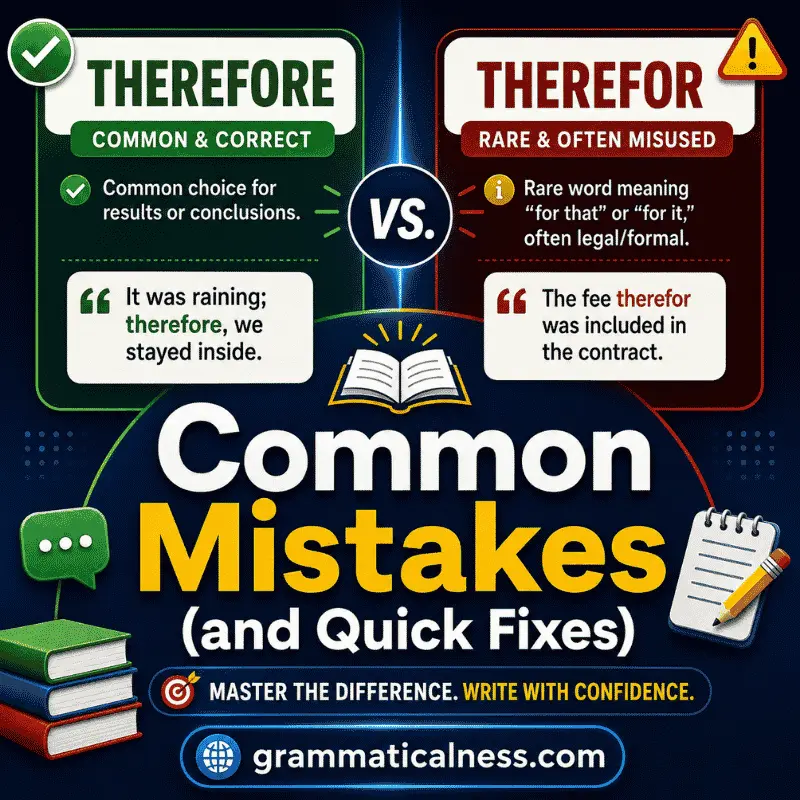
Mistake 1: Using therefor as a fancy spelling of therefore.
Wrong: Sales were low; therefor, we changed the plan.
Correct: Sales were low; therefore, we changed the plan.
Mistake 2: Using therefore when the meaning is “for it.”
Wrong: The client paid the invoice and received a receipt therefore.
Formal: The client paid the invoice and received a receipt therefor.
Clearer: The client paid the invoice and received a receipt for it.
Mistake 3: Creating a comma splice with therefore.
Wrong: The file was missing, therefore I sent another copy.
Better: The file was missing; therefore, I sent another copy.
Also correct: The file was missing. Therefore, I sent another copy.
Mistake 4: Using therefor in casual writing.
Stiff: I sent the package and got tracking therefor.
Natural: I sent the package and got tracking for it.
Everyday Examples
Here are natural examples of therefore:
The train was delayed; therefore, I called my office.
The recipe needs two hours to chill. Therefore, start early.
The payment did not go through; therefore, the order was canceled.
She had already seen the movie and therefore skipped the recap.
The instructions were unclear; therefore, several people made the same mistake.
Here are formal examples of therefor:
The applicant paid the filing fee and received confirmation therefor.
The seller transferred the goods and accepted payment therefor.
The board stated its decision and the reasons therefor.
The contractor requested reimbursement therefor.
The tenant made the required deposit and received a receipt therefor.
In everyday wording, many therefor sentences sound better with for it or for that.
Formal: The contractor requested reimbursement therefor.
Plain: The contractor requested reimbursement for it.
Dictionary-Style Word Details
Verb
• therefore: Not used as a verb in standard US English. You cannot “therefore” something.
• therefor: Not used as a verb in standard US English. You cannot “therefor” a payment, document, or action.
Noun
• therefore: Not used as a noun in standard US English. It functions as an adverb.
• therefor: Not used as a noun in standard US English. It also functions as an adverb.
Synonyms
• therefore: Closest plain alternatives include so, thus, consequently, as a result, and for that reason. These are not always equal in tone. So is more casual. Consequently and thus sound more formal.
• therefor: Closest plain alternatives include for it, for that, for this, in return, and in exchange for that. These usually sound clearer than therefor in general writing.
Clear antonyms do not fit neatly for either word because both words show a relationship between ideas rather than naming a simple opposite.
Example Sentences
• therefore: The deadline passed; therefore, late applications will not be accepted.
• therefore: The office is closed Friday. Therefore, replies may take longer.
• therefor: After paying the full amount, the buyer received a bill of sale.
Word History
• therefore: The word has long been used in English to mean “for that reason” or “because of that.” Its modern use remains common in reasoning, explanation, and cause-and-effect writing.
• therefor: The word has also existed for a long time, but modern readers mostly meet it in formal or legal-style writing. Its meaning is tied to “for that” or “in return for that.”
Do not treat therefor as a new spelling trend or a modern shortcut. It is an older standard word with a narrow modern use.
Phrases Containing
• therefore: Common patterns include and therefore, therefore,, is therefore, was therefore, and therefore necessary.
Examples:
The rule changed and therefore affected the schedule.
The request was incomplete and was therefore denied.
• therefor: Common formal patterns include payment therefor, receipt therefor, compensation therefor, reasons therefor, and reimbursement therefor.
Examples:
The company sought reimbursement therefor.
The decision and the reasons therefor were recorded.
FAQs
Yes. Therefor is a real word, but it is rare in modern everyday English. It means “for that,” “for it,” or “in return for that.” Most people see it in legal, financial, or very formal writing.
Both are correct, but they mean different things. Use therefore when you mean “as a result” or “for that reason.” Use therefor when you mean “for that” or “in return for that.”
No. Therefor is not a misspelling of therefore. It is a separate word with a different meaning. However, because therefor is uncommon, readers may think it looks like a typo in ordinary writing.
Use therefor when you mean “for that” or “in exchange for that.” For example: “The buyer paid the fee and received a receipt therefor.” In plain English, you could write “received a receipt for it.”
No. Therefor is not common in everyday American English. It appears mostly in legal documents, contracts, formal notices, and older-style writing. In most normal writing, for it or for that sounds clearer.
In almost every email, use therefore if you mean “as a result.” Avoid therefor unless you are writing in a formal legal or contract-style context. Most readers will find for it clearer than therefor.
Try replacing the word with so. If so fits, use therefore. Try replacing it with for it. If for it fits, use therefor or rewrite the sentence more naturally.
Therefore shows a result: “The price changed; therefore, we updated the invoice.” Therefor refers back to something: “The client paid the invoice and received a receipt therefor.”
Conclusion
The difference between therefore and therefor is clear once you focus on meaning.
Use therefore when you mean “as a result,” “for that reason,” or “because of that.” It is the normal choice for essays, emails, reports, articles, and everyday explanations.
Use therefor only when you mean “for that,” “for it,” or “in return for that.” It is a real word, but it sounds formal and often legal.
When in doubt, try this test: if so fits, use therefore. If for it fits, use therefor or rewrite the sentence in plainer English.