
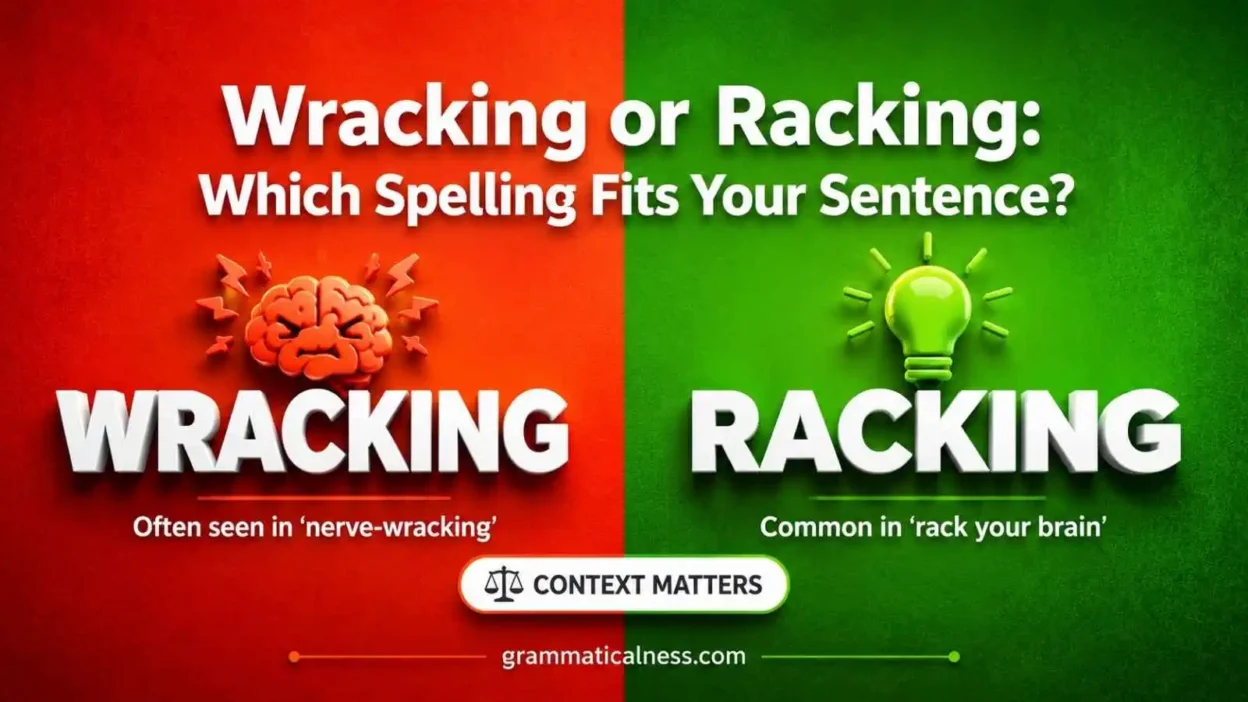
Wracking or racking can be confusing because both spellings are real, both sound the same, and both appear in phrases about stress, pain, and effort.
Still, they are not always interchangeable. In careful American English, racking is usually the safer choice when you mean straining, tormenting, or trying hard to think. That is why racking my brain and nerve-racking are the standard choices many editors prefer.
Wracking is also a real word. It is linked more strongly with wrecking, ruin, destruction, and some accepted pain phrases, such as wracked with grief or storm-wracked coast.
The best choice depends on the sentence. This guide explains the difference clearly without pretending the answer is simpler than it really is.
Quick Answer
Use racking when you mean straining, tormenting, stretching, or making someone suffer.
For example: I have been racking my brain all morning.
A second common example is: The final interview was nerve-racking.
Choose wracking when the meaning is closer to wrecking, ruining, or deeply afflicting.
For example: The family was wracked with grief after the accident.
In many pain phrases, both forms appear, but racking is the safer traditional choice when the idea is strain. Wracking is more defensible when the idea is ruin, damage, or devastation.
Why People Confuse Them
People confuse wracking and racking for three main reasons.
The first reason is sound. Both words are pronounced the same way because the w in wracking is silent.
A second reason is meaning overlap. Each word can appear near ideas such as stress, pain, suffering, and emotional pressure.
Common phrases also pull the spellings in different directions. Racking my brain comes from the idea of stretching or straining the mind. Wrack and ruin points toward destruction.
Because stress can feel both strained and destructive, writers often mix the two. That overlap is why a strict “one is always right” answer does not work.
Key Differences At A Glance
| Context | Best Choice | Why |
| Trying hard to remember or solve something | racking | The standard phrase is “racking my brain.” |
| Something extremely stressful | racking | “Nerve-racking” is the older, safer form. |
| Physical shelves, storage, or display | racking | This comes from “rack,” meaning a frame or shelf. |
| Scoring, collecting, or accumulating | racking | The phrase is “racking up,” not “wracking up.” |
| Severe emotional suffering | racking or wracking | Both appear, but “racked with” is often safer in careful writing. |
| Ruin, wreckage, or devastation | wracking | This fits the destructive sense of “wrack.” |
| Storm-damaged scenery | wracking / wracked | “Storm-wracked” fits the ruin or wreckage idea. |
Meaning and Usage Difference
Both words can work as verb forms, but they guide the reader toward different ideas.
Racking is connected to a rack: a frame, shelf, or old torture device used for stretching. That background gives the verb its figurative sense of strain or torment. When you rack your brain, you are straining your mind.
Wracking is connected more with wreckage, ruin, and destruction. A thing that is wracked sounds damaged, shaken, or devastated.
Some emotional and physical suffering phrases allow overlap. Even so, the practical choice is simple: use racking for strain and standard expressions; use wracking for ruin or destructive force.
| Feature | Wracking | Racking |
| Core idea | Ruining, wrecking, deeply afflicting | Straining, tormenting, stretching, arranging on a rack |
| Best-known uses | Wracked with grief, storm-wracked, wrack and ruin | Racking my brain, nerve-racking, racking up points |
| Safer in formal writing? | Only in the right ruin or affliction context | Yes, especially for brain, nerve, and rack-related phrases |
| Pronunciation | Sounds like “racking” | Sounds like “wracking” |
Tone, Context, and Formality
In casual writing, many readers will accept either spelling in phrases like racked with pain or wracked with pain. The meaning is usually clear.
For school, business, and polished publication writing, racking is often the safer choice when the phrase is about mental strain or nervous stress.
Write: The exam was nerve-racking.
Another standard example is: I spent an hour racking my brain.
Use wracking when you want a stronger sense of damage, devastation, or emotional wreckage.
A natural example is: The family was wracked with grief.
Both words are pronounced RAK-ing. Because they sound alike, the difference is visual and contextual, not spoken.
Which One Should You Use?
For most everyday sentences, racking is the safer choice.
Use it when someone is thinking hard, feeling strained, feeling nervous, arranging items on a rack, or accumulating something.
She was racking her brain for the password.
The wait for the test results was nerve-racking.
Their team is racking up wins.
Choose wracking when the sentence suggests destruction, ruin, or deep affliction.
The sentence “The old pier was wracking under the waves” is possible, but it sounds less natural than a past-participle version.
A smoother version is: The old pier was wracked by the waves.
Another strong example is: He was wracked with grief after the call.
When unsure, use racking for stress and strain. Save wracking for ruin, wreckage, or strongly destructive emotional pain.
When One Choice Sounds Wrong
Some uses clearly call for racking, not wracking.
Incorrect: She is wracking up points this season.
Correct: She is racking up points this season.
Incorrect: Put the glasses on the drying wracking.
Correct: Put the glasses on the drying racking.
Common but less preferred: I was wracking my brain for his name.
Better in careful writing: I was racking my brain for his name.
Other sentences clearly lean toward wracking, especially when the meaning is devastated or damaged.
Less natural: The storm-racking shore was covered in debris.
Better: The storm-wracked shore was covered in debris.
Less natural: The village was racking from years of war.
Better: The village was wracked by years of war.
Common Mistakes (and Quick Fixes)
One common error is using wracking in racking up.
Incorrect: The company is wracking up debt.
Correct: The company is racking up debt.
Another problem is using wracking automatically because stress feels destructive.
Common: The interview was nerve-wracking.
Preferred in careful writing: The interview was nerve-racking.
A third mistake is treating racking and wracking as fully interchangeable.
They overlap in some suffering phrases, but they do not overlap everywhere. A wine rack is never a wine wrack. A team racks up wins, not wracks them up.
The final issue is forgetting that the past form often sounds more natural.
Better: She was racked with guilt.
Also common: She was wracked with guilt.
Everyday Examples
I was racking my brain, but I could not remember the apartment number.
Those last five minutes of the game were nerve-racking.
This sales team is racking up new accounts every week.
At the warehouse, the crew is racking the boxes by size.
After missing the deadline, she was racked with guilt.
He was wracked with grief after losing his dog.
Heavy storms wracked the island for days.
Years of salt air left the old building weather-wracked.
That choice was racking his nerves all week.
By the end of the scandal, the organization was wracked by mistrust.
Dictionary-Style Word Details
Verb
Wracking: A present-participle form of wrack. It can mean damaging, ruining, wrecking, or deeply afflicting. In some phrases, it also appears as a variant of racking, especially in emotional suffering contexts.
Example: The disaster was wracking the community’s confidence.
In many sentences, the past form wracked is more natural than wracking.
Example: The community was wracked by the disaster.
Racking: A present-participle form of rack. It can mean straining, tormenting, placing something on a rack, or accumulating something in the phrase racking up.
Example: I am racking my brain for a better answer.
Example: They are racking up late fees.
Noun
Wracking: Not commonly used as a noun in standard American English. It may appear as a gerund, meaning the act of wracking, but most everyday uses are verbal or adjectival.
Example: The constant wracking of the coastline changed the shape of the beach.
That sentence is possible, but it sounds formal and uncommon.
Racking: Can appear as a gerund noun from the verb rack. It can also refer to rack systems in physical or workplace contexts, though that use is separate from the word-choice confusion.
Example: The racking of the pool balls took only a few seconds.
Example: Better warehouse racking saved space.
Synonyms
Wracking: Closest plain alternatives include wrecking, ruining, devastating, damaging, and shattering. These fit best when wracking means causing ruin or deep harm.
Depending on context, possible opposites include repairing, restoring, healing, or stabilizing.
Racking: Closest plain alternatives include straining, tormenting, distressing, taxing, and afflicting. These fit best when racking means causing stress, pain, or mental effort.
Possible opposites depend on context: soothing, easing, relieving, or calming.
The alternatives are not exact in every sentence. Choose based on the meaning you need.
Example Sentences
Wracking: The sudden loss shook the whole family.
In a stronger version, you could write: The sudden loss was wracking the whole family.
Wracking: Years of neglect were wracking the old bridge.
Another natural form is: The coast was wracked by heavy storms.
Racking: I kept racking my brain for the client’s name.
A common stress phrase is: Waiting for the final vote was nerve-racking.
You can also use it for accumulation: The rookie is racking up assists faster than expected.
Word History
Racking comes from rack, a word tied to frames, shelves, and the idea of stretching or straining. That history explains why racking fits phrases about tension, torment, and mental effort.
Wracking comes from wrack, a word tied to wreckage, ruin, and destruction. That background explains why wracking fits damage-heavy phrases such as storm-wracked or wrack and ruin.
The histories are separate, but modern usage has blended the words in some pain and suffering phrases. That is why both forms can appear in similar-looking sentences.
Phrases Containing
Wracking: Common phrases include wracked with grief, wracked with pain, storm-wracked, war-wracked, and wrack and ruin.
Racking: Common phrases include racking my brain, nerve-racking, racked with guilt, racked with pain, racking cough, racking up points, and racking up debt.
Do not use wracking up when you mean accumulating. The phrase is racking up.
FAQs
Racking my brain is the safer and more standard choice in careful American English. It means you are trying very hard to remember something, solve a problem, or think of an answer.
Example: I was racking my brain trying to remember her name.
Nerve-racking is the preferred spelling in careful writing. Nerve-wracking is common and widely understood, but nerve-racking is the safer choice for school, work, and edited writing.
Example: Waiting for the interview result was nerve-racking.
Racking usually means straining, tormenting, arranging something on a rack, or accumulating something. It appears in phrases like racking my brain, nerve-racking, and racking up points.
Example: The team is racking up wins this season.
Wracking usually connects to ruin, destruction, damage, or deep suffering. It often appears in phrases like wracked with grief, storm-wracked, and wrack and ruin.
No. The correct phrase is racking up. It means collecting, gaining, or accumulating something.
Incorrect: She is wracking up awards.
Correct: She is racking up awards.
Use racking most often. It is the safer choice for common phrases like racking my brain, nerve-racking, and racking up. Save wracking for ruin, destruction, or deep emotional suffering.
Conclusion
The choice between wracking or racking depends on meaning.
Use racking for strain, stress, mental effort, nervous pressure, physical rack-related actions, and racking up.
Choose wracking when the meaning is closer to wrecking, ruining, devastating, or deeply afflicting.
For everyday American English, racking is the safer default in phrases like racking my brain and nerve-racking. Wracking is still useful, but it works best when your sentence carries the force of damage, ruin, or emotional devastation.