

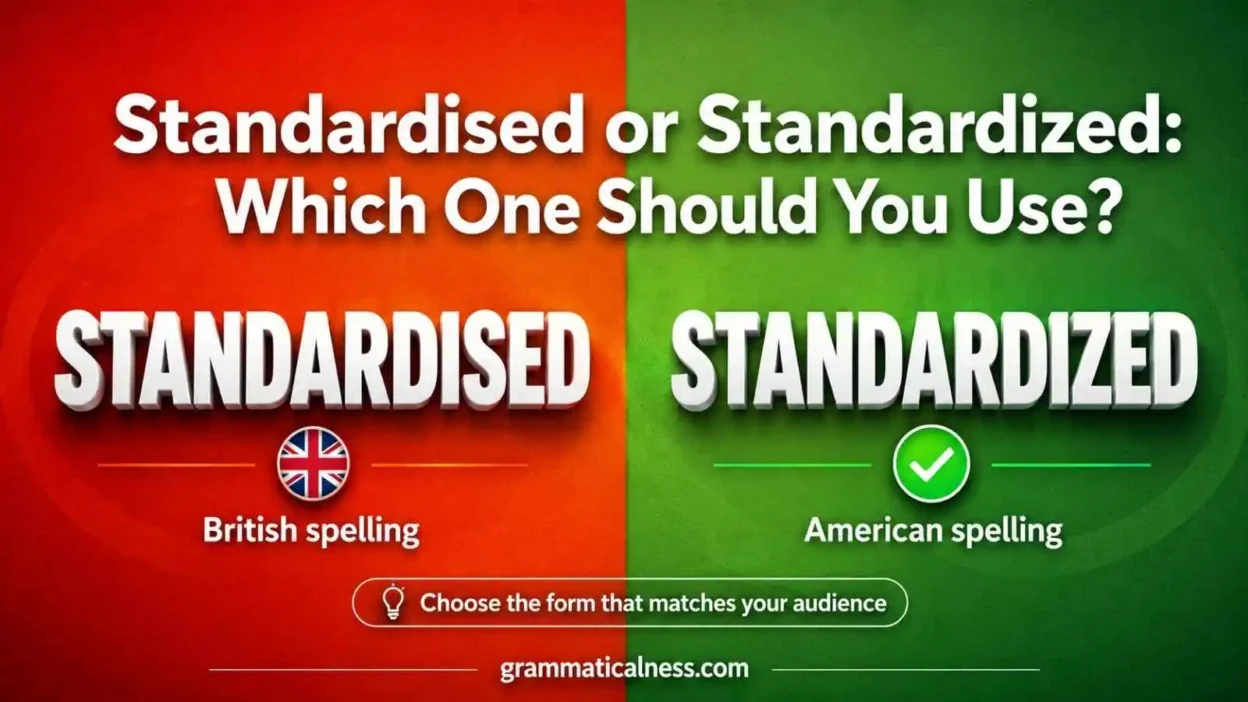
Should you write standardised or standardized?
For a US audience, standardized is the better choice. However, standardised is also correct in British English. Both words mean the same thing: made consistent, brought into the same form, or made to follow a standard.
Therefore, the difference is not meaning. Instead, the difference is spelling style and audience expectation.
Quick Answer
Use standardized in American English.
Use standardised when you are writing in British English or following a British-style guide.
Correct for US readers: The school uses a standardized test.
Correct for British readers: The school uses a standardised test.
Both sentences describe the same kind of test. However, the spelling changes depending on the audience. In short, standardized is the natural US choice, while standardised is the British-style choice.
Why People Confuse Them
People often confuse standardised and standardized because the words look almost the same. Only one letter changes near the end: s in standardised and z in standardized.
Also, English spelling is not always the same in every country. American English usually prefers -ize in words like standardized, organized, and recognized. British English often uses -ise in words like standardised, organised, and recognised.
Even so, the meaning stays the same. A standardized process and a standardised process are the same type of process. The choice depends on where and for whom you are writing.
Key Differences At A Glance
| Context | Best Choice | Why |
| US school writing | standardized | It is the normal American spelling. |
| US business writing | standardized | It looks natural and professional to American readers. |
| British writing | standardised | It matches common British spelling style. |
| International document with US style | standardized | It keeps the document consistent. |
| Quoting a British source | standardised | It keeps the original spelling. |
| Search or database terms | Both may matter | Some records may use one spelling, while others use the other. |
Meaning and Usage Difference
Standardized means made to follow a standard. For example, it can describe a test, process, form, system, method, product, or format.
Example: The company created a standardized form for all new hires.
Standardised has the same meaning. However, it follows British spelling.
Example: The company created a standardised form for all new hires.
Both words can work as adjectives.
Example: The report used a standardized format.
They can also work as past-tense verb forms.
Example: The team standardized the process last year.
For standardised, the base verb is standardise. For standardized, the base verb is standardize. As a result, the spelling changes in related forms too: standardisation in British style and standardization in US style.
Pronunciation does not need much attention here. In normal speech, the two forms sound very similar. Therefore, the real choice is written style, not spoken sound.
Extra comparison:
- standardised: British-style spelling; same meaning.
- standardized: US-style spelling; same meaning.
- Main difference: spelling convention.
- Main mistake: mixing both forms in one document.
Tone, Context, and Formality
Neither word is more formal by meaning. Both can appear in school work, business reports, technical writing, academic papers, and official documents.
However, standardized usually looks smoother to American readers. In a US report, standardised may look like a typo, even though it is correct in British English.
On the other hand, standardised often looks more natural in British-style writing. Still, some publishers and institutions may choose standardized if their house style prefers -ize endings.
Because of that, the safest rule is simple: match your audience and stay consistent.
Which One Should You Use?
Use standardized if your readers are mainly in the United States.
Choose standardized for:
US school papers
US business reports
American websites
résumés for US jobs
technical documents in American English
emails to US clients
Use standardised if your readers expect British English.
Choose standardised for:
UK school papers
British business documents
Commonwealth-style writing
documents following a British style guide
quotes from British sources
For a global audience, choose one spelling style before you start. Then, use that style throughout the whole document. This makes your writing look cleaner and more professional.
When One Choice Sounds Wrong
Standardised can look wrong in US writing, although it is not truly wrong. The issue is audience fit.
Less natural for US readers: The survey used standardised questions.
Better for US readers: The survey used standardized questions.
Meanwhile, standardized may look out of place in a British-style document if the rest of the writing uses British spelling.
Mixed style: The programme used standardized testing and organised lessons.
Better British-style consistency: The programme used standardised testing and organised lessons.
Better US-style consistency: The program used standardized testing and organized lessons.
In other words, the spelling should match the rest of the document. Otherwise, the writing can feel uneven.
Common Mistakes (and Quick Fixes)
Mistake 1: Mixing both spellings in one document.
Wrong: The team standardised the form, then standardized the report.
Better for US readers: The team standardized the form, then standardized the report.
Mistake 2: Thinking the words have different meanings.
Wrong idea: Standardized means testing, but standardised means general consistency.
Better idea: Both words can describe tests, systems, forms, products, data, and processes.
Mistake 3: Using the British spelling for a US audience by accident.
Less natural in the US: Our office uses a standardised checklist.
Better in the US: Our office uses a standardized checklist.
Mistake 4: Changing spelling inside a direct quote.
Wrong: A British report says “standardised,” but you silently change it to “standardized.”
Better: Keep the spelling in direct quotes. However, outside the quote, use your chosen style.
Everyday Examples
US style: The hospital uses standardized labels for medication.
British style: The hospital uses standardised labels for medication.
US style: The district introduced a standardized reading test.
British style: The district introduced a standardised reading test.
US style: We need a standardized process for customer refunds.
British style: We need a standardised process for customer refunds.
US style: The data was standardized before the team reviewed it.
British style: The data was standardised before the team reviewed it.
US style: Please send the document in a standardized format.
British style: Please send the document in a standardised format.
As these examples show, the sentence meaning does not change. Instead, the spelling changes to match the writing style.
Dictionary-Style Word Details
Verb
standardised: This is commonly used as the past tense and past participle of the British verb standardise.
Example: The lab standardised the testing method.
standardized: This is commonly used as the past tense and past participle of the US verb standardize.
Example: The lab standardized the testing method.
Noun
standardised: Not commonly used as a noun in standard US English. Instead, it usually works as an adjective or a verb form. The related British-style noun is standardisation.
standardized: Not commonly used as a noun in standard US English. Instead, it usually works as an adjective or a verb form. The related US noun is standardization.
Synonyms
standardised: Closest plain alternatives include uniform, consistent, regulated, regularized, and made consistent.
standardized: Closest plain alternatives include uniform, consistent, regulated, regularized, and made consistent.
Clear opposites can include unstandardized, inconsistent, irregular, and nonuniform, depending on the sentence.
Example Sentences
standardised: The agency used a standardised form for every application.
standardised: The results were standardised before the final review.
standardized: The agency used a standardized form for every application.
standardized: The results were standardized before the final review.
Word History
standardised: This form comes from the British-style spelling of the verb standardise, built from standard plus the -ise verb ending.
standardized: This form comes from the US-style spelling of the verb standardize, built from standard plus the -ize verb ending.
Overall, the important point is the spelling pattern, not a separate meaning history. Both forms are tied to the idea of making something match a standard.
How Did English Spelling Become Standardized?
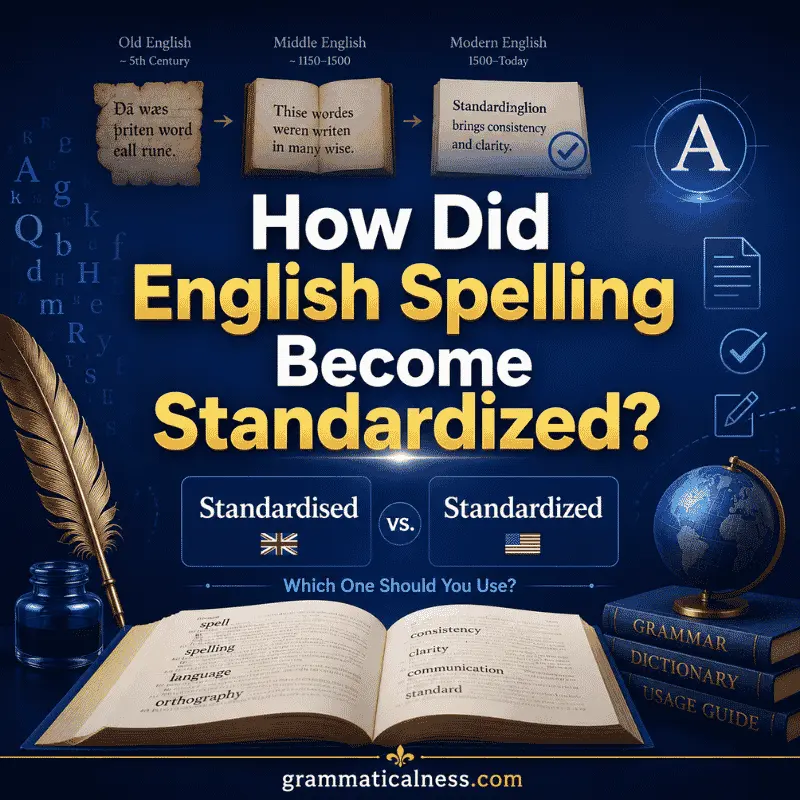
English spelling became standardized gradually rather than through one official law or language authority.
The printing press played an important early role. After printing spread in England, printers began favoring more consistent spellings so books could be produced for wider audiences. However, spelling variation continued for a long time.
Dictionaries, schools, publishers, and common usage later made spelling more consistent. In the United States, Noah Webster promoted several distinctly American spellings through his dictionaries. These forms became established because schools, publishers, and readers adopted them—not because the government required them.
There were also spelling-reform movements that tried to simplify English or make spelling match pronunciation more closely. However, no single movement created one universal spelling system for every English-speaking country. That is one reason American and British English still differ in forms such as standardized and standardised.
Phrases Containing
standardised: standardised test, standardised form, standardised process, standardised method, standardised data, standardised assessment.
standardized: standardized test, standardized form, standardized process, standardized method, standardized data, standardized assessment.
For US writing, standardized test is the expected form. Therefore, use that spelling when writing for American readers.
FAQs
Both standardised and standardized are correct. However, standardized is the preferred spelling in American English, while standardised is mainly used in British English.
In the USA, use standardized. For example, write standardized test, standardized process, and standardized form when writing for American readers.
No, standardised is not wrong. Instead, it is the British-style spelling. However, it may look unusual or incorrect to many US readers.
Yes, both words mean the same thing. They describe something that has been made consistent, uniform, or set according to a standard.
American English usually prefers -ize spellings in words like standardized, organized, and recognized. Because of that, standardized looks more natural in US writing.
It is better not to mix them. Choose standardized for US English or standardised for British English, then use the same spelling throughout the article.
Here is a simple example:
The school uses a standardized test for all students.
This means every student takes a test that follows the same format or standard.
Here is a British-style example:
The school uses a standardised test for all pupils.
The meaning is the same as standardized, but the spelling follows British English.
Standardized can be both. As a verb, it means something was made consistent. As an adjective, it describes something that follows a standard.
Example as a verb: The team standardized the process.
Example as an adjective: The company uses a standardized process.
For US business writing, standardized is the best choice. It looks professional, natural, and consistent for American readers.
Conclusion
For American readers, choose standardized. For British-style writing, choose standardised.
The meaning is the same. However, the spelling changes by region and style.
When your document is for a US audience, write standardized process, standardized test, standardized form, and standardized data. If you are following British style, use standardised instead.