
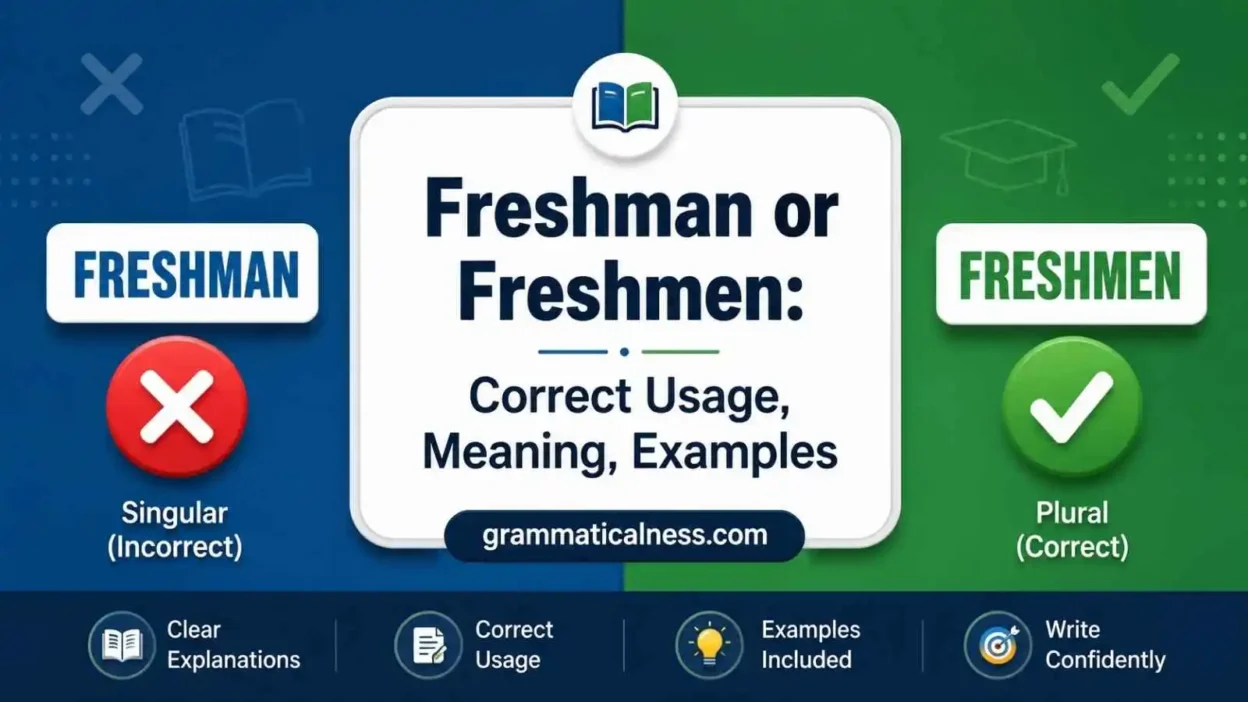
Freshman and freshmen are both correct, but they are not used the same way.
The choice depends on number and sentence role. Use freshman for one first-year student. Use freshmen for two or more first-year students.
There is one extra point: freshman is also the usual form before another noun in common phrases like freshman year, freshman class, and freshman orientation.
Quick Answer
Use freshman when you mean one person.
Use freshmen when you mean more than one person.
Use freshman before another noun in common school phrases.
Examples:
- She is a freshman at Arizona State.
- The freshmen met their advisors today.
- My freshman year went by fast.
- The freshman class is larger this year.
So, if you are asking “freshman or freshmen,” the answer is simple: freshman = one or modifier; freshmen = plural noun.
Why People Confuse Them
People confuse these words because they look almost the same and often sound the same in normal speech.
In American English, both are usually pronounced like FRESH-muhn. The spelling changes, but the sound often does not. That makes the mistake easy to miss when you are writing quickly.
Another reason is that freshman class can feel strange. A class has many students, so some writers expect freshmen class. But in that phrase, freshman describes the kind of class, so the singular form is the standard choice.
Key Differences At A Glance
| Feature | freshman | freshmen |
| Number | Singular | Plural |
| Main use | One first-year student | Two or more first-year students |
| Before another noun | Common: freshman year | Not the usual choice in fixed phrases |
| Example | a freshman | the freshmen |
The biggest difference is not meaning. Both point to first-year status. The difference is grammar.
Meaning and Usage Difference
A freshman is one student in the first year of high school, college, or university.
A freshmen is not one student. It means a group of first-year students.
Correct:
- My brother is a freshman.
- Several freshmen joined the club.
Wrong:
- My brother is a freshmen.
- Several freshman joined the club.
The word freshman can also describe something connected with the first year:
- freshman year
- freshman seminar
- freshman dorm
- freshman orientation
In these phrases, freshman works like a describing word before a noun.
Confused about plural spellings? Also check tomatoes or tomatos for a quick grammar fix.
Tone, Context, and Formality
Both words are standard in US English. You can use them in school emails, essays, news writing, and casual conversation.
Still, some colleges and style guides prefer first-year student because it is more inclusive and clearer for a wide audience. That does not make freshman or freshmen wrong. It only means a school, company, or publication may choose a different style.
For everyday US writing, freshman and freshmen are normal. For official school copy, follow the school’s wording when it has a stated preference.
Which One Should You Use?
| Context | Best Choice | Why |
| One student | freshman | It is singular. |
| Two or more students | freshmen | It is plural. |
| First year of school | freshman year | The word modifies “year.” |
| Group entering school | freshmen | The word names multiple students. |
| Class as a unit | freshman class | The word modifies “class.” |
| Official inclusive wording | first-year student | Some schools prefer this style. |
A quick test helps: Ask, “Am I naming one student, many students, or describing another noun?”
One student: freshman.
Many students: freshmen.
Describing another noun: usually freshman.
When One Choice Sounds Wrong
Freshmen sounds wrong when you are talking about one person.
Wrong: She is a freshmen in college.
Correct: She is a freshman in college.
Freshman sounds wrong when you are talking about several students as people.
Wrong: The freshman are moving in today.
Correct: The freshmen are moving in today.
Freshmen year also sounds wrong in standard writing.
Wrong: I loved my freshmen year.
Correct: I loved my freshman year.
The noun after the word matters. In freshman year, the main noun is year, not students.
Common Mistakes (and Quick Fixes)
Mistake: “I am a freshmen.”
Fix: “I am a freshman.”
Mistake: “The school welcomed many freshman.”
Fix: “The school welcomed many freshmen.”
Mistake: “Freshmen orientation starts Monday.”
Fix: “Freshman orientation starts Monday.”
Mistake: “Her freshmen year was busy.”
Fix: “Her freshman year was busy.”
Mistake: “All freshman must attend.”
Fix: “All freshmen must attend.”
The easiest memory trick is man / men. One man, many men. One freshman, many freshmen.
Everyday Examples
My cousin is a freshman at a high school in Dallas.
The freshmen are meeting in the gym after lunch.
I changed my major during freshman year.
The freshman class voted for its student council reps.
Two freshmen from our dorm started a podcast.
A freshman on the soccer team scored the winning goal.
The college sent parking rules to all incoming freshmen.
My freshman seminar meets every Wednesday morning.
Dictionary-Style Word Details
Verb
- freshman: Not commonly used as a verb in standard US English.
- freshmen: Not commonly used as a verb in standard US English.
Noun
- freshman: A count noun for one first-year student. It can also mean a beginner or newcomer in a job, sport, public office, or activity.
- freshmen: The plural noun form of freshman. It means two or more first-year students or newcomers.
Synonyms
- freshman: Closest plain alternatives: first-year student, new student, beginner, newcomer, rookie. Use rookie mainly for sports, jobs, or casual contexts.
- freshmen: Closest plain alternatives: first-year students, new students, newcomers, rookies.
Clear antonyms are context-based, not exact. In school settings, senior can be an opposite in class-year order, but it is not a direct opposite in every use.
Example Sentences
- freshman: Maya is a freshman at a public high school in Ohio.
- freshman: He had a tough freshman year, but his grades improved later.
- freshmen: The freshmen lined up for campus tours.
- freshmen: Several freshmen joined the robotics club.
Word History
- freshman: Dictionaries connect the word to fresh plus man. In modern US English, it can refer to students of any gender.
- freshmen: This is the irregular plural form of freshman, following the same pattern as man and men.
Exact early dating can vary by dictionary, so the practical point is the current rule: freshman is singular, and freshmen is plural.
Phrases Containing
- freshman: freshman year, freshman class, freshman orientation, freshman seminar, freshman dorm, freshman season
- freshmen: incoming freshmen, college freshmen, high school freshmen, first-year freshmen, freshmen on campus
Conclusion
The difference between freshman and freshmen is about grammar, not a deep change in meaning.
Use freshman for one first-year student: “She is a freshman.” Use freshmen for more than one: “The freshmen arrived early.”
When the word comes before another noun, the safe standard choice is usually freshman: freshman year, freshman class, freshman orientation.
That one rule will help you avoid the most common mistakes.