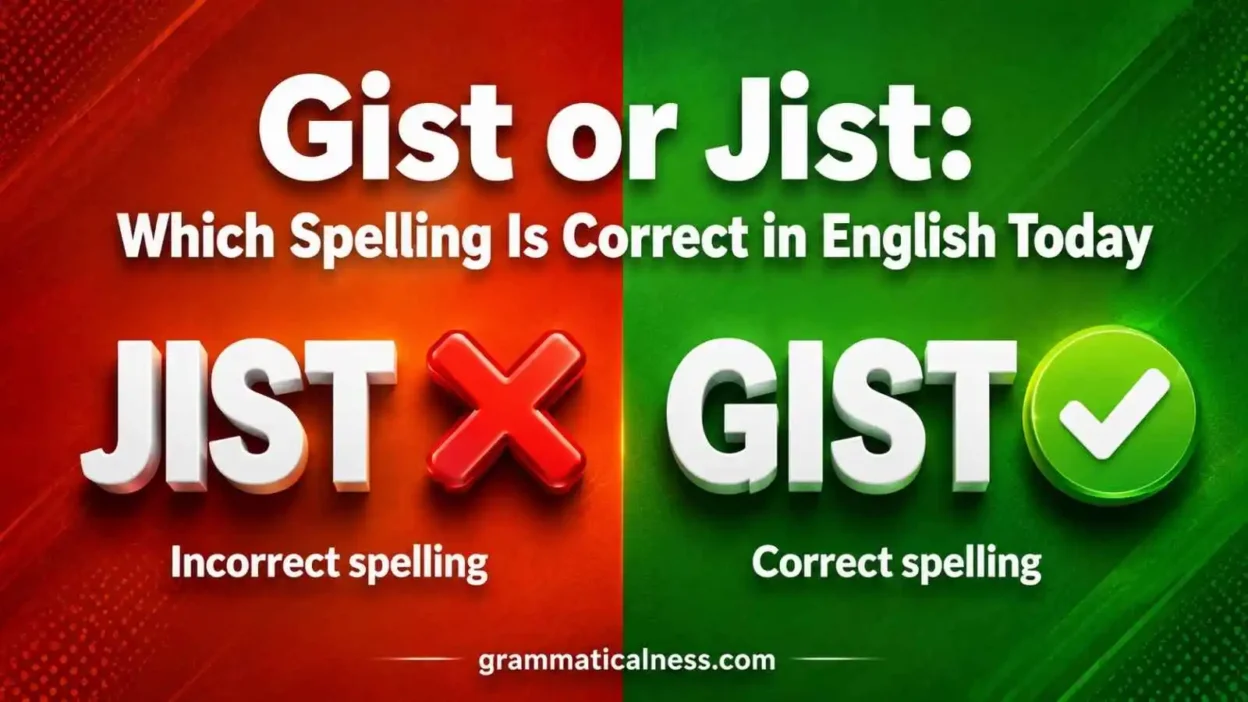
Gist or jist is a common writing question because the correct word does not sound the way many people expect. In speech, gist starts with a soft g sound, so it sounds like “jist.” In writing, though, only gist is correct when you mean the main point or basic idea.
This guide explains the difference clearly, with examples you can use in school, work, emails, and everyday writing. You will also learn why jist appears so often, when gist sounds natural, and how to avoid the most common mistake.
Quick Answer
Use gist, not jist. Gist is the correct noun for the main point, basic meaning, or essence of something. Jist is a misspelling when used for that meaning. The pronunciation causes the confusion because gist is pronounced like “jist,” but the spelling still begins with g.
Why People Confuse Them
People confuse gist and jist because gist has a soft g. That means the first sound is like the j in jam. When someone hears “get the gist,” the spelling jist can look logical at first.
The problem is that English spelling does not always match sound in a simple way. Gist follows the same soft-g pattern you hear in words like giant and gentle. So the sound may point you toward j, but standard spelling still uses g.
Another reason is that gist often appears in casual speech before people see it in print. You may hear “I get the gist” many times before you ever write it.
Key Differences At A Glance
| Context | Best Choice | Why |
| Main idea of a meeting | gist | It means the central point or basic meaning. |
| School essay or report | gist | It is the standard spelling in formal writing. |
| Casual text message | gist | Casual tone does not make jist correct. |
| Work email | gist | It looks polished and clear. |
| Legal context | gist | It can refer to the grounds or basis of a legal action. |
| Any sentence meaning “main point” | gist | Jist is not the accepted spelling for this meaning. |
Meaning and Usage Difference
Gist means the main point, basic idea, or essence of something. It is a noun, and it often appears in phrases like the gist, get the gist, give me the gist, and the gist of it.
Jist is not the standard spelling for that meaning. When writers use jist to mean “main point,” readers usually understand the intent, but they will see it as a spelling mistake.
| Feature | gist | jist |
| Standard English status | Correct spelling | Incorrect for this meaning |
| Main meaning | Main point or essence | No standard “main point” meaning |
| Part of speech here | Noun | Misspelled form |
| Pronunciation | Sounds like “jist” | Same sound if read aloud |
| Best use | All normal writing | Avoid for this meaning |
Use gist when you mean the point of a story, article, conversation, rule, lecture, or message.
Tone, Context, and Formality
Gist is neutral. You can use it in casual, school, business, and professional writing. It works in a sentence like, “I missed a few details, but I got the gist.”
In very formal writing, main point, central idea, or essence can sometimes sound more precise. Still, gist is not slang. It is a normal English word.
Jist has a different effect. In a text to a friend, it may pass unnoticed. In an essay, resume, client email, or workplace note, it can make the writing look rushed. Therefore, correct it to gist whenever you are editing.
Which One Should You Use?
Use gist every time you mean “the main point.” This is the safest choice in US English.
Choose gist in these sentences:
- I got the gist of the meeting.
- Can you give me the gist before the call?
- The gist of her argument was clear.
- I skimmed the article and understood the gist.
Do not use jist for that meaning. The spelling may match the sound, but it does not match standard written English.
When One Choice Sounds Wrong
Jist sounds wrong in standard writing whenever it means “main point.”
Incorrect: I understood the jist of the email.
Correct: I understood the gist of the email.
Incorrect: What is the jist of the movie?
Correct: What is the gist of the movie?
Gist can also sound awkward if you use it in the wrong phrase. For example, “Give me a gist” sounds less natural than “Give me the gist.” Most everyday uses take the, especially in the phrase the gist of.
Better: Give me the gist of what happened.
Awkward: Give me a gist of what happened.
Common Mistakes (and Quick Fixes)
Mistake 1: Spelling the word by sound
Incorrect: I got the jist.
Correct: I got the gist.
Mistake 2: Using jist in work writing
Incorrect: Here is the jist of the proposal.
Correct: Here is the gist of the proposal.
Mistake 3: Treating gist as a full summary
Gist is the core idea, not every detail. If you need all key details, use summary instead.
Less precise: Send me the gist of the full report by Friday.
Clearer: Send me a summary of the full report by Friday.
Mistake 4: Forgetting of after the phrase
Incorrect: I got the gist the message.
Correct: I got the gist of the message.
Everyday Examples
I did not catch every number, but I got the gist of the budget update.
Before we join the call, can you give me the gist?
The gist of the article is that rent prices are rising in several cities.
She explained the gist of the policy in two minutes.
I watched the trailer and got the gist of the story.
The gist of his advice was simple: save more, spend less, and plan ahead.
Even without the slides, the team understood the gist.
Dictionary-Style Word Details
Verb
Gist: Not commonly used as a verb in standard US English for this meaning. Use summarize, explain, or condense instead.
Jist: Not commonly used as a verb in standard US English. Do not use it as a verb for “summarize.”
Noun
Gist: A noun meaning the main point, basic meaning, or essence of something. It is often used with the, as in the gist of the message.
Jist: Not the standard noun spelling for “main point.” If you mean the main idea, write gist.
Synonyms
Gist: Closest plain alternatives include main point, essence, core idea, central point, substance, takeaway, and basic meaning.
Jist: No separate synonyms apply when it is used as a misspelling of gist. Correct the spelling first, then use the synonyms for gist.
Useful contrast words for gist include details, specifics, and minor points. These are not perfect antonyms, but they help show the difference between the core idea and the extra information.
Example Sentences
Gist
The gist of the memo was that the deadline moved to Friday.
I missed the first five minutes, but I got the gist.
Please give me the gist before I read the full report.
Jist: Incorrect for this meaning. Write “I got the gist,” not “I got the jist.”
Jist: Incorrect for this meaning. Write “the gist of the story,” not “the jist of the story.”
Word History
Gist has a legal background and later developed its broader meaning of the main point or essence. The legal sense still exists, but most readers now meet the word in everyday phrases such as get the gist.
Jist does not have a supported history as the standard spelling for the “main point” meaning. In this comparison, it is best treated as a spelling error caused by pronunciation.
Phrases Containing
Gist: the gist, get the gist, give me the gist, the gist of it, catch the gist, grasp the gist.
Jist: No standard phrases use jist for the “main point” meaning. The correct forms are get the gist, the gist of it, and give me the gist.
FAQs
Is it gist or jist?
The correct spelling is gist. Use gist when you mean the main point, basic idea, or essence of something. Jist is a common misspelling for this meaning. The confusion happens because gist is pronounced like “jist,” but the accepted spelling starts with g.
Is jist a real word?
For the meaning “main point,” jist is not the standard word. In everyday writing, schoolwork, emails, and professional documents, write gist. Some dictionaries may record rare or unrelated uses of jist, but that does not make it correct for phrases like “get the gist.”
What does gist mean?
Gist means the central idea or most important part of something. For example, if someone explains a long meeting in one sentence, they are giving you the gist. It does not include every detail. It gives the basic meaning so you can understand the main point quickly.
How do you use gist in a sentence?
You can use gist in natural sentences like these: “I missed a few details, but I got the gist.” “Can you give me the gist before the meeting?” “The gist of the article was easy to understand.” In most cases, gist appears in the phrase the gist of.
Is “the jist of it” correct?
No. The correct phrase is the gist of it. Write, “I understand the gist of it,” not “I understand the jist of it.” The phrase means you understand the basic idea, even if you do not know every small detail.
What is another word for gist?
Good alternatives for gist include main point, core idea, essence, central point, basic meaning, and takeaway. Use summary when you need a fuller version with more details.
Conclusion
Gist is the correct choice, and jist is the spelling to avoid when you mean the main point or essence of something. The confusion is understandable because gist sounds like “jist,” but standard written English keeps the g. Use gist in casual messages, school writing, work emails, reports, and professional documents. When you want the core idea without every detail, ask for the gist.
The correct spelling is gist. Use gist when you mean the main point, basic idea, or essence of something. Jist is a common misspelling for this meaning. The confusion happens because gist is pronounced like “jist,” but the accepted spelling starts with g.
For the meaning “main point,” jist is not the standard word. In everyday writing, schoolwork, emails, and professional documents, write gist. Some dictionaries may record rare or unrelated uses of jist, but that does not make it correct for phrases like “get the gist.”
Gist means the central idea or most important part of something. For example, if someone explains a long meeting in one sentence, they are giving you the gist. It does not include every detail. It gives the basic meaning so you can understand the main point quickly.
You can use gist in natural sentences like these: “I missed a few details, but I got the gist.” “Can you give me the gist before the meeting?” “The gist of the article was easy to understand.” In most cases, gist appears in the phrase the gist of.
No. The correct phrase is the gist of it. Write, “I understand the gist of it,” not “I understand the jist of it.” The phrase means you understand the basic idea, even if you do not know every small detail.
Good alternatives for gist include main point, core idea, essence, central point, basic meaning, and takeaway. Use summary when you need a fuller version with more details.