
Choosing between cancellation or cancelation can feel harder than it should. American writers often learn to use one l in canceled and canceling, so cancelation may appear logical. Yet the noun does not follow that preference as strongly.
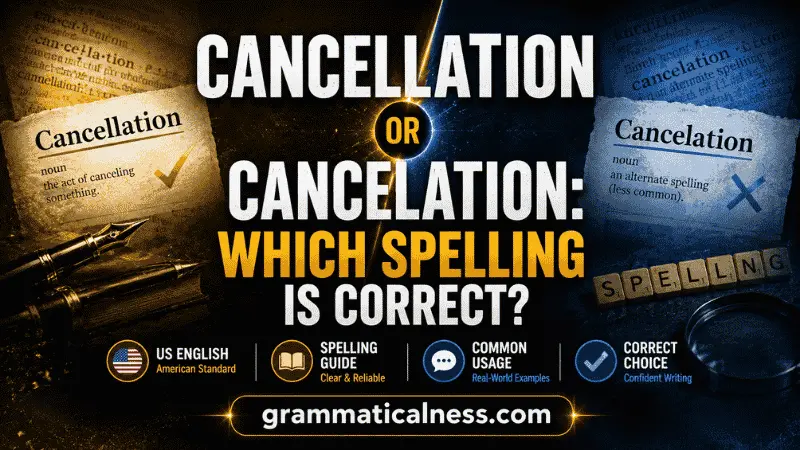
Cancellation, with two l’s, is the established and widely expected spelling in American English. Cancelation, with one l, also appears in US dictionaries as a valid variant, but readers encounter it much less often. The two forms have the same meaning and grammatical role.
For clear everyday, academic, business, and public writing, cancellation is the best default. Use cancelation only when a company, publication, or existing document follows that spelling consistently.
Quick Answer
Both forms can be correct in American English, but cancellation is the standard and strongly preferred spelling. Cancelation is an accepted one-l variant, not a separate word or a different meaning. Choose cancellation for almost every US context because it looks familiar, professional, and natural to the broadest audience.
Why People Confuse Them
The confusion comes from other forms of cancel. In American English, writers commonly use canceled and canceling with one l. That pattern makes cancelation seem like the obvious noun.
However, established spelling does not always follow a perfectly consistent rule. Cancellation retained the double l and became the normal form in both American and British writing. The shorter cancelation survives mainly as a less common American variant.
Another source of confusion is spell-check behavior. One program may accept both spellings, while another may flag cancelation. That difference reflects dictionary settings and house preferences rather than a difference in meaning.
Key Differences At A Glance
| Feature | cancellation | cancelation |
| Meaning | The act or result of canceling | The same meaning |
| Part of speech | Noun | Noun |
| US status | Standard and widely preferred | Accepted but uncommon variant |
| Formal writing | Best choice | Usually avoided |
| Reader reaction | Familiar and expected | May look like a typo |
| Pronunciation | Same pronunciation | Same pronunciation |
The difference is not semantic. It is a matter of spelling frequency, convention, and audience expectation.
Meaning and Usage Difference
Cancellation and cancelation name the same action or result. Both can refer to stopping an event, ending an order or agreement, invalidating something, or making a reserved place available again.
In ordinary writing, cancellation appears in phrases such as flight cancellation, subscription cancellation, cancellation fee, and notice of cancellation. Cancelation can fit the same grammatical positions, but it is less familiar.
Both words function as nouns. Neither spelling becomes a verb. The related verb is cancel, as in “Please cancel my appointment.” The noun follows in “I received confirmation of the cancellation.”
Because their meanings are identical, replacing one spelling with the other does not change the sentence’s message. It changes only how conventional the writing looks.
Tone, Context, and Formality
Cancellation works at every level of US writing. It suits casual messages, school assignments, company policies, legal notices, news reports, and customer service pages.
Cancelation does not create a more casual or more formal tone. It simply looks less standard to many readers. In a private note, that may not matter. In a contract, policy, application, or public notice, the unusual spelling can distract readers or appear inconsistent.
Regional context also matters. Cancellation is normal across major varieties of English. Cancelation is mainly recognized as an American variant, so it may look especially unexpected to readers outside the United States.
Which One Should You Use?
| Context | Best Choice | Why |
| US business email | cancellation | It is familiar and professional |
| School or college paper | cancellation | It is the safest standard spelling |
| Website policy | cancellation | Readers expect it in formal information |
| Airline or hotel message | cancellation | It matches common customer language |
| Existing brand style using one l | cancelation | Consistency may outweigh general preference |
| International audience | cancellation | It is broadly accepted across English varieties |
Use cancellation unless you have a clear reason not to. A house style, product interface, or existing set of forms may require cancelation. In that case, follow the chosen spelling consistently throughout the document.
When One Choice Sounds Wrong
Cancellation rarely sounds or looks wrong because it is the dominant spelling. It works naturally in both singular and plural forms: cancellation and cancellations.
Cancelation may look wrong when the surrounding document uses cancellation elsewhere. It can also appear careless in a formal notice because many readers do not know that the one-l form is accepted.
The spelling becomes genuinely wrong when consistency rules require the other form. For example, a company policy titled “Cancellation Policy” should not switch to “cancelation fee” in the next paragraph. The problem there is inconsistency, not meaning.
Common Mistakes (and Quick Fixes)
A common mistake is assuming that canceled, canceling, and cancellation must all use the same number of l’s. American English commonly uses one l in the first two forms but normally uses two in cancellation.
Another mistake is calling cancelation completely incorrect. It is better described as accepted but uncommon in US English.
Writers also mix the spellings within one page. Fix this by searching the document for both forms and choosing one. In most cases, replace cancelation with cancellation.
Finally, do not change the pronunciation based on the spelling. Both forms are spoken the same way.
Everyday Examples
The airline sent a cancellation notice after the storm worsened.
Our dentist charges a fee for a late cancellation.
Maya received confirmation of her subscription cancellation.
The hotel offered us a room after another guest’s cancellation.
The school announced the cancellation of Friday’s game.
The app used cancelation in one menu but cancellation in its policy page.
The editor changed cancelation to cancellation for consistency.
Please submit your cancellation request before noon.
These examples show why the double-l spelling feels natural in many modern US settings. The one-l form remains understandable, but it often draws attention to the spelling instead of the message.
Dictionary-Style Word Details
Verb
- Cancellation: Not used as a verb. It is a noun.
- Cancelation: Not used as a verb. It is an alternative spelling of the same noun.
Use cancel when the sentence needs a verb: “We need to cancel the reservation.”
Noun
- Cancellation: The usual noun for the act of canceling, something canceled, or a place made available after a reservation ends.
- Cancelation: The same noun and meanings, spelled with one l. It is accepted in American English but less common.
Both forms can be countable or uncountable depending on context: “a cancellation,” “several cancellations,” or “notice of cancellation.”
Synonyms
Both spellings share the same closest plain alternatives. The best choice depends on context:
- For an event: calling off, abandonment
- For a rule or agreement: revocation, annulment, rescission
- For a service: termination
- For an opposing effect: neutralization
A useful opposite is continuation when something proceeds instead of being canceled. No separate synonym set applies to cancelation because its meaning is identical.
Example Sentences
- Cancellation: The concert cancellation disappointed fans who had traveled for the show.
- Cancelation: The form used the heading “Membership Cancelation Request.”
- Cancellation: We received a full refund after the tour’s cancellation.
- Cancelation: The one-l spelling appeared throughout the company’s older forms.
Word History
Cancellation is the established double-l noun related to cancel. Cancelation is a one-l spelling variant associated mainly with American usage. The forms are spelling variants rather than separate words.
The history does not create a meaning difference. Modern writers should base their choice on standard usage and consistency.
Phrases Containing
- Cancellation: cancellation fee, cancellation policy, flight cancellation, last-minute cancellation, notice of cancellation, cancellation request
- Cancelation: The same combinations are grammatically possible, such as cancelation fee and cancelation request, but the double-l versions are more familiar.
FAQs
Both spellings can be correct in American English, but cancellation is the safer and far more familiar choice. Major US dictionaries list cancelation as an accepted variant while marking it as less common. Use cancellation unless a house style specifically requires one l.
Cancellation keeps the double l because that spelling became firmly established in standard English, including American English. The usual US preference for canceled and canceling does not fully carry over to this noun. English spelling patterns often contain established exceptions.
Cancelation is not automatically a misspelling in US English. It appears in dictionaries as a valid variant of cancellation. Still, many readers and spell-check systems expect the double-l form, so the one-l spelling may look accidental or less polished.
Use cancellation in most formal writing. It is the standard-looking form in business emails, policies, contracts, school papers, news writing, and customer notices. Cancelation can be defensible in American English, but it creates an unnecessary distraction for many readers.
No, they have the same meanings. Either spelling can refer to stopping an event, ending an order or agreement, or an opening created when someone gives up a reservation. The difference concerns spelling frequency and reader expectation, not definition.
Avoid mixing them in one document. Choose one spelling and apply it consistently to headings, policies, messages, and forms. For a US audience, cancellation is usually the best default because it is widely recognized and rarely questioned.
Conclusion
Cancellation and cancelation mean the same thing, and both can appear in American English. The practical difference is that cancellation is standard, widely recognized, and suitable for every level of writing. Cancelation is a valid but uncommon variant that may look unusual.
For clear US English, choose cancellation. Use cancelation only when an established style already requires it, and keep that spelling consistent throughout the document.