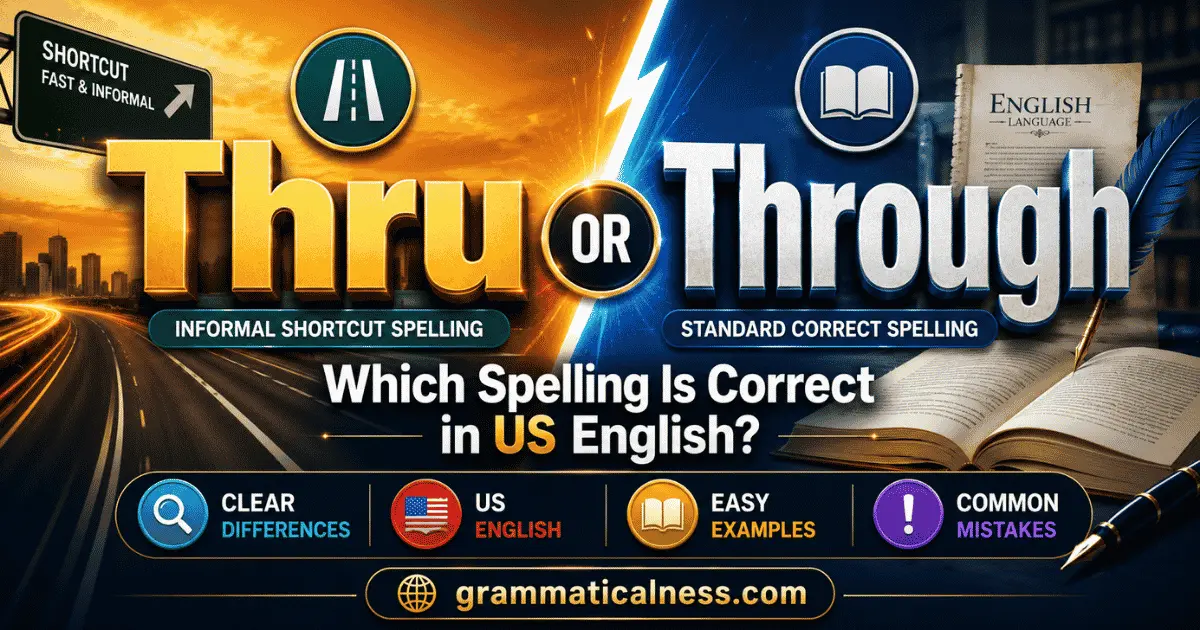
Through is the standard choice in American English. Thru usually carries the same basic meaning, but it is an informal alternative most often seen in signs, casual writing, advertising, and established forms such as drive-thru.
The difference is therefore not usually about meaning. It is mainly about register and context. In an essay, business document, application, report, or ordinary polished sentence, choose through. In a restaurant sign saying drive-thru, the shorter form is completely familiar.
Quick Answer
Use through as your default.
Write:
- We walked through the park.
- The office is open Monday through Friday.
- She worked through the problem.
- I read the report through twice.
Use thru mainly when informal or shortened wording is intentional, especially in expressions such as drive-thru or on signs where space matters. Major dictionaries classify it as a less common, informal, or nonstandard variant rather than the normal standard spelling.
Why People Confuse Them
The confusion is easy to understand because thru and through are pronounced the same way: “throo.” They also generally point to the same underlying meanings.
The shorter spelling also appears frequently in highly visible places:
Compact comparison
- through → standard form for normal writing
- thru → informal shortened variant
- drive-through / drive-thru → both recognized forms of the established compound
- Pronunciation → the same for both
Seeing DRIVE THRU on restaurant signs can make the shorter spelling seem suitable everywhere. It is not. Its acceptability depends heavily on context.
Key Differences At A Glance
| Context | Best Choice | Why |
| School essay | through | Standard written English |
| Business email | through | Neutral and professional |
| Report or formal document | through | Appropriate across formal contexts |
| Normal everyday sentence | through | Safest standard choice |
| Casual text | through or thru | Thru may be used informally |
| Restaurant service lane | drive-thru or drive-through | Both forms are established |
| Short sign or advertisement | thru may fit | Shortened wording is common on signs |
| Date range in polished writing | through | Standard form: Monday through Friday |
The easiest rule is simple: when you are unsure, write through.
Meaning and Usage Difference
The two forms normally do not have separate dictionary meanings. Thru functions as an informal spelling variant of through. Merriam-Webster calls it a less common spelling, while Cambridge marks it as nonstandard in its main entry.
Through has several common uses.
It can show movement from one side or place to another:
We drove through the tunnel.
It can refer to an entire period:
She worked through the night.
It can mean by means of something:
I heard about the opening through a friend.
In North American English, it can also mean up to and including in a range:
The store is open Tuesday through Sunday.
It can function as a preposition, adverb, or adjective, depending on the sentence.
Thru may represent these meanings informally, but that does not make it equally suitable in every piece of writing.
According to Merriam-Webster, “thru” is a less common spelling of “through” and is chiefly informal.
https://www.merriam-webster.com/dictionary/thru
Tone, Context, and Formality
Through has a neutral tone. It works naturally in formal, professional, academic, and casual writing.
Thru feels more compressed and informal. Dictionaries and usage references particularly associate it with casual writing, signs, advertisements, and certain compounds.
Compare:
Please walk through the main entrance.
This looks natural in instructions, an email, or a formal notice.
DRIVE THRU
This looks natural on a short commercial sign.
That distinction matters more than the meaning itself.
Which One Should You Use?
Choose through for almost all ordinary sentences.
Use it when writing:
- essays
- reports
- applications
- professional messages
- instructions
- articles
- school assignments
- date and number ranges
For example:
Applications are accepted June 1 through June 30.
We reviewed every section of the proposal.
She walked through the lobby and took the elevator.
Choose thru only when the informal or shortened form serves a clear purpose.
The most familiar case is drive-thru. American Heritage recognizes both drive-through and drive-thru for the service arrangement in which customers remain in their vehicles.
When One Choice Sounds Wrong
Using thru in polished prose can look unnecessarily casual.
Less suitable:
Please submit your application thru the company website.
Better:
Please submit your application through the company website.
Less suitable:
The research was conducted thru several stages.
Better:
The research was conducted through several stages.
Likewise, replacing through with thru inside familiar expressions can look awkward:
She supported me thru thick and thin.
In informal messaging, readers will understand it. In standard edited writing, however, use:
She supported me through thick and thin.
Established expressions normally retain the standard spelling unless a brand, sign, title, or deliberately informal style calls for something else.
Common Mistakes (and Quick Fixes)
One common mistake is assuming that thru is simply a misspelling with no recognized use. That goes too far. Dictionaries record it as an informal or less common variant, and drive-thru is firmly established.
Another mistake is treating the forms as completely interchangeable.
Mistake: “They mean the same thing, so either spelling works everywhere.”
Quick fix: Meaning may overlap, but register does not. Use through whenever standard written English is expected.
A third mistake is using thru automatically for ranges.
Casual:
Mon thru Fri
Standard prose:
Monday through Friday
Oxford specifically records through in North American English for ranges meaning “until and including.”
Finally, do not confuse either form with threw. Threw is the past tense of throw and is a different word.
Everyday Examples
Here are natural US-English examples showing where each choice fits.
Standard everyday writing
We drove through downtown before traffic got heavy.
I found the apartment through an online listing.
The kids ran through the sprinklers all afternoon.
Our support line is open Monday through Friday.
She stayed calm through the entire meeting.
Read the instructions all the way through before starting.
Informal or sign-style uses
Let’s grab coffee at the drive-thru.
The DRIVE THRU lane closes at 10 p.m.
I’ll be busy Mon thru Wed.
The last example may work in a casual note or compact schedule, but Monday through Wednesday is preferable in normal prose.
Dictionary-Style Word Details
Verb
thru: Not commonly used as a verb by itself in standard US English.
through: Not normally a verb by itself. It often appears with verbs in combinations such as go through, get through, run through, and put through. Oxford treats these as combinations built around the verb rather than making through itself a verb.
Noun
thru: Not commonly used as a standalone noun. However, drive-thru can function as a noun, as in “We stopped at the drive-thru.”
through: Not normally a standalone noun in standard everyday use. Drive-through can function as a noun in the same way.
American Heritage recognizes both drive-through and drive-thru as noun forms of that compound.
Synonyms
Because thru and through cover several meanings, there is no single synonym that replaces them in every sentence.
thru: Closest plain alternatives depend on the intended sense: via, across, throughout, during, or until and including. In standard prose, the closest direct replacement is usually through.
through: Closest plain alternatives include via, across, throughout, during, and by way of, depending on context. Merriam-Webster lists different alternatives for its different senses rather than one universal synonym.
There is also no single antonym that works across every meaning.
Example Sentences
thru:
The sign pointed drivers toward the drive-thru lane.
The temporary schedule reads “Open Wed thru Sun.”
These uses suit commercial or compressed informal contexts.
through:
Sunlight came through the window.
We worked through several possible solutions.
The sale runs July 10 through July 20.
She read the contract through before signing it.
Word History
thru: Although it may look modern, the shortened spelling has much older roots than texting or restaurant signs. Merriam-Webster explains that English historically had many spellings of the word and that forms resembling thru appeared long before modern spelling became standardized. Its present status, however, remains chiefly informal.
through: The word developed from Old English forms including thurh and thuruh. English spelling changed substantially over centuries before through became the standard modern form. Oxford also traces it to Old English and notes later spelling changes.
The safe historical conclusion is that thru is not merely a recent invention, but through is the established standard spelling today.
Phrases Containing
thru:
- drive-thru
- drive-thru lane
- drive-thru window
- Mon thru Fri — informal or space-saving style
The strongest established use is drive-thru.
through:
- through and through
- through thick and thin
- go through
- get through
- see through
- put through
- through the night
- Monday through Friday
In ordinary fixed expressions and polished prose, through remains the natural standard form.
FAQs
Yes, thru is a recognized informal spelling of through. However, it is not the standard choice for most writing. You will most often see it in signs, advertisements, casual messages, and established expressions such as drive-thru. In essays, reports, professional emails, and formal documents, use through.
Both drive-thru and drive-through are accepted forms. In American English, drive-thru is especially common on restaurant signs, menus, and business branding because it is shorter. Drive-through is also correct and may look more formal in regular prose.
In standard writing, Monday through Friday is the better choice. Monday thru Friday may appear on signs, schedules, or advertisements where space is limited. For professional, academic, or polished writing, always prefer through.
Usually, no. Thru generally carries the same basic meaning as through. The main difference is formality and usage. Through is the standard spelling, while thru is an informal shortened variant used in limited contexts.
It is better to avoid thru in formal writing. Use through in school assignments, business communication, reports, applications, and professional documents. The shorter form can make formal writing look overly casual.
No. Thru and through are pronounced the same way, roughly like “throo.” Their identical pronunciation is one reason writers sometimes confuse them. The difference is mainly in spelling, formality, and context rather than pronunciation or basic meaning.
Conclusion
For thru or through, choose through in nearly all normal writing.
Both forms can express the same basic ideas, and they are pronounced the same. The real difference is usage: through is standard and works across formal and informal contexts, while thru is an informal shortened variant associated especially with signs, casual wording, and established compounds such as drive-thru.
A simple rule will keep your writing natural: use through by default; use thru only when the shortened informal form clearly fits the context.