

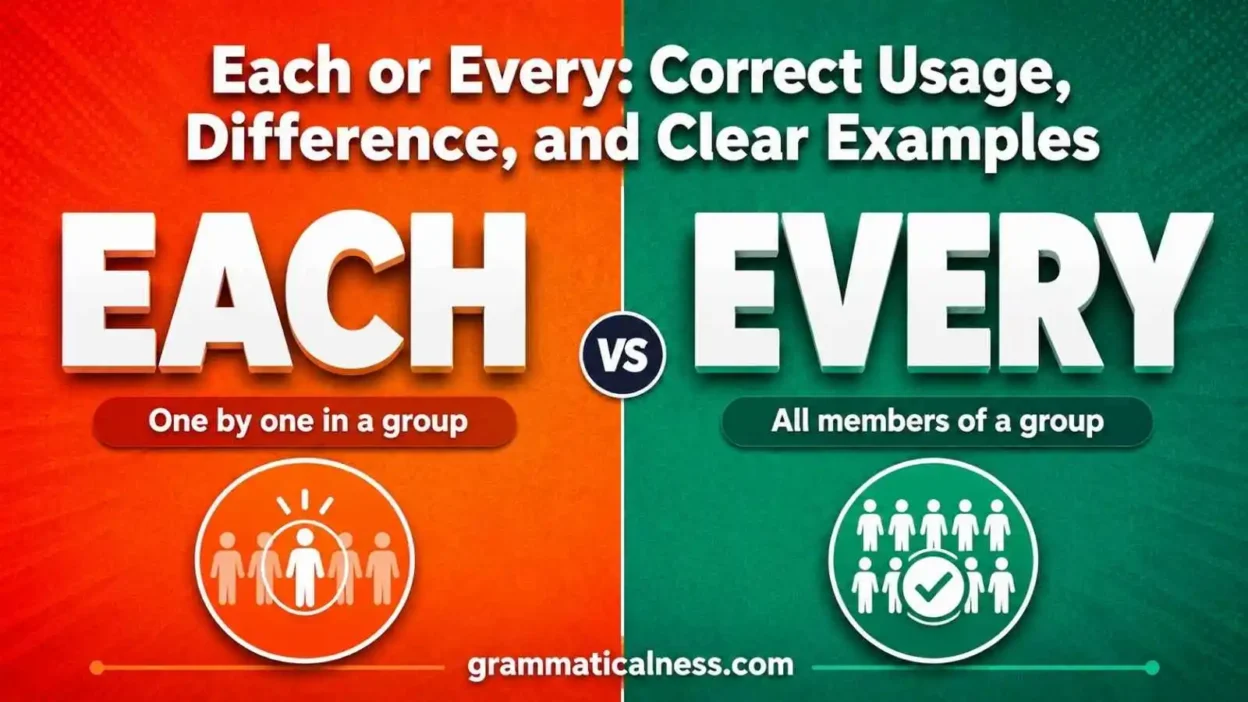
Both each and every are correct English words, but they do not always fit the same sentence. The choice depends on whether you want to focus on people or things one by one, or on a whole group without exceptions.
This difference is small but useful. In many everyday sentences, both words can sound possible. Still, each often feels more individual and specific, while every often feels more complete, general, or repeated over time.
Quick Answer
Use each when you are thinking about members of a group separately, one by one. Use every when you mean all members of a group as a complete set, with no exceptions. Both usually come before a singular noun and take a singular verb, but each has more sentence positions than every.
Why People Confuse Them
People confuse each and every because both can mean “all members” in many sentences.
For example, these two sentences are both correct:
• Each student received a workbook.
• Every student received a workbook.
The difference is emphasis. Each student makes you picture the students one at a time. Every student stresses that no student was left out.
Another reason is grammar. Both words often appear before a singular noun:
• each ticket
• every ticket
• each room
• every room
However, they do not behave the same in every structure. You can say each of the rooms, but you should say every one of the rooms, not every of the rooms.
Key Differences At A Glance
| Context | Best Choice | Why |
| Two people or things | each | Each works naturally with two or more. |
| Three or more people or things as a full group | every | Every stresses the whole group with no exceptions. |
| Thinking about items one by one | each | It highlights individual members separately. |
| Talking about repeated times | every | Every is natural for routines and intervals. |
| Before “of them” or “of us” | each | Use each of them, not every of them. |
| After almost, nearly, or practically | every | Say almost every, not almost each. |
| After a plural subject | each | They each have their own locker. |
| Meaning “apiece” after a number | each | The tickets cost $20 each. |
Meaning and Usage Difference
Each means every one in a group, considered separately. It is useful when the individual members matter.
Examples:
• Each desk has a name tag.
• Each player gets two attempts.
• The twins each have their own backpack.
In these examples, the sentence looks at the members one by one.
Every means all members of a group, with no exceptions. It is useful when the complete group matters more than the separate members.
Examples:
• Every desk was cleaned before class.
• Every player must sign the form.
• Every store in the mall was closed.
In these examples, the sentence stresses total coverage.
A helpful difference is group size. Each can refer to two or more. Every is normally used for three or more because it points to a full group or series.
Correct:
• She wore a bracelet on each wrist.
• The office has cameras at each entrance.
• Every seat in the theater was taken.
Less natural:
• She wore a bracelet on every wrist.
A person has two wrists, so each wrist is the better choice.
Tone, Context, and Formality
Each often sounds more careful, exact, or personal. It fits instructions, grading, inspections, payments, and situations where one item or person gets separate attention.
Examples:
• Review each form before you submit it.
• The nurse checked each patient’s chart.
• Each employee will receive a separate login.
Every sounds broader and more inclusive. It fits rules, routines, promises, schedules, and general statements.
Examples:
• Every customer deserves clear service.
• The bus leaves every 15 minutes.
• Every applicant must upload a resume.
Neither word is slang. Both are normal in casual, academic, and professional writing. The tone changes because of focus, not because one word is more formal than the other.
Which One Should You Use?
Use each when the sentence means “one by one.”
• Each box has a different label.
• Sign each page at the bottom.
• We each brought a snack.
Use every when the sentence means “all of them.”
• Every box arrived on time.
• Every page must be complete.
• Every guest received a thank-you note.
Use every for repeated times and regular intervals.
• I check my email every morning.
• The team meets every Friday.
• Take one tablet every eight hours.
Use each after a plural subject when the members do something separately.
• The students each chose a topic.
• We each paid for our own meal.
• The apartments each have a balcony.
When One Choice Sounds Wrong
Some sentences need each, not every.
Wrong: Every of the kids got a sticker.
Correct: Each of the kids got a sticker.
Correct: Every one of the kids got a sticker.
Wrong: They every have a locker.
Correct: They each have a locker.
Correct: Every student has a locker.
Wrong: The tickets cost $15 every.
Correct: The tickets cost $15 each.
Other sentences need every, not each.
Wrong: Almost each seat was full.
Correct: Almost every seat was full.
Wrong: We meet each three weeks.
Correct: We meet every three weeks.
Wrong: Practically each store was closed.
Correct: Practically every store was closed.
Each day can be correct, but every day is more natural for a routine.
Natural: I walk the dog every day.
Possible: Each day, I write down one thing I learned.
Common Mistakes (and Quick Fixes)
Mistake: Using every of
Fix: Use each of or every one of.
• Each of the files is saved.
• Every one of the files is saved.
Mistake: Using a plural noun right after each or every
Fix: Use a singular noun.
• Each student has a folder.
• Every student has a folder.
Mistake: Using every after a plural subject
Fix: Use each.
• They each have a badge.
• We each chose a seat.
Mistake: Using each after almost or nearly
Fix: Use every.
• Nearly every room was booked.
• Almost every answer was correct.
Mistake: Using every for two items
Fix: Use each or both.
• Each hand was cold.
• Both hands were cold.
Everyday Examples
• Each apartment has a private entrance.
• Every apartment in the building has Wi-Fi.
• Each child picked a book from the shelf.
• Every child in the class passed the quiz.
• We each ordered a different sandwich.
• Every sandwich came with fries.
• Each invoice needs a signature.
• Every invoice must be paid by Friday.
• The doctor checked each test result.
• Every test result was uploaded to the portal.
• Each team member gave a short update.
• Every team member attended the meeting.
• The store gives each customer a receipt.
• Every customer can return items within 30 days.
• Each side of the card has a different design.
• Every chapter ends with review questions.
Dictionary-Style Word Details
Verb
• each: Not commonly used as a verb in standard US English.
• every: Not commonly used as a verb in standard US English.
Noun
• each: Not commonly used as a noun. It can work as a pronoun, as in “Each has a different answer,” and as an adverb meaning “apiece,” as in “They cost $10 each.”
• every: Not commonly used as a noun. It normally works before a singular noun, as in “every student,” “every day,” or “every chance.”
Synonyms
• each: Closest plain alternatives include each one, every one separately, apiece, and per, depending on the sentence.
• every: Closest plain alternatives include all, every single, each individual, and without exception, depending on the sentence.
Clear antonyms do not always fit because both words are quantifiers. In specific sentences, opposites may use no, none, or not every, but those are sentence-level opposites, not exact word-for-word replacements.
Example Sentences
• each: Each guest received a printed invitation.
• each: The bags cost $25 each.
• each: We each chose a different route home.
• every: Every guest received a printed invitation.
• every: The store is open every day except Sunday.
• every: Every answer must include a full sentence.
Word History
• each: The word goes back to Old English and is connected with the idea of every one considered separately. Its modern use still keeps that one-by-one feeling.
• every: The word also goes back to Old English and developed from a combination connected to “ever” and “each.” In modern English, it strongly suggests all members of a group or series.
The history supports why the words overlap, but modern usage matters most when choosing between them.
Phrases Containing
• each: each of, each one, each other, each way, each time, each and every, each to their own.
• every: every day, every time, every one of, every other, every now and then, every single, every step of the way.
The phrase each and every is correct, but it is emphatic. Use it when you really want to stress both individual attention and total inclusion.
FAQs
Is each or every correct?
Both each and every are correct. Use each when you want to focus on people or things one by one. Use every when you want to stress the whole group with no exceptions. For example, “Each student chose a topic” focuses on individual students, while “Every student passed” focuses on the full class.
What is the main difference between each and every?
The main difference is focus. Each points to separate members of a group. Every points to all members as one complete group. “Each room has a window” makes you notice the rooms separately. “Every room has a window” stresses that no room is missing one.
Can each and every be used interchangeably?
Sometimes, yes, but not always. “Each guest received a gift” and “Every guest received a gift” are both correct, but the emphasis changes. However, you cannot say “every of them.” The correct forms are “each of them” or “every one of them.”
Do each and every take singular or plural verbs?
Both usually take a singular noun and a singular verb when they come before a noun. Say “Each student has a book” and “Every student has a book,” not “have.” However, each can also appear after a plural subject, as in “The students each have a book.”
Should I say each day or every day?
Both can be correct, but every day is more common for routines. Say “I exercise every day” when you mean it is your regular habit. Use each day when you want to make the days feel separate, as in “Each day brought a new challenge.”
Is each better for two things?
Yes. Each works naturally with two or more things. For example, “She held a cup in each hand” sounds correct because a person has two hands. Every usually works better with three or more members in a group or series.
Conclusion
Each and every are both correct, but they point your reader in different directions. Use each when you want people or things seen separately. Use every when you want the full group, the full series, or a repeated time pattern.
For most writing, this simple test works: if “one by one” matters, choose each. If “all with no exceptions” matters, choose every.
Both each and every are correct. Use each when you want to focus on people or things one by one. Use every when you want to stress the whole group with no exceptions. For example, “Each student chose a topic” focuses on individual students, while “Every student passed” focuses on the full class.
The main difference is focus. Each points to separate members of a group. Every points to all members as one complete group. “Each room has a window” makes you notice the rooms separately. “Every room has a window” stresses that no room is missing one.
Sometimes, yes, but not always. “Each guest received a gift” and “Every guest received a gift” are both correct, but the emphasis changes. However, you cannot say “every of them.” The correct forms are “each of them” or “every one of them.”
Both usually take a singular noun and a singular verb when they come before a noun. Say “Each student has a book” and “Every student has a book,” not “have.” However, each can also appear after a plural subject, as in “The students each have a book.”
Both can be correct, but every day is more common for routines. Say “I exercise every day” when you mean it is your regular habit. Use each day when you want to make the days feel separate, as in “Each day brought a new challenge.”
Yes. Each works naturally with two or more things. For example, “She held a cup in each hand” sounds correct because a person has two hands. Every usually works better with three or more members in a group or series.