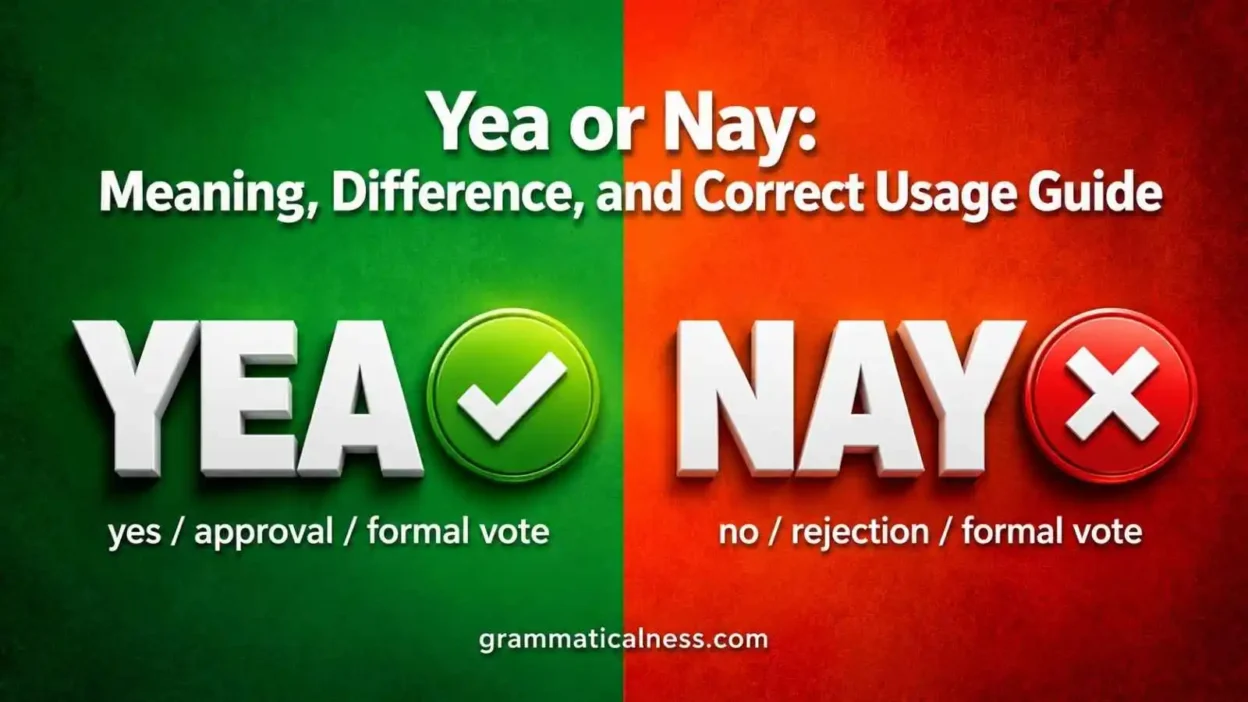
“Yea or nay” is a formal way to ask for a clear yes-or-no choice. The words are short, but they can confuse readers because they sound old-fashioned and are easy to mix up with casual words like “yeah” or excited words like “yay.”
The main difference is simple: yea means a yes vote, and nay means a no vote. You will usually see them in voting, official decisions, board meetings, committees, and formal writing.
Quick Answer
Use yea when someone supports, approves, or votes yes.
Use nay when someone rejects, opposes, or votes no.
Correct:
- The council recorded six yeas and three nays.
- Each board member must vote yea or nay.
- She voted yea on the proposal.
- He voted nay because he opposed the change.
For everyday conversation, yes and no sound more natural than yea and nay.
Why People Confuse Them
People confuse yea and nay because both words are mostly used in special situations. Many readers do not see them often outside voting records, formal meetings, or old-style writing.
Another reason is sound. Yea is pronounced like “yay,” so writers sometimes choose the wrong spelling. But yea is the voting word. Yay expresses excitement, as in “Yay, we won!”
Nay is easier to understand because it clearly points to no, refusal, or opposition. Still, it sounds formal, so it can feel strange in casual speech.
Key Differences At A Glance
| Context | Best Choice | Why |
| Voting yes | yea | It means an affirmative vote. |
| Voting no | nay | It means a negative vote. |
| Formal decision record | yea / nay | Both fit official vote language. |
| Casual conversation | yes / no | These sound more natural today. |
| Excitement or celebration | not yea | Use a different word for cheering, not the vote word. |
| Refusing a proposal | nay | It shows opposition or a negative vote. |
Meaning and Usage Difference
Yea means “yes” in a formal or voting sense. It can be used as a response, but it is most natural when someone is casting or recording a vote.
Example:
- The members who supported the plan voted yea.
Nay means “no” in the same kind of setting. It marks a negative vote or a refusal.
Example:
- The members who opposed the plan voted nay.
Pronunciation is useful here because the words are often read aloud in meetings. Yea sounds like “yay.” Nay rhymes with “day.” Even though yea sounds like a cheering word, it is not used to cheer in formal writing.
Compact comparison:
- yea = yes, approval, support, affirmative vote
- nay = no, refusal, opposition, negative vote
- yea or nay = yes or no, especially in a clear decision
Tone, Context, and Formality
Both yea and nay sound formal, official, or old-fashioned. They are not wrong, but they are not the normal choice for everyday speech.
Natural formal use:
- The committee asked for a yea-or-nay vote.
- The clerk counted 12 yeas and 4 nays.
Less natural casual use:
- Do you want pizza, yea or nay?
That casual sentence is understandable, but it sounds playful or dramatic. In regular speech, most people would say:
- Do you want pizza, yes or no?
Use yea and nay when the setting calls for a recorded choice, a formal decision, or a deliberate yes-or-no contrast.
Which One Should You Use?
Choose yea when the answer is yes, the vote is in favor, or the person supports the idea.
Choose nay when the answer is no, the vote is against, or the person rejects the idea.
Use the full phrase yea or nay when asking someone to make a clear decision.
Examples:
- We need a yea or nay by Friday.
- The chair asked each member to answer yea or nay.
- My vote is yea.
- Her vote was nay.
For normal messages, emails, and daily questions, choose yes or no instead.
When One Choice Sounds Wrong
Yea sounds wrong when the meaning is no.
Wrong:
- He voted yea because he opposed the rule.
Better:
- He voted nay because he opposed the rule.
Nay sounds wrong when the meaning is approval.
Wrong:
- She voted nay to support the project.
Better:
- She voted yea to support the project.
The words also sound wrong when the tone is too casual.
Awkward:
- Are you coming to lunch, yea or nay?
Better:
- Are you coming to lunch, yes or no?
The casual version is not impossible, but it sounds like the speaker is joking, being dramatic, or copying meeting language.
Common Mistakes (and Quick Fixes)
A common mistake is using yay when the meaning is a yes vote.
Wrong:
- The board voted yay.
Better:
- The board voted yea.
Another mistake is using nay as a normal everyday no in serious modern writing.
Stiff:
- Nay, I cannot attend the meeting.
Better:
- No, I cannot attend the meeting.
A third mistake is treating yea and nay as casual agreement words. They are better for clear choices, especially votes.
Weak:
- I’m a yea on getting coffee.
Better:
- I’m in favor of getting coffee.
- I vote yes on coffee.
Everyday Examples
Here are natural examples that show the difference clearly:
- The proposal passed with eight yeas and two nays.
- Please answer yea or nay before the meeting starts.
- The senator voted yea on the bill.
- Three members voted nay, so the motion failed.
- I need a clear yea or nay, not a maybe.
- The committee recorded each yea and nay.
- Her yea helped the policy move forward.
- His nay showed strong opposition to the budget.
- The chair asked, “All those in favor, vote yea.”
- The final count was 20 yeas and 11 nays.
In these examples, yea always points to approval or a yes vote. Nay always points to refusal, opposition, or a no vote.
Dictionary-Style Word Details
Verb
- yea: Not commonly used as a verb in standard US English. Say “vote yea,” not “yea the proposal.”
- nay: Not commonly used as a verb in standard US English. Say “vote nay,” not “nay the proposal.”
Correct:
- The board voted yea.
- Two members voted nay.
Noun
- yea: A yes vote or a person who votes yes.
- nay: A no vote or a person who votes no.
Examples:
- The yeas outnumbered the nays.
- The clerk counted every yea and nay.
- There were 14 yeas and 9 nays.
Synonyms
- yea: closest plain alternatives are “yes,” “approval,” “support,” and “affirmative vote.”
- nay: closest plain alternatives are “no,” “refusal,” “opposition,” and “negative vote.”
Useful opposites:
- The opposite of yea is nay.
- The opposite of nay is yea.
These are strongest as opposites in voting and decision-making contexts.
Example Sentences
- yea: She voted yea because she supported the new policy.
- yea: The amendment received 15 yeas.
- yea: Each member must answer yea or nay.
- nay: He voted nay because he disagreed with the plan.
- nay: The motion failed after too many nays.
- nay: A nay vote means the member is against the proposal.
Word History
- yea: The word goes back to older English forms connected with “yes.” Today, it survives mainly in voting, formal writing, and set phrases.
- nay: The word comes through older forms meaning “no” or negative response. Today, it is most familiar as the opposite of yea in voting.
The exact history is not needed for everyday use. The practical modern point is that yea means a formal yes, and nay means a formal no.
Phrases Containing
- yea or nay: a clear yes-or-no choice.
- vote yea: vote yes or in favor.
- vote nay: vote no or against.
- the yeas and nays: the yes votes and no votes.
- say yea or nay: give a clear decision.
Examples:
- Give me a yea or nay by noon.
- The report lists the yeas and nays.
- The committee will vote yea or nay today.
FAQs
“Yea or nay” means yes or no. It asks someone to make a clear choice, often in a vote, meeting, or formal decision.
The correct phrase is yea or nay. Yea means a yes vote. Yay is used to show excitement, like “Yay, we won!”
Yes. Yea means yes, especially in formal voting or official decisions. For example, “She voted yea” means she voted yes.
Yes. Nay means no, especially as a negative vote. For example, “He voted nay” means he voted no.
Use yea when someone supports, approves, or votes in favor of something. It is most common in formal voting language.
Use nay when someone rejects, opposes, or votes against something. It is the formal opposite of yea.
Yes. Yea or nay sounds formal, official, or old-fashioned. In everyday conversation, yes or no usually sounds more natural.
You can, but it may sound playful, dramatic, or overly formal. For normal speech, use yes or no instead.
Yea is a formal word meaning yes, especially in voting. Yeah is a casual way to say yes in conversation.
The opposite of yea is nay. Yea means yes or support, while nay means no or opposition.
Conclusion
Yea and nay are both correct, but they mean opposite things. Yea means yes, approval, or an affirmative vote. Nay means no, refusal, or a negative vote.
Use them in formal voting, official decisions, and clear yes-or-no choices. For everyday speech, yes and no usually sound better. When you need the formal pair, remember the simple rule: yea supports; nay opposes.