
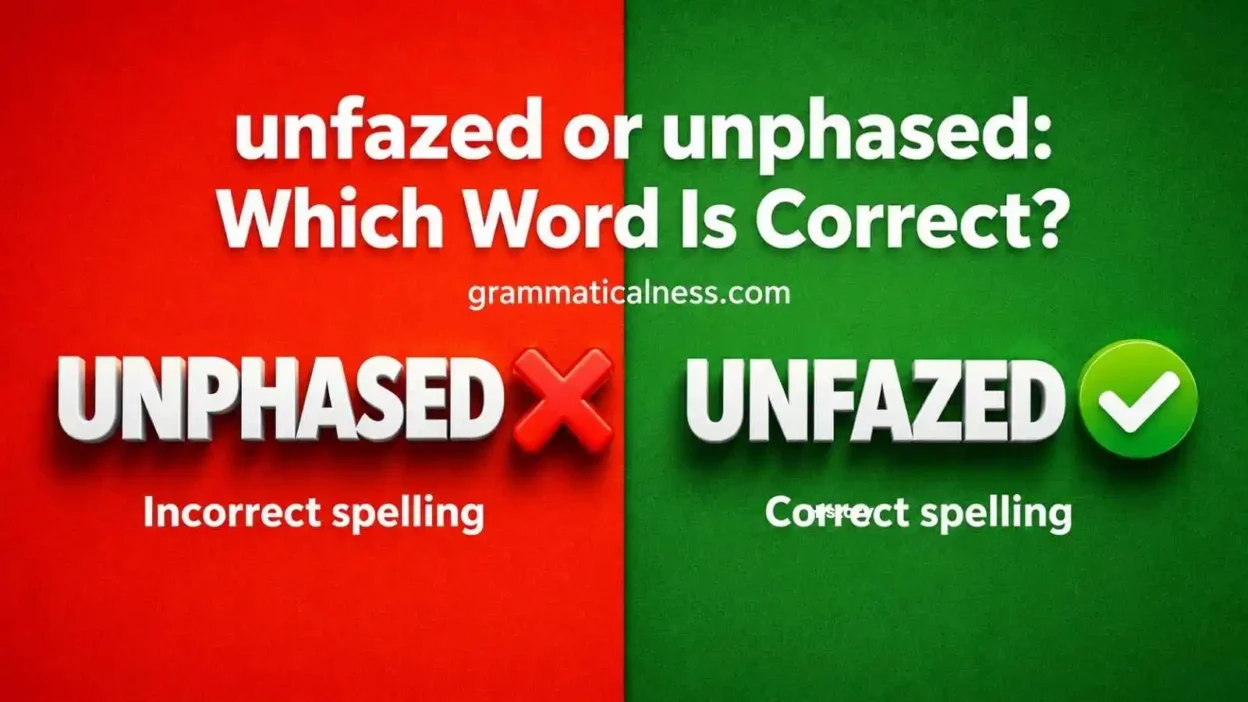
The correct choice is unfazed.
Use unfazed when you mean someone is calm, not bothered, not upset, or not thrown off by a situation.
Unphased is usually a mistake in this meaning. It looks believable because phase is a real word, but phase and faze are different words.
Correct:
She stayed unfazed after the tough feedback.
Incorrect in normal use:
She stayed unphased after the tough feedback.
Quick Answer
Choose unfazed almost every time.
Unfazed means “not disturbed,” “not worried,” or “not affected in a visible way.”
Unphased is not the standard word for that idea. In everyday US English, readers will usually see it as a misspelling of unfazed.
The simple rule:
Use unfazed for emotions, reactions, stress, criticism, surprises, and pressure.
Avoid unphased when you mean “calm” or “not bothered.”
Why People Confuse Them
People confuse these words because fazed and phased sound the same.
That sound makes unphased look possible. It also seems logical because many people know the word phase, as in a stage, step, or period.
But the meaning “bothered or disturbed” comes from faze, not phase.
So the opposite is:
fazed → unfazed
Not:
phased → unphased
That is the main difference.
Key Differences At A Glance
| Context | Best Choice | Why |
| Someone stays calm under pressure | unfazed | It means not bothered or disturbed. |
| A person ignores criticism | unfazed | It describes a reaction or attitude. |
| A team keeps playing after a bad call | unfazed | It fits confidence and composure. |
| A student is not upset by a hard test | unfazed | It describes being steady or calm. |
| A work email about not being affected by changes | unfazed | It is the standard spelling. |
| A technical note about phases | Avoid unless truly phase-related | “Unphased” can confuse readers and is not the emotional word. |
Meaning and Usage Difference
Unfazed is an adjective. It describes someone who is not upset, surprised, or shaken.
Examples:
The manager was unfazed by the last-minute change.
Maya looked unfazed when the projector stopped working.
The crowd got loud, but the quarterback stayed unfazed.
Unphased is not the standard form for this meaning. If you write “unphased by the news,” most careful readers will understand what you meant, but they may also notice the spelling error.
There is one narrow reason the spelling can seem possible: phased relates to phase, as in stages or wave patterns. But that is not the meaning people usually want in phrases like “unfazed by criticism.”
For clear everyday writing, use unfazed.
Compact comparison:
- unfazed: standard adjective meaning calm, not bothered, not disturbed
- unphased: usually a misspelling when used to mean calm or not bothered
- faze: to disturb, worry, or unsettle
- phase: a stage, step, period, or technical state
Tone, Context, and Formality
Unfazed works in casual, professional, academic, and journalistic writing.
It sounds natural in a text message:
I was nervous, but she was totally unfazed.
It also works in a work update:
The support team remained unfazed during the outage.
It can appear in polished writing too:
Despite repeated setbacks, the candidate appeared unfazed.
Unphased does not have the same standing in normal writing. In a resume, school paper, news article, or business email, it will usually look like an error.
Pronunciation is useful here because the two forms sound alike: unfazed is pronounced like “un-FAYZD.” That shared sound is why the spelling mistake is so common.
Which One Should You Use?
Use unfazed when describing a person, group, animal, or even an organization that stays calm or steady.
Good uses:
She was unfazed by the delay.
The dog seemed unfazed by the thunder.
Our team was unfazed by the schedule change.
Use a clearer phrase instead of unphased if you are truly talking about phases.
Instead of:
The system remained unphased.
Write:
The system was not shifted out of phase.
Or:
The rollout was not divided into phases.
That wording avoids confusion.
When One Choice Sounds Wrong
Unphased sounds wrong when the sentence is about feelings, stress, pressure, surprise, or confidence.
Wrong:
He was unphased by the interview questions.
Better:
He was unfazed by the interview questions.
Wrong:
The team looked unphased after falling behind.
Better:
The team looked unfazed after falling behind.
Wrong:
I’m unphased by negative comments.
Better:
I’m unfazed by negative comments.
When the meaning is “not bothered,” unfazed is the word readers expect.
Common Mistakes (and Quick Fixes)
Mistake 1: Using unphased because phase is familiar.
Fix: Remember that faze means disturb. If someone is not disturbed, they are unfazed.
Mistake 2: Treating unfazed as only casual.
Fix: Unfazed is fine in professional writing.
Mistake 3: Writing “unphased by” in a work email.
Fix: Write “unfazed by” when you mean “not bothered by.”
Mistake 4: Using unfazed for objects in a technical phase sense.
Fix: If you mean phase in a technical way, rewrite the sentence with phase clearly.
Everyday Examples
The coach stayed unfazed after the early penalty.
Nina was unfazed by the rude comment and kept presenting.
The barista looked unfazed even with a line out the door.
I thought the noise would scare the cat, but she was completely unfazed.
The new hire seemed unfazed by the busy first week.
The senator appeared unfazed by the tough questions.
The class was unfazed when the fire drill interrupted the quiz.
The app crashed during the demo, but the presenter stayed unfazed.
Dictionary-Style Word Details
Verb
unfazed: Not commonly used as a verb in standard US English. It is used as an adjective.
Example: She seemed unfazed.
unphased: Not commonly used as a verb in standard US English. If a writer needs a verb related to stages, the verb is usually phase, as in “phase in” or “phase out,” not “unphased.”
Noun
unfazed: Not used as a noun in standard US English.
unphased: Not used as a common noun in standard US English.
Synonyms
unfazed: closest plain alternatives include calm, composed, unbothered, untroubled, unshaken, and undisturbed.
Clear antonyms include fazed, shaken, rattled, upset, and disturbed.
unphased: No good everyday synonyms fit when it is used by mistake for unfazed. If the intended meaning is phase-related, use a clearer phrase such as not shifted out of phase, not divided into phases, or unchanged in phase, depending on the context.
Example Sentences
unfazed:
She was unfazed by the tough questions.
The team stayed unfazed after losing the first round.
He seemed unfazed by the long wait.
The nurse remained unfazed during the busy shift.
unphased:
Avoid it when you mean calm or not bothered.
Incorrect: She was unphased by the bad review.
Correct: She was unfazed by the bad review.
Word History
unfazed: The word is formed from un- plus fazed. The base word faze means to disturb, worry, or unsettle.
unphased: This spelling is usually a mix-up with phase. The word phase has meanings about stages, periods, or technical states. That is why unphased may look logical, but it is not the right form for “not bothered.”
Phrases Containing
unfazed:
unfazed by criticism
unfazed by pressure
unfazed by the delay
seemingly unfazed
remain unfazed
stay unfazed
unphased:
No common standard phrase uses unphased to mean calm or not bothered. In everyday writing, phrases like unphased by pressure should be changed to unfazed by pressure.
Still unsure about tricky word choices? Learn the real difference between “deep-seated” and “deep-seeded” to avoid another common writing mistake.
FAQs
Unfazed is the correct word when you mean calm, unaffected, or not disturbed by something. For example, “She remained unfazed by the criticism.” Unphased is far less common and usually appears only in specialized contexts involving phases or stages.
Unfazed means not worried, surprised, confused, or disturbed by a difficult situation. Someone who is unfazed stays calm and composed even when facing pressure, criticism, or unexpected problems. For example, “He seemed unfazed by the sudden change in plans.”
Yes, unphased can be a real word, but it usually does not mean “unbothered.” It may be used in technical contexts to describe something that has not been phased, synchronized, or arranged in phases. In everyday English, unfazed is normally the intended word.
The confusion happens because fazed and phased sound the same. However, they come from different words. Faze means to disturb or unsettle someone, while phase usually refers to a stage, period, or process. Their similar pronunciation often causes spelling mistakes.
You can use unfazed to describe someone who remains calm despite difficulty or surprise. For example, “The speaker was unfazed by the technical problem.” Another example is, “Despite the harsh comments, she remained completely unfazed.”
Fazed means disturbed, bothered, or unsettled. Phased usually means organized, introduced, or completed in stages. For example, “He was fazed by the news” refers to an emotional reaction, while “The project was phased over three years” describes a gradual process.
Conclusion
Use unfazed, not unphased, when you mean calm, steady, or not bothered.
Unfazed is the standard word in US English. It fits people who stay composed during criticism, pressure, bad news, delays, or surprises.
Unphased usually comes from confusing phase with faze. It may look reasonable, but it is not the right choice for emotional calm.
Best rule to remember:
If nothing bothers someone, they are unfazed.