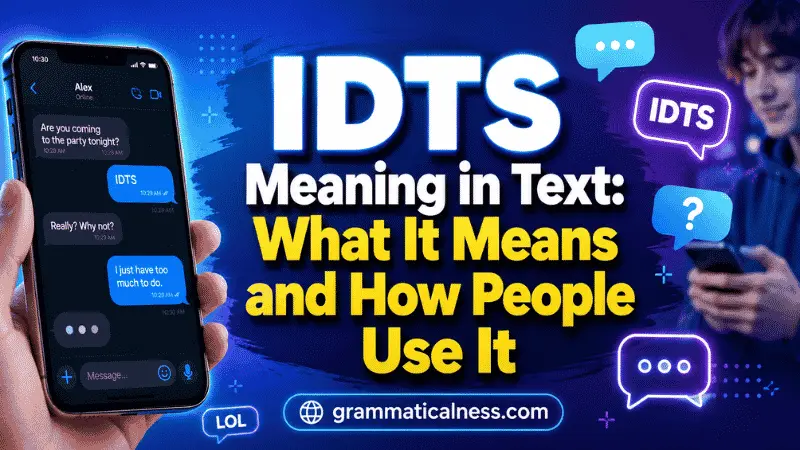
You may see IDTS in a text message, direct message, group chat, or comment. The four-letter reply can look confusing if you have not seen it before. In most casual conversations, it carries one simple idea. The sender does not think something is true, likely, or sensible.
A reply like IDTS can answer a question, challenge a prediction, or soften disagreement. Because short messages provide few tone clues, the same four letters may feel neutral in one conversation and sharp in another.
Knowing what it signals helps you respond more naturally. IDTS can sound uncertain, skeptical, playful, or mildly dismissive depending on context. This guide explains its meaning, common uses, grammar label, examples, similar shortcuts, and situations where clearer wording works better.
Quick Answer
IDTS meaning in text is “I don’t think so.” People use it informally to express doubt, disagreement, uncertainty, or a soft negative response.
TL;DR
• IDTS stands for “I don’t think so.”
• It is mainly used in casual digital conversations.
• The tone can range from uncertain to sarcastic.
• Context determines whether it sounds friendly or dismissive.
• Use the full phrase when clarity matters more.
What Does IDTS Mean in Text?
IDTS stands for “I don’t think so.” It works as a shortened reply when someone doubts a claim, prediction, suggestion, or assumption.
The full phrase often expresses less certainty than a direct “no.” For example, “IDTS” can mean “probably not” when the speaker lacks complete information. Collins similarly connects think with an impression that may not be certain.
Friend: “Do you think Maya is coming tonight?”
You: “IDTS. She said she had to work.”
In another conversation, the same letters may show disagreement.
Friend: “That was definitely the best episode.”
You: “IDTS. I liked last week’s episode more.”
The meaning therefore stays stable, while the conversational purpose changes slightly. It can communicate uncertainty, disagreement, disbelief, or rejection.
What Tone Does IDTS Have?
IDTS is informal and highly dependent on context. A neutral conversation may make it sound like a simple, cautious answer.
Punctuation and surrounding words can change the emotional effect. “IDTS” looks neutral, while “IDTS lol” may sound lighter or more playful.
A short reply can also seem dismissive during a disagreement. Someone who wants a warmer tone can add a reason.
“IDTS, but I could be wrong.”
That version keeps the shorthand while reducing the chance of sounding overly certain. In a tense conversation, the full phrase may be easier to interpret.
Sarcasm is possible, but it is not required. Dictionary.com documents sarcastic use, while other references also emphasize doubt and uncertainty.
How to Use IDTS in Texts, DMs, and Chats
IDTS works best as a response to something already mentioned. The reader needs enough context to understand what the sender doubts.
Common uses include answering a yes-or-no question, questioning a prediction, rejecting a suggestion, or disagreeing with an opinion.
| Context | Example | Likely meaning |
| Uncertainty | “Will the store still be open?” “IDTS.” | Probably not |
| Disagreement | “This one looks better.” “IDTS.” | I disagree |
| Rejection | “Should we leave at midnight?” “IDTS.” | I do not favor that |
| Disbelief | “He finished it in five minutes.” “IDTS.” | I doubt that |
Uppercase “IDTS” and lowercase “idts” usually communicate the same meaning. Wiktionary records lowercase idts as an alternative form.
Lowercase can look more relaxed because casual messages often ignore capitalization.
The abbreviation also appears inside longer replies.
“IDTS we have enough time before class.”
That form is understandable in casual chat. However, “I don’t think we have enough time” is clearer in careful writing.
Is IDTS an Abbreviation, Initialism, or Slang?
IDTS is an abbreviation formed from the first letters of “I don’t think so.” More specifically, it can be described as an initialism.
An initialism uses initial letters to represent a longer expression. IDTS is mainly written rather than spoken aloud in everyday conversation.
People also commonly call IDTS an acronym or texting slang. Dictionary.com uses acronym, while Wiktionary uses the more specific label initialism.
Grammatically, the full expression “I don’t think so” functions as a short response. The word “so” points back to an idea already mentioned. Cambridge documents this short-answer pattern with think.
That structure explains why IDTS usually needs conversational context. Without a previous statement or question, the reply may feel incomplete.
IDTS and Similar Texting Shortcuts
Several texting shortcuts begin with similar letters, so they can be easy to mix up. Their meanings are not interchangeable.
• IDT usually means “I don’t think.”
• IDTS means “I don’t think so.”
• IDK means “I don’t know.”
• IMO means “in my opinion.”
Slang.net places IDT beside IDTS as a related shorthand form.
IDT often needs more words after it, such as “IDT he’ll come.” IDTS can stand alone because the final “S” represents “so.”
IDK expresses lack of knowledge rather than a negative opinion. Someone saying IDTS usually has a tentative view, even if that view is uncertain.
When Not to Use IDTS
Avoid IDTS when the reader may not recognize texting shorthand. The full phrase removes unnecessary guessing.
It is also a poor choice in formal school assignments, resumes, cover letters, official notices, and careful business writing. Current usage references classify IDTS as casual texting language rather than formal prose.
Professional chat can be more flexible, depending on the workplace and relationship. Still, “I don’t think so” or a specific explanation is safer when accuracy matters.
Sensitive conversations also deserve clearer language. If a decision affects money, health, safety, deadlines, or responsibilities, explain what you mean instead of relying on four letters.
Common Mistakes With IDTS
One mistake is treating IDTS as a guaranteed “no.” The full phrase can express uncertainty, so the sender may simply believe something is unlikely.
Another mistake is assuming the abbreviation is always rude. Tone depends on the conversation, punctuation, relationship, and added wording.
Do not confuse IDTS with IDK. “IDK” means the speaker does not know, while “IDTS” expresses a doubtful or negative judgment.
Writers should also avoid forcing IDTS into a sentence where “I don’t think” fits better.
Less natural: “IDTS he is ready, but maybe later.”
Clearer: “IDT he is ready, but maybe later.”
Clearest: “I don’t think he is ready, but maybe later.”
Mini Quiz
- What does IDTS usually stand for in a text message?
- Which reply is clearer in a formal email: “IDTS” or “I don’t think so”?
- A friend asks, “Will the concert sell out?” You reply, “IDTS.” What are you expressing?
- Which abbreviation usually means “I don’t know”: IDTS or IDK?
Answer key:
- “I don’t think so.”
- “I don’t think so.”
- Doubt or uncertainty that it will sell out.
- IDK.
FAQs
IDTS stands for “I don’t think so.” It is a short, informal response used when someone doubts or disagrees with something.
IDTS is not automatically rude. It can sound neutral, playful, skeptical, or dismissive depending on the surrounding conversation.
Adding a short explanation can soften the tone. For example, “IDTS, but I might be wrong” sounds less abrupt.
In casual messages and comments, IDTS usually means “I don’t think so.” Current texting references preserve that meaning across social and messaging contexts.
Context still matters. A joking exchange may make it sound playful, while an argument may make it sound sharper.
Your reply depends on what you asked or claimed. You might say, “Why not?”, “Fair enough,” or provide more information.
If the answer is unclear, ask what the person means. That is better than guessing from tone alone.
IDT usually represents “I don’t think,” while IDTS represents “I don’t think so.” Slang references treat them as related but distinct shorthand forms.
IDTS can often work as a complete reply to a previous question. IDT commonly introduces more information, such as “IDT they’re open yet.”
The letters IDTS can represent other phrases in specialized organizations or technical contexts. Acronym directories list several non-chat expansions.
In ordinary texting and social conversation, “I don’t think so” is the relevant interpretation. Use the surrounding topic to determine which meaning fits.
Conclusion
IDTS meaning in text is straightforward: it usually means “I don’t think so.” The shorthand lets someone express doubt, disagreement, uncertainty, or a soft negative response quickly.
Use it with people who understand casual texting language. When tone or accuracy matters, write the full phrase and add enough context to make your meaning clear.