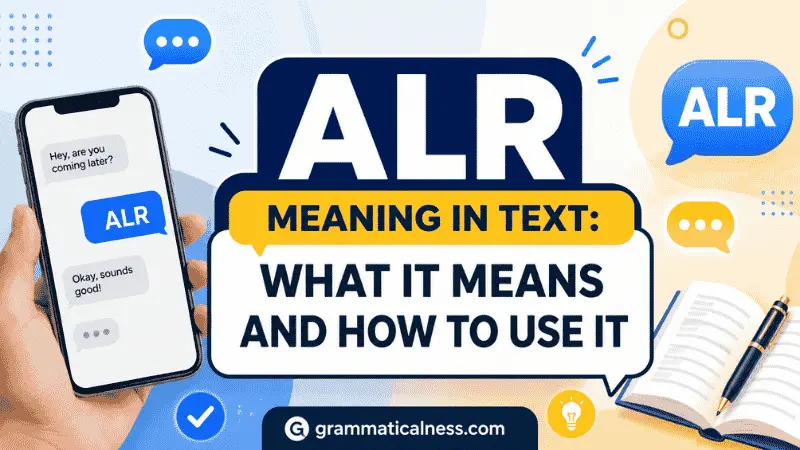
If someone replies with “alr” in a text, the message may look unclear at first. You may see it in group chats, direct messages, comments, or quick replies between friends. In most casual conversations, ALR is a shortened form of “alright.” It can show agreement, acceptance, understanding, or a simple acknowledgment.
Context still matters because ALR can occasionally shorten “already.” The position of the term usually makes the intended meaning easy to identify. A standalone “alr” often means “alright.” In a sentence like “I finished alr,” it may mean “already.”
This guide explains the ALR meaning in text, its common uses, tone, and sentence function. You will also learn when to avoid it and how to read it correctly in different chats.
Quick Answer
ALR meaning in text usually means “alright,” similar to “okay,” “fine,” or “got it.” In some sentences, ALR can also shorten “already,” so context decides the meaning.
TL;DR
• ALR usually means “alright” in casual texting.
• It can show agreement, acceptance, or understanding.
• ALR may occasionally mean “already.”
• Sentence position often reveals the intended meaning.
• Avoid ALR in formal or important messages.
What Does ALR Mean in Text?
In texting, ALR is usually a clipped form of “alright.” A clipping shortens a word while keeping its basic meaning. ALR is not normally an acronym because its letters do not represent separate words.
When ALR means “alright,” it can work like a quick response. It may mean “okay,” “sure,” “that’s fine,” or “I understand.” The exact shade depends on the conversation.
For example:
• “Meet me outside at six.” — “Alr.”
• “I’ll send the notes tonight.” — “Alr, thanks.”
• “We can change the plan.” — “Alr, that works.”
In these examples, ALR acknowledges or accepts the previous message. It is highly informal and belongs mainly in casual digital communication.
How ALR Is Used in Texts and Online Chats
People use ALR for several related purposes. The core meaning often stays close to “alright,” but the conversational job changes.
Agreement: ALR can accept a suggestion or plan.
“Want to grab lunch at noon?” — “Alr.”
Acknowledgment: It can show that you received and understood information.
“Remember to bring your charger.” — “Alr, got it.”
Acceptance: It may signal that something is acceptable, even without enthusiasm.
“We need to leave a little earlier.” — “Alr, that’s fine.”
Conversation closure: A short ALR can help end an exchange.
“I’ll text you tomorrow.” — “Alr, later.”
The term does not carry one fixed emotional tone. A friendly exchange can make it sound relaxed. A tense exchange can make the same reply seem flat.
Can ALR Mean “Already”?
Yes. ALR can sometimes be a clipping of “already,” although “alright” is the usual reading in standalone replies. Lexical references document both uses in internet slang and text messaging.
Sentence position is the easiest clue. If ALR replaces a reply like “okay,” it probably means “alright.” If it describes something completed earlier, “already” may fit better.
Compare these examples:
• “Can you come at eight?” — “Alr.” = “Alright.”
• “I alr sent it.” = “I already sent it.”
• “She knows alr.” = “She knows already.”
• “Alr, I’ll call you later.” = “Alright, I’ll call you later.”
Do not assume every ALR means the same thing. Read the whole sentence before deciding.
How Tone and Context Change ALR
ALR is usually neutral by itself. However, short replies can feel warmer or colder depending on punctuation, surrounding words, and the relationship.
“Alr!” can sound upbeat or energetic. “Alr 👍” may feel friendly and confirming. A plain “alr” often sounds casual and neutral.
“Alr.” can feel more final in some conversations. “Alr…” may suggest hesitation, annoyance, or uncertainty. Those readings are not guaranteed, because punctuation habits differ.
Capitalization usually does not change the basic meaning. “ALR,” “Alr,” and “alr” can all represent the same shorthand. Lowercase forms often match the relaxed style of everyday messaging.
When to Use ALR—and When to Avoid It
ALR fits best in casual conversations with people who understand texting shorthand. It works well for quick confirmations, simple agreement, and low-stakes replies.
You might use it when texting a friend about plans. It can also fit a relaxed group chat or a casual direct message. In those settings, the shortened form usually feels natural.
Avoid ALR when clarity or professionalism matters. A complete response is safer in school assignments, job applications, formal emails, or important workplace messages.
Instead of “alr,” choose a clearer phrase that matches your purpose:
• “Okay, I understand.”
• “That works for me.”
• “Yes, I can do that.”
• “Understood. Thank you.”
• “I already sent it.”
These versions reduce ambiguity. They also make your tone easier to read.
ALR Examples in Real Conversations
The best way to understand ALR is to see how context changes its meaning.
Confirming plans
Maya: “Movie starts at 7:30.”
Jordan: “Alr, I’ll be there by 7.”
Here, ALR means “alright” and confirms the plan.
Accepting a change
Chris: “Can we move the call to tomorrow?”
Devon: “Alr, no problem.”
The reply shows acceptance without needing a longer answer.
Acknowledging information
Ava: “The door code is 4821.”
Sam: “Alr, got it.”
ALR means the message was received and understood.
Meaning “already”
Leo: “Did you tell Nina?”
Rae: “Yeah, I alr told her.”
Here, ALR means “already” because it modifies “told.”
Sounding brief
Taylor: “I really hoped you could come.”
Morgan: “Alr.”
The reply may feel distant because the message calls for more empathy. The word itself is not automatically rude.
Mini Quiz
Choose the best meaning or usage.
- “Meet me at the café at four.” — “Alr.” What does ALR mean?
- In “I alr finished,” what does ALR most likely mean?
- Is ALR usually suitable for a formal job application?
- Which is clearer for work: “Alr” or “Understood, thank you”?
Answer key:
- Alright or okay.
- Already.
- No.
- “Understood, thank you.”
FAQs
On Snapchat, ALR usually means “alright” or “okay.” It often appears in quick replies that confirm plans or acknowledge a message.
ALR is not inherently rude. However, a one-word reply can feel abrupt when the other person expects a fuller response.
It can represent either word in informal writing. “Alright” is usually the better reading for a standalone reply, while sentence context may signal “already.”
Usually, no. In texting, ALR is better described as a shortened or clipped spelling because it comes from one word.
It is better to avoid ALR in formal communication. Use a complete phrase such as “okay,” “understood,” or “that works for me.”
On TikTok, ALR most often means “alright.” It may appear in comments, captions, or messages as a quick sign of agreement or acknowledgment.
The basic meaning does not depend on the sender’s gender. Read the surrounding message, tone, and sentence position instead of assuming a hidden gender-specific meaning.
Your reply depends on the conversation. You can continue with the next detail, say “great,” or end the chat if everything is settled.
Conclusion
The ALR meaning in text is usually “alright,” especially in short replies and casual chats. It can also mean “already” when the sentence clearly points to that meaning.
Check the surrounding words before interpreting it. When the situation is formal or important, use a complete word or phrase instead.