

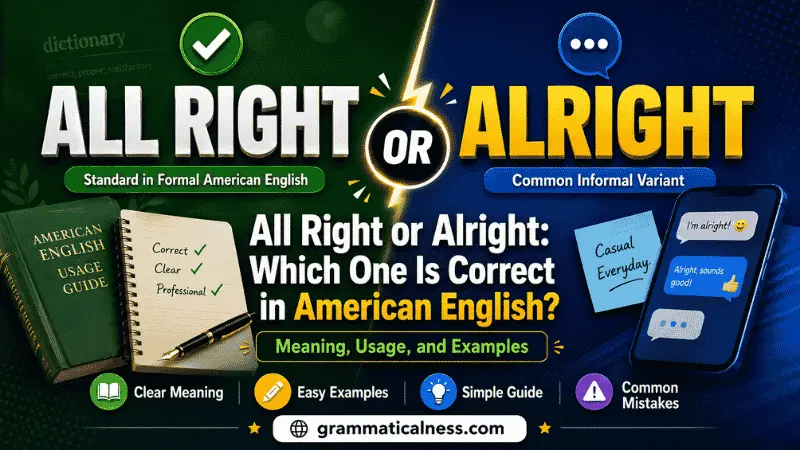
All right and alright usually communicate the same basic ideas. They can describe something as acceptable, say that a person is safe or well, show agreement, or introduce a new point in conversation.
The difference is mainly acceptance and context. All right is the older, standard two-word form. Alright is a common one-word variant, especially in casual writing and dialogue, but some teachers, editors, and publications still reject it.
One meaning also requires all right: when all means “every one” and right means “correct.”
Quick Answer
Use all right in formal, academic, professional, and edited writing. It is accepted in every context where alright means okay, fine, safe, or satisfactory.
Alright is common in texts, dialogue, lyrics, and relaxed writing. Many readers accept it, but others still view it as informal or nonstandard.
The safest rule is simple: when uncertain, choose all right.
Why People Confuse Them
The two forms sound the same in normal speech, so pronunciation does not help writers choose between them. Alright also looks natural beside closed compounds such as already and altogether.
Modern communication adds to the confusion. People often see alright in messages, fiction, headlines, and entertainment titles, while teachers and editors may continue to require all right.
This is a usage and style issue more than a difference in everyday meaning.
Key Differences At A Glance
- All right: The standard two-word form and the safest choice in every type of writing.
- Alright: A common one-word variant that creates a more casual or conversational impression.
- Shared use: Both can mean acceptable, safe, well, satisfactory, or agreed.
- Unique use of all right: It can literally mean that every item is correct.
Meaning and Usage Difference
All right can function as an adjective, adverb, or interjection-like expression.
As an adjective, it can describe a condition or quality: “The patient is all right now” or “The presentation was all right.” In the first sentence, it means safe or well. In the second, it means acceptable but not outstanding.
As an adverb, it describes how something happens: “The new employee handled the call all right.” Here, it means adequately or satisfactorily.
At the start of a sentence, it can show agreement, resignation, or a transition: “All right, let’s review the final draft.”
Alright can perform those same roles in casual usage. However, it cannot clearly replace the separate words when all modifies a group: “Maya got the questions all right” means every answer was correct. “Maya did alright” means her overall performance was acceptable.
Tone, Context, and Formality
All right is neutral. It works in a text message, school assignment, business email, report, or novel.
Alright usually feels more relaxed. It often appears in dialogue and personal messages because it matches the smooth way the expression sounds in speech.
The one-word form is not meaningless or rare, but its acceptance is uneven. A reader may accept it without hesitation, while an editor may change it. Choose all right when credibility, consistency, or house style matters.
Which One Should You Use?
| Context | Best Choice | Why |
| School assignment | All right | It is the standard, broadly accepted form. |
| Professional email | All right | It avoids an unnecessary style objection. |
| Report or formal document | All right | Edited writing usually favors the two-word form. |
| Casual text message | Either | Both are easily understood in relaxed communication. |
| Fictional dialogue | Either | Alright may support an informal voice, depending on style. |
| Meaning “every one correct” | All right | The two separate words carry a literal grammatical meaning. |
When One Choice Sounds Wrong
Alright sounds out of place when the sentence means every person, answer, direction, or item is right.
Correct: “The students were all right about the deadline.”
This can mean every student was correct. Writing “The students were alright” changes the message to say the students were safe, well, or generally acceptable.
All right rarely sounds wrong. It may look slightly more traditional in highly casual dialogue, but it remains correct. Alright becomes risky when the setting expects standard edited English or when the two separate words carry their literal meanings.
Common Mistakes (and Quick Fixes)
Mistake: Treating alright as more correct because it is one word.
Quick fix: Use all right as your default.
Mistake: Claiming alright always has a different meaning.
Quick fix: Recognize that the forms usually overlap when they mean okay or satisfactory.
Mistake: Using alright for “every item correct.”
Quick fix: Keep the words separate: “I got the answers all right.”
Mistake: Writing allright.
Quick fix: Choose either all right or, in a casual setting, alright.
Mistake: Switching forms randomly.
Quick fix: Follow one consistent style unless the literal meaning requires all right.
Everyday Examples
- “Is everyone all right after the storm?”
- “The mechanic said the brakes looked all right.”
- “All right, I’ll send the revised file this afternoon.”
- “Jordan did all right during the first week of training.”
- “The restaurant was all right, but the service was slow.”
- “Alright, who wants to go first?”
- “I’m alright now; I just needed a few minutes.”
- “The concert was alright, though the opening act was better.”
- “She checked the quiz and found that her answers were all right.”
- “We tested every switch, and they were all right.”
The last two examples require the separate words because all refers to every answer or switch.
Dictionary-Style Word Details
Verb
- All right: Not commonly used as a verb in standard US English.
- Alright: Not commonly used as a verb in standard US English.
Use a real verb such as approve, accept, recover, or manage when the sentence requires an action.
Noun
- All right: Not normally used as a noun in this comparison.
- Alright: Not normally used as a noun in standard US English.
Both forms mainly work as adjectives, adverbs, or conversational expressions.
Synonyms
- All right: Closest plain alternatives include okay, fine, acceptable, satisfactory, adequate, safe, and well.
- Alright: The same alternatives apply when alright means okay, acceptable, or well.
The best opposite depends on meaning. Possible opposites include unacceptable, wrong, unsafe, unwell, or unsatisfactory. No single opposite fits every use.
Example Sentences
- All right: “Your schedule looks all right to me.”
- All right: “Did the package arrive all right?”
- All right: “All right, we can discuss it tomorrow.”
- Alright: “The trip went alright despite the rain.”
- Alright: “Alright, I understand your concern.”
- Alright: “She felt alright after resting.”
Word History
All right is the older expression. It developed from the ordinary words all and right and became established as a way to express correctness, safety, agreement, or satisfactory condition.
Alright appeared later as a closed-up spelling. It has remained common for generations, especially in informal writing, but acceptance has never been completely uniform.
Phrases Containing
- All right: all right with me, doing all right, feeling all right, all right already, everything is all right.
- Alright: doing alright, feeling alright, everything is alright, alright already.
These combinations often share the same meaning. Use the two-word versions when the setting calls for standard or carefully edited writing.
FAQs
Yes, alright appears in dictionaries and is common in everyday writing. However, some dictionaries and many editors still label it informal or nonstandard. Use all right when you need the form least likely to be questioned.
They are interchangeable when they mean okay, acceptable, safe, or satisfactory. They are not interchangeable when all right literally means every item is correct, as in “She got the answers all right.” Alright would change that meaning.
Yes, all right is the better choice in a professional email. It is standard, familiar, and accepted across edited contexts. Alright may look too casual or may be corrected, even though the reader will understand it.
It is widely understood and common in casual communication. Still, “Are you all right?” is the safer standard form, especially in school, workplace, medical, or published writing. Both versions ask whether someone is safe, healthy, or emotionally okay.
Yes, alright can fit dialogue, texts, and other relaxed writing because it reflects common modern usage. The choice can also support a conversational voice. Keep all right when a publisher, teacher, or house style requires it.
No, all right often means acceptable, fine, safe, or satisfactory rather than perfect. Context decides the meaning. In “The report is all right,” it suggests adequacy. In “The answers are all right,” it may mean every answer is correct.
Conclusion
All right is the best default for US writers. It is standard, versatile, and accepted in formal and informal settings.
Alright is a well-established casual variant, not a different word with a dependable separate meaning. Use it when an informal voice fits and no style rule prohibits it.
Remember the one firm distinction: when all means “every one,” write all right as two words.