
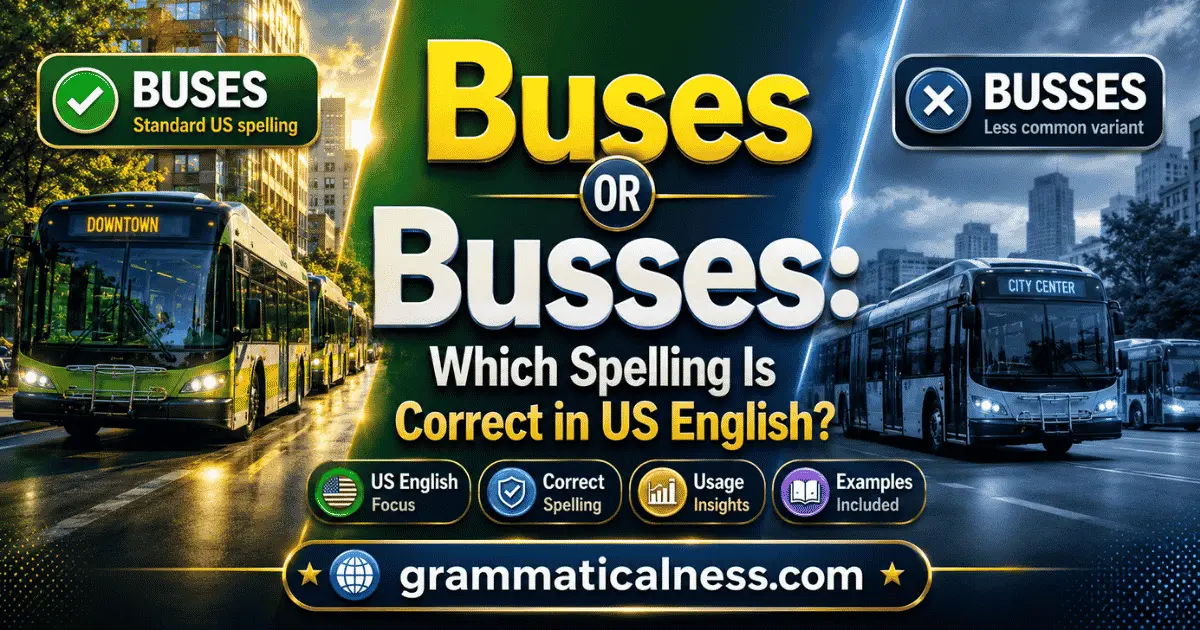
When you mean more than one bus, the best spelling in modern US English is buses.
You may still see busses, and major dictionaries do recognize it as an alternate plural of bus. However, it is now uncommon enough that many readers may assume it is a spelling mistake. her reason the choice can be confusing. Busses can also come from the separate word buss, which means a kiss or the act of kissing. That means the two forms sometimes overlap in grammar but do not always represent the same word. er
Use buses when you mean more than one bus:
Three buses arrived at the station.
For transportation, school vehicles, shuttle service, or technical uses of the noun bus, buses is the clear modern choice.
Busses is technically accepted by some major dictionaries as an alternate plural of bus, but it is rare. It can also be the plural or verb form of buss, meaning “kiss.” le is simple: write buses for transportation.
Why People Confuse Them
The confusion starts with spelling. Because bus ends in s, some writers expect the final consonant to double before adding -es. That makes busses look logical.
Historically, both plural spellings competed with each other. Merriam-Webster notes that buses eventually became dominant and that busses survived as a recognized but increasingly uncommon variant. e of confusion is buss.
Buss is a separate English word meaning kiss. Its regular plural is busses, and as a verb, busses can mean “kisses.”
So this sentence involves transportation:
The buses leave every 20 minutes.
But this rare use involves kissing:
He busses her on the cheek before leaving.
The words sound alike, which makes context especially important.
Key Differences At A Glance
| Context | Best Choice | Why |
| More than one passenger bus | buses | Standard modern plural |
| School transportation vehicles | buses | Normal US usage |
| City or shuttle vehicles | buses | Clear and familiar |
| More than one computer or electrical bus | buses | Standard plural remains the safest form |
| Third-person verb meaning transports by bus | buses | Standard form of the verb bus |
| Third-person verb meaning clears restaurant tables | buses | Standard US form |
| Rare alternate plural of bus | busses | Dictionary-recognized but uncommon |
| Plural of buss, meaning kiss | busses | Belongs to the separate word buss |
| Verb meaning kisses | busses | Third-person singular of buss |
Compact comparison:
- Buses: the standard modern plural of bus and also a form of the verb bus.
- Busses: a rare alternate plural of bus and also a form of buss, meaning “kiss.”
- Best everyday choice for transportation: buses.
Major dictionaries record the alternate transportation plural, but current usage strongly favors buses. d Usage Difference
The main difference is not that one form is always correct and the other is always wrong.
Buses is the normal plural of the noun bus.
The city added ten electric buses.
Two school buses were waiting outside.
It can also be the third-person singular form of the verb bus. The verb may refer to transporting people by bus or, in US usage, clearing dishes from restaurant tables. t buses students from several neighborhoods.
She buses tables during the dinner shift.
Busses has two possible explanations.
First, dictionaries may recognize it as an alternate plural of bus:
Several busses were parked nearby.
That sentence is not necessarily grammatically wrong. Still, buses is much more natural for a modern US audience. ses** can come from buss, a separate noun and verb meaning “kiss.”
She gave the child two quick busses.
He busses his grandmother on the cheek.
Those uses are valid, although kiss is more familiar in ordinary modern conversation. ext, and Formality
For transportation, buses is neutral and standard. It fits casual writing, schoolwork, journalism, business communication, transportation notices, and formal documents.
Replacement buses will operate during construction.
Nothing about that spelling feels unusual.
Using busses for vehicles can create a different reaction. Although dictionaries still recognize it, its rarity may make readers pause or assume that the writer added an unnecessary s. Merriam-Webster specifically notes that the form has become rare enough to look erroneous to many people. on, dictionary acceptance and practical preference are not the same thing.
In modern US writing:
Accepted: busses as an alternate plural of bus
Preferred: buses
When busses comes from buss meaning “kiss,” the issue is not formality so much as familiarity. The word exists, but kiss is usually clearer to a general audience.
Which One Should You Use?
Choose buses whenever you are talking about transportation vehicles.
Write:
The buses are running late.
We rented two buses for the conference.
Several school buses lined up outside the stadium.
The same recommendation applies when bus has a technical meaning, such as a computer or electrical pathway. Merriam-Webster records those meanings under the same noun bus, whose normal plural is buses. ses** for the standard third-person form of the verb bus:
The hotel buses guests to the airport.
Marcus buses tables on weekends.
Use busses when you specifically intend the separate word buss, meaning a kiss or the act of kissing:
In the scene, the character busses her partner on the cheek.
You may encounter busses meaning several transportation vehicles, and dictionaries support that interpretation. Still, choosing buses avoids distraction and ambiguity.
When One Choice Sounds Wrong
Busses often looks wrong when the sentence clearly concerns transportation:
Less natural: The school purchased five new busses.
Better: The school purchased five new buses.
The first version can be defended as a dictionary-listed variant, but the second matches normal modern usage.
The reverse problem appears when busses comes from buss.
Suppose you mean kisses:
She gave the baby several busses.
Changing that to:
She gave the baby several buses.
would create a completely different meaning.
Context therefore matters. Buses almost always points readers toward bus. Busses may represent either the rare alternate plural of bus or a form of the separate word buss.
That extra ambiguity is another reason buses is the clearer transportation spelling.
Common Mistakes (and Quick Fixes)
Mistake: Saying busses is never a word
That is too absolute.
Fix: Recognize that dictionaries list busses as an alternate plural of bus, and busses is also a valid form of buss. eating buses and busses as equally common transportation plurals**
They are not equally natural in current writing.
Fix: Use buses as the default transportation plural.
Mistake: Assuming busses always refers to vehicles
It can also relate to kissing.
Fix: Check the base word. Bus normally becomes buses. Buss, meaning “kiss,” becomes busses.
Mistake: Writing bus’s when you mean several buses
An apostrophe normally marks possession, not an ordinary plural.
Plural: The buses arrived.
Possessive: The bus’s door was broken.
Mistake: Doubling the s automatically
English spelling does not require bus to become busses in normal modern plural use.
Fix: Memorize the standard pair:
one bus → two buses
Everyday Examples
Here are natural examples showing how the choice works.
Transportation
The buses stop running after midnight.
We watched three buses pull into the terminal.
School
The district purchased six new school buses.
Parents waited while the buses arrived.
Travel
Shuttle buses connect the airport with nearby hotels.
Tour buses were parked outside the museum.
Public service
Extra buses will run during the holiday weekend.
The city plans to replace older diesel buses.
Verb: transporting
The organization buses volunteers to the event each morning.
Verb: restaurant work
Jordan buses tables after school.
Rare alternate transportation spelling
The company owns several busses.
This form may be recognized, but buses would be more natural.
Buss meaning kiss
In the story, the child busses his mother on the cheek.
Here, busses does not refer to transportation.
Dictionary-Style Word Details
Verb
buses: Can be the third-person singular form of bus. It can mean transporting people by bus or, in US usage, clearing dishes from tables.
The hotel buses guests downtown.
She buses tables on Friday nights.
Merriam-Webster records bus as both a noun and verb. an be the third-person singular form of buss, meaning “kisses.”
He busses the child on the forehead.
Dictionaries also recognize doubled-s inflections connected with bus, but for ordinary transportation writing, the single-s forms are clearer and more familiar. uses:** The standard plural of bus.
Three buses were delayed by traffic.
This applies to passenger vehicles and other established noun senses of bus, including technical uses. an be a rare alternate plural of bus.
Several busses were parked outside.
It can also be the plural of buss, meaning kisses:
She gave her children several good-night busses.
The transportation sense is recognized but uncommon; the kiss sense belongs to a separate word.
buses: Exact synonyms are limited because different types of buses have different functions. Closest plain alternatives, depending on context, include coaches, shuttles, and transit vehicles.
These are not always interchangeable. For example, a coach usually suggests a particular type of passenger vehicle.
busses: When used as an alternate plural of bus, the same closest alternatives may apply.
When busses is the plural of buss, the closest direct alternative is kisses.
There is no useful single antonym for either transportation buses or busses meaning kisses.
Example Sentences
buses
The buses arrive every fifteen minutes.
Two buses took the team to the tournament.
Our hotel buses guests to the airport.
Maya buses tables at a neighborhood restaurant.
busses
The older document spells the plural as busses.
Although busses is recognized as a variant, buses is clearer today.
In the novel, the child busses his father on the cheek.
The affectionate busses made the toddler laugh.
Word History
buses: The base word bus developed as a shortened form of omnibus. Merriam-Webster records bus in this transportation sense from the nineteenth century. ellings buses and busses once competed more closely. Merriam-Webster reports that buses moved ahead in frequency in the twentieth century and eventually became the overwhelming modern choice. Its dictionaries preferred busses until 1961 before shifting preference. hen it represents buss, meaning “kiss,” it comes from a separate and much older word. Merriam-Webster gives its origin cautiously as perhaps an alteration of Middle English bassen, meaning “to kiss.” of bus and buss should therefore not be treated as one simple spelling story.
Phrases Containing
buses:
- school buses
- city buses
- shuttle buses
- tour buses
- electric buses
- buses run regularly
- buses arrive and depart
These are natural modern combinations when referring to transportation.
busses:
No common modern fixed transportation phrase requires busses. When referring to vehicles, phrases such as school buses, city buses, and shuttle buses are normally written with buses.
When busses comes from buss, possible constructions include:
- busses on the cheek
- gives someone busses
- busses someone goodbye
Because buss is much less familiar than kiss, many writers would choose kisses instead for maximum clarity.
FAQs
Both spellings can be correct, but buses is the standard and strongly preferred plural of bus in modern US English. Busses is still recognized as an alternate plural, but it is uncommon and may look like a spelling mistake to many readers.
The normal plural of bus in American English is buses. For example, write school buses, city buses, tour buses, and shuttle buses. This spelling is the clearest choice for everyday, academic, business, and professional writing.
Yes. Busses is a real word. It can be a rare alternate plural of bus. It can also come from the separate word buss, which means a kiss or the act of kissing. Context determines which meaning applies.
Write school buses. Although school busses may be technically recognized because busses can be an alternate plural, school buses is the normal modern spelling and will look more natural to American readers.
Yes. Buses can be a verb. It may mean transporting people by bus, as in “The district buses students to school.” In American English, it can also refer to clearing dishes from restaurant tables.
Both plural forms existed historically, but buses became the dominant modern spelling. Today, busses is much less common for transportation and may cause unnecessary confusion because it is also connected with buss, meaning “kiss.” For clear modern writing, buses is usually the best choice.
Conclusion
For modern US English, buses is the best choice when you mean more than one bus.
Write school buses, city buses, shuttle buses, and tour buses. Also use buses as the standard third-person verb form in sentences such as “The hotel buses guests downtown.”
Busses is not automatically incorrect. Major dictionaries still recognize it as an alternate plural of bus, but it is rare in current transportation writing. It can also come from the separate word buss, meaning “kiss.” ule you can confidently follow: when you mean transportation, choose buses.