
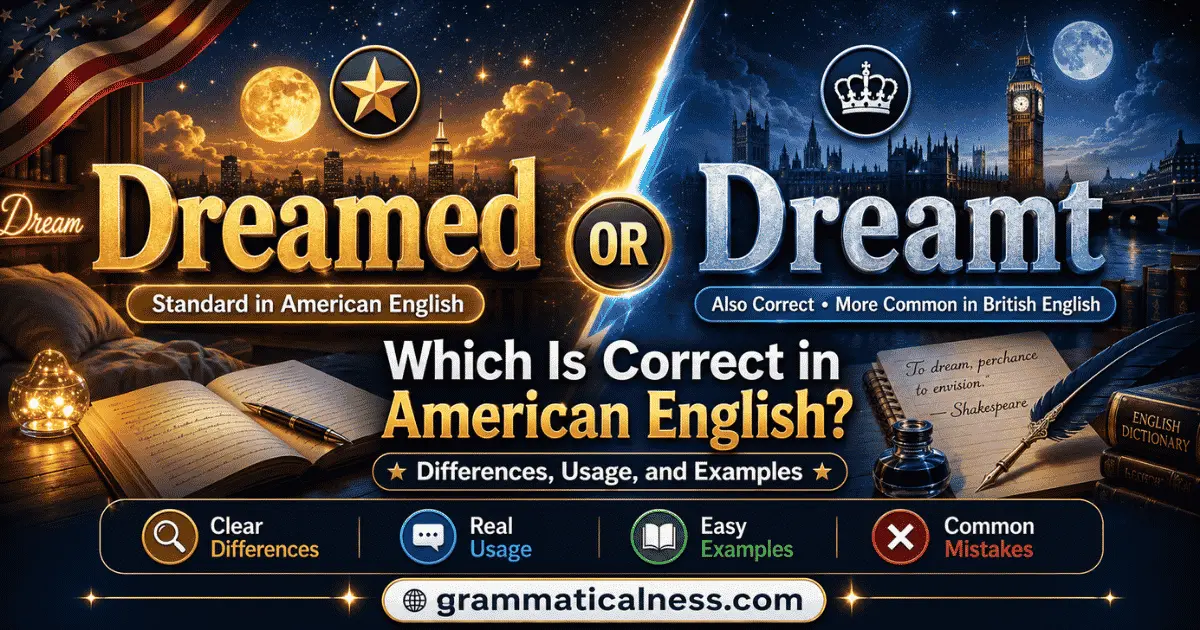
Choosing between dreamed or dreamt can be confusing because both words look like possible past forms of dream. In this case, both really are correct.
The difference is mainly about form and regional preference, not meaning. Dreamed is the regular past form and is the usual choice in American English. Dreamt is an irregular past form that remains correct but is more strongly associated with British English.
For US writing, dreamed is generally the clearest choice.
Quick Answer
Both dreamed and dreamt are correct past-tense and past-participle forms of the verb dream.
Use dreamed for most American English writing:
I dreamed about my childhood last night.
Dreamt has the same basic meaning and is grammatically correct, but it is more common in British English:
I dreamt about my childhood last night.
For a US audience, choose dreamed unless you have a specific reason to use dreamt.
Why People Confuse Them
The confusion comes from the fact that dream has two accepted ways to form its past tense.
Dreamed follows the familiar regular pattern of adding -ed:
dream → dreamed
Dreamt uses an irregular change:
dream → dreamt
Both forms survived in standard English, so this is not a case where one word is correct and the other is a mistake.
Regional habits make the choice seem more complicated. American speakers and writers normally favor dreamed, while dreamt appears more naturally in British English.
Key Differences At A Glance
| Context | Best Choice | Why |
| General American English | dreamed | Most expected US form |
| US school or professional writing | dreamed | Natural and consistent for American readers |
| British English | dreamt or dreamed | Both occur, with dreamt strongly established |
| Simple past | dreamed or dreamt | Both are grammatically correct |
| Past participle | dreamed or dreamt | Both can follow have, has, or had |
| Meaning during sleep | either | No required meaning difference |
| Hopes or imagined possibilities | either | Both forms can express this sense |
The central contrast is simple:
- Dreamed: regular past form; preferred in American English.
- Dreamt: irregular past form; also correct, but less usual in American English and more closely associated with British usage.
Meaning and Usage Difference
There is no basic meaning difference between dreamed and dreamt. They are alternative past forms of the same verb.
Both can describe mental experiences during sleep:
I dreamed that I missed my flight.
I dreamt that I missed my flight.
They can also describe hopes, ambitions, or imagined possibilities:
She dreamed of opening her own bakery.
She dreamt of opening her own bakery.
Likewise, both can work as past participles:
I have dreamed about that place before.
I have dreamt about that place before.
The grammar is valid in each example. For American readers, however, the versions with dreamed usually sound more familiar.
Do not create a false rule that dreamed must refer to sleep while dreamt must refer to hopes, or vice versa. English does not require that distinction.
Tone, Context, and Formality
Neither word is inherently more formal than the other.
In American English, dreamed usually sounds neutral and ordinary. It works naturally in conversation, school assignments, news writing, business communication, fiction, and personal writing.
Dreamt may stand out more to a US reader because it is less typical in American usage. Depending on the context, it may sound British, traditional, or stylistically marked.
That does not make dreamt incorrect or automatically more literary. The main issue is audience expectation.
Compare:
I dreamed about moving to California.
This sounds completely ordinary in American English.
I dreamt about moving to California.
This is also correct, but many US readers will notice the less familiar form.
Which One Should You Use?
For a US audience, use dreamed as your default.
Choose it for sentences about sleep:
I dreamed about the ocean last night.
Use it for ambitions:
She dreamed of becoming a veterinarian.
Use it as a past participle:
We had dreamed about taking this trip for years.
You can use dreamt without making a grammatical error. It may be appropriate when following British usage, preserving an author’s voice, or writing in a context where that form feels natural.
The safest practical rule is:
American English → dreamed
British English → dreamt or dreamed
Consistency also matters. In a polished piece of writing, avoid switching randomly between the two forms unless there is a clear reason.
When One Choice Sounds Wrong
Because both forms are standard, dreamt is rarely grammatically wrong simply because dreamed could replace it.
Still, context affects what sounds natural.
In ordinary US writing:
I dreamed about you last night.
usually sounds more natural than:
I dreamt about you last night.
The second sentence remains correct. It simply uses a form that is less expected for many American readers.
Problems arise when writers treat the two words as having separate mandatory meanings.
Incorrect rule:
Use dreamed only for sleep and dreamt only for ambitions.
Better rule:
Both forms can express either meaning; regional usage is the main practical difference.
Another error is using the base verb where a past participle is required:
Incorrect: I have dream about this before.
Correct: I have dreamed about this before.
Also correct: I have dreamt about this before.
Common Mistakes (and Quick Fixes)
Mistake: Assuming dreamt is incorrect
Dreamt is a legitimate past-tense and past-participle form.
Quick fix: Use dreamed for standard US style, but do not label dreamt as ungrammatical.
Mistake: Inventing a meaning difference
Some writers assume one form describes sleep while the other describes hopes.
Quick fix: Remember that both can carry the same meanings.
Mistake: Thinking dreamt is always more formal
Regional preference does not equal formality.
Quick fix: Choose according to audience and style rather than assuming dreamt is more sophisticated.
Mistake: Using the wrong tense structure
I have dreamed of this moment.
I have dreamt of this moment.
Both are correct because each can function as a past participle.
Mistake: Switching forms randomly
A paragraph that repeatedly changes between dreamed and dreamt can feel inconsistent.
Quick fix: Pick one form for your audience and use it consistently.
Everyday Examples
Here are natural examples with dreamed, the preferred choice for most US contexts:
I dreamed that I was back in high school.
Maya dreamed about visiting New York during the holidays.
He dreamed of owning a small cabin in Colorado.
We had dreamed about this vacation for years.
I never dreamed the project would become so successful.
Who dreamed up this unusual idea?
The same grammar can work with dreamt:
I dreamt that I was flying over the city.
She dreamt about her old neighborhood.
They had dreamt of starting a family business.
I never dreamt that we would meet again.
Who dreamt up that strange plan?
The meanings do not change simply because the past form changes. The main difference is which form sounds more natural to the intended audience.
Dictionary-Style Word Details
Verb
Dreamed: A regular past-tense and past-participle form of dream. It is the standard default choice in American English.
She dreamed about the concert.
She had dreamed about it for months.
Dreamt: An irregular past-tense and past-participle form of dream. It has the same core grammatical functions and meanings but is more strongly associated with British usage.
She dreamt about the concert.
She had dreamt about it for months.
Noun
Dreamed: Not normally used as a noun in this comparison. Here, it functions as a form of the verb dream.
Dreamt: Not normally used as a noun. It is an inflected verb form.
The noun is dream, as in:
I had a strange dream.
Synonyms
Because dreamed and dreamt are forms of the same verb, their closest alternatives depend on the intended meaning.
For imagining or hoping:
- imagined
- envisioned
- fantasized
- pictured
For the sleep-related sense, had a dream may be the closest plain alternative.
I dreamed about flying.
I had a dream about flying.
There is no single exact antonym that works naturally for every meaning of either form.
Example Sentences
Dreamed:
I dreamed about my grandparents last night.
She dreamed of becoming a doctor.
We had dreamed about buying a home near the lake.
Nobody dreamed the small company would grow so quickly.
Dreamt:
I dreamt about my grandparents last night.
She dreamt of becoming a doctor.
We had dreamt about buying a home near the lake.
Nobody dreamt the small company would grow so quickly.
All of these constructions are grammatically possible. Dreamed is generally the more natural choice for American English.
Word History
Both dreamed and dreamt have a long history as past forms of dream.
Dreamed follows the regular English pattern of forming a past tense with -ed. Dreamt developed as an irregular alternative with a -t ending.
Both forms remained in use rather than one completely replacing the other. Over time, regional preferences became especially important: dreamed became the dominant everyday form in American English, while dreamt remained more prominent in British usage.
Their historical difference does not create a modern difference in basic meaning.
Phrases Containing
Both forms can appear in the same common structures.
Dreamed of / dreamt of
She dreamed of living near the ocean.
She dreamt of living near the ocean.
Dreamed about / dreamt about
I dreamed about our old house.
I dreamt about our old house.
Dreamed that / dreamt that
He dreamed that he could fly.
He dreamt that he could fly.
Dreamed up / dreamt up
Who dreamed up this plan?
Who dreamt up this plan?
For American English, the versions with dreamed are generally the safest choices.
FAQs
Both are grammatically correct, but dreamed is the standard and more natural choice in American English. Dreamt is also valid, though it is more strongly associated with British English. For US readers, use dreamed in most everyday, academic, and professional writing.
The main difference is usage preference, not meaning. Dreamed is the regular past-tense form of dream and is preferred in American English. Dreamt is an irregular past form that is more common in British English. Both can express dreams during sleep, hopes, or imagined possibilities.
Yes. “I dreamt last night” is grammatically correct. However, an American speaker is more likely to say, “I dreamed last night.” The meaning is the same, so the choice mainly depends on the variety of English you are using.
Both are correct. You can write “She dreamed of becoming a doctor” or “She dreamt of becoming a doctor.” For American English, dreamed of is usually the better choice because it sounds more natural to US readers.
Yes. Both forms can follow have, has, or had. For example, “I have dreamed about that place before” and “I have dreamt about that place before” are both correct. American English usually favors dreamed.
No. There is no required meaning difference between them. Both can describe experiences during sleep, hopes, wishes, or imagined situations. Avoid rules that assign one meaning to dreamed and another to dreamt. The real distinction is mainly regional preference.
Conclusion
Both dreamed and dreamt are correct forms of the verb dream. They can function as both the simple past and the past participle, and they do not have a required difference in meaning.
The practical distinction is regional usage. Dreamed is the preferred and most natural choice in American English, while dreamt is a correct alternative that is more strongly associated with British English.
For US writing, use dreamed as your default:
I dreamed about it last night.
I have dreamed of this moment for years.
Use dreamt when it suits the variety of English or style you are following, but do not treat it as a different verb with a different meaning.