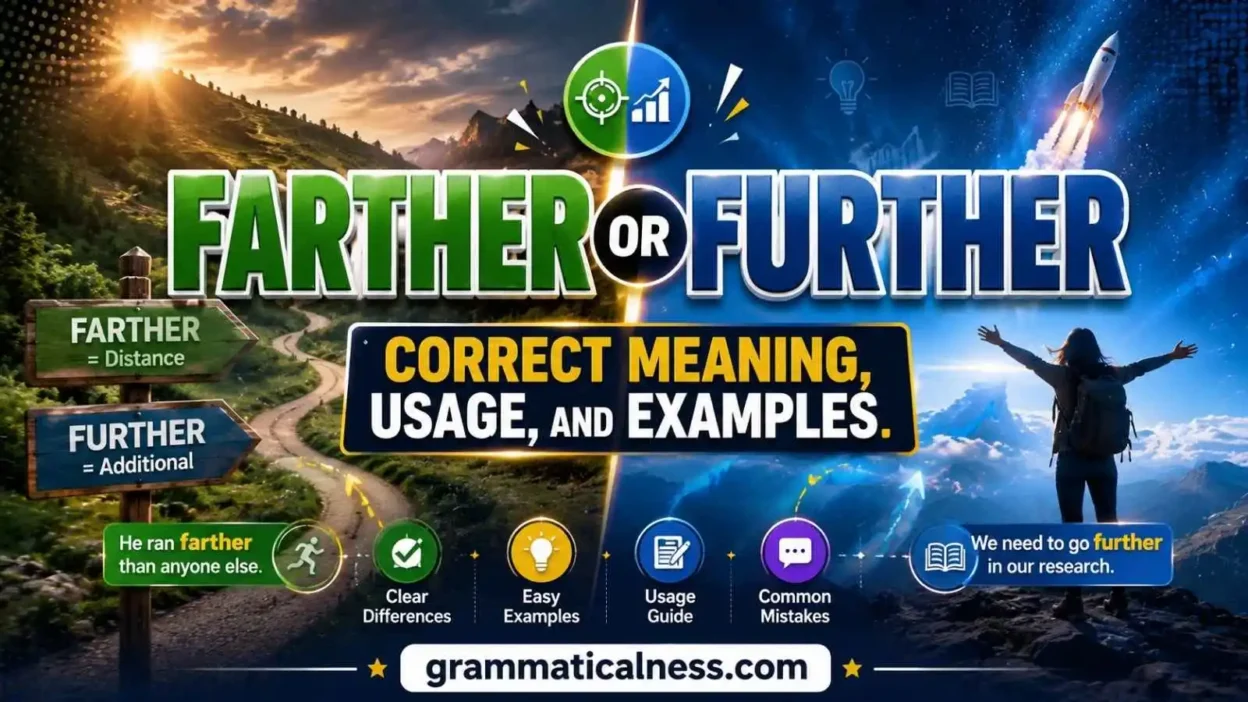
Farther and further are both correct words, but they are not always the best choice in the same sentence. In everyday US English, farther is usually the safer choice for physical distance. Further is usually better for figurative distance, additional information, degree, or progress.
That said, the difference is not as strict as many people learn in school. Both words can describe distance in some cases. The clearest rule is this: use farther when you mean a measurable distance, and use further when you mean more, additional, or to advance something.
Quick Answer
Use farther for physical distance: “The gas station is farther down the road.” Use further for additional, more, or figurative ideas: “We need further information.” When the sentence is about distance only, further may also be acceptable, but farther often sounds clearer in American English.
Why People Confuse Them
People confuse farther and further because both come from the idea of “far.” They also sound close, look close, and often appear in the same kinds of sentences.
For example, both of these can sound natural:
“The cabin is farther from town than we expected.”
“The cabin is further from town than we expected.”
The confusion grows because further has more jobs than farther. Further can mean “additional,” “more,” or “to advance.” Farther usually stays closer to distance.
So the problem is not that one word is always wrong. The problem is knowing when one word does a job the other word does not do well.
Key Differences At A Glance
| Context | Best Choice | Why |
| Physical distance | Farther | It points to measurable space. |
| Figurative distance | Further | It often fits abstract separation or progress. |
| Additional information | Further | Farther sounds wrong in this meaning. |
| More discussion | Further | It means “to a greater extent.” |
| To advance a goal | Further | Further works as a verb. |
| Casual travel question | Farther | It sounds clear and natural in US English. |
| Formal notice or business writing | Further | It often fits “additional” or “more” meanings. |
Meaning and Usage Difference
Farther usually means “at or to a greater distance.” It works well when you can imagine miles, feet, blocks, steps, or another real measure.
Examples:
“The hotel is farther from the airport than the map showed.”
“She moved farther away from the window.”
“Can you throw the ball farther than your brother?”
Further can also describe distance, but it has extra meanings. It can mean “more,” “additional,” “to a greater extent,” or “to help something advance.”
Examples:
“We need further details before we approve the plan.”
“I do not want to discuss the issue further.”
“The grant helped further her research.”
A practical way to choose is to ask what the sentence means. When you mean real distance, farther is usually the cleaner choice. When you mean more information, more action, or progress, further is the correct choice.
Tone, Context, and Formality
Farther sounds direct and concrete. It fits driving, walking, throwing, moving, traveling, and location.
Examples:
“The next exit is farther north.”
“We walked farther than planned.”
“The farther parking lot has more open spaces.”
Further often sounds more formal when it means “additional.” You may see it in business emails, school writing, instructions, reports, and notices.
Examples:
“Please send further information.”
“No further action is required.”
“The team needs further review before launch.”
In conversation, people often use further for distance too. However, if your sentence involves a measurable place or movement, farther usually gives readers a clearer signal.
Which One Should You Use?
Choose farther when the sentence answers “how far?”
“The school is farther from my apartment now.”
“The runner went farther in today’s practice.”
“The store is farther down the highway.”
Choose further when the sentence answers “how much more?” or “what additional thing?”
“We need to talk further.”
“She requested further training.”
“The new policy may further reduce delays.”
Here is the safest writing rule:
Use farther for physical distance. Use further for additional, more, or advance.
This rule will not explain every possible sentence, but it will help you avoid the most common mistakes.
When One Choice Sounds Wrong
Farther sounds wrong when you mean “additional.”
Wrong: “Please send farther information.”
Correct: “Please send further information.”
Farther also sounds wrong as a verb.
Wrong: “This class will farther your career.”
Correct: “This class will further your career.”
Further can sound less precise when the sentence is clearly about physical distance in US English.
Less clear: “The mall is further from our house than the school.”
Clearer: “The mall is farther from our house than the school.”
However, further is not automatically wrong in distance sentences. It often works, especially when the sentence suggests movement, progress, or direction. Still, farther is the better choice when you want a simple, physical-distance meaning.
Common Mistakes (and Quick Fixes)
Mistake 1: Using farther for “additional.”
Wrong: “Call us with any farther questions.”
Correct: “Call us with any further questions.”
Mistake 2: Using farther as a verb.
Wrong: “The internship will farther my skills.”
Correct: “The internship will further my skills.”
Mistake 3: Treating the school rule as absolute.
Too strict: “Further can never mean physical distance.”
Better: “Further can refer to distance, but farther is often clearer for measurable distance in American English.”
Mistake 4: Choosing by sound only.
Wrong: “We need farther review.”
Correct: “We need further review.”
Mistake 5: Using further when a travel sentence needs sharper wording.
Acceptable: “How much further is the hotel?”
Clearer in US English: “How much farther is the hotel?”
Everyday Examples
“Is the grocery store farther than the pharmacy?”
“The kids walked farther than they had ever walked before.”
“Move the chair farther from the heater.”
“Our new office is farther from downtown.”
“The farther trail has a better view.”
“Please send further details by Friday.”
“We cannot move forward without further review.”
“She asked no further questions.”
“The coach did not discuss the injury further.”
“The scholarship helped further his education.”
“Before we go any further, let’s check the budget.”
“The company took further steps to improve safety.”
Compact comparison block:
• Farther: best for real, measurable distance.
• Further: best for additional information, degree, progress, or abstract distance.
• Both: can sometimes describe distance.
• Safest rule: farther for space, further for more.
Dictionary-Style Word Details
Verb
• Farther: Not commonly used as a verb in standard US English. Do not write “farther your career” or “farther the project.”
• Further: Commonly used as a verb meaning to advance, promote, or help something develop. Example: “The workshop will further her training.”
Noun
• Farther: Not commonly used as a noun in standard US English.
• Further: Not commonly used as a noun in standard US English. It is usually an adjective, adverb, or verb.
Synonyms
• Farther: closest plain alternatives include more distant, at a greater distance, beyond, and more remote. These fit best when the sentence is about distance.
• Further: closest plain alternatives include additional, more, extra, moreover, advance, promote, and develop. The best choice depends on whether further is acting as an adjective, adverb, or verb.
Clear antonyms are limited because these words change meaning by context. For physical distance, closer can be the opposite of farther. For additional or more, less or fewer may fit some further sentences, but not all.
Example Sentences
Use farther for physical distance: The new apartment is farther from work, but the rent is lower.
When giving directions or describing space, farther is usually the better choice: Please stand farther back from the curb.
A location can also be farther along a path, road, or route: Their campsite was farther down the river.
Choose further for additional information or detail: The manager asked for further explanation.
You can also use further to mean “more” or “to a greater extent”: We should not discuss the issue further today.
In formal or professional writing, further can mean “to advance or promote”: The training program helped further her career.
Word History
• Farther: Farther developed as a variant connected to further and is now strongly associated with distance in modern usage.
• Further: Further is the older form and has kept broader meanings, including distance, additional, more, and the verb meaning to advance.
The exact history is complex, so it is safer not to claim that farther is simply “far plus -ther.” Modern usage matters more for today’s writing.
Phrases Containing
• Farther: farther away, farther down the road, farther north, farther from home, farther than expected, farther back, farther along the trail.
• Further: further information, further notice, further action, further review, further discussion, further education, further your career, look no further, until further notice.
FAQs
Is it farther or further?
Both words are correct, but they are used differently. Use farther when you mean physical distance, such as miles, steps, blocks, or space between places. Use further when you mean more, additional, or progress. For example, “The store is farther away” means real distance. “We need further details” means additional information.
Is farther only for distance?
Farther is mainly used for physical distance in modern US English. It works well when you can measure how far something is. For example, “The school is farther from my house than the library.” It is not a good choice when you mean “additional.” You should not write “farther information.” The correct phrase is “further information.”
Can further also mean distance?
Yes, further can also refer to distance, and many speakers use it that way. For example, “How much further is the hotel?” is common and understandable. Still, when the sentence is clearly about measurable distance, farther is often the cleaner choice in American English.
When should I use further?
Use further when you mean additional, more, to a greater degree, or to advance something. For example, “Please send further instructions,” “We will discuss this further tomorrow,” and “The course helped further her career.” In these sentences, farther would sound wrong.
Is it “further questions” or “farther questions”?
The correct phrase is further questions. Questions are not physical distances, so farther does not fit. You can write, “Please contact us with any further questions.” This means “any additional questions.”
Is it “look no further” or “look no farther”?
The common phrase is look no further. It means you do not need to search any more. “Look no farther” may appear in distance-related wording, but “look no further” is the standard phrase for recommendations, ads, and helpful suggestions.
Conclusion
Farther and further overlap in distance sentences, but they are not fully interchangeable in every context. Farther is the stronger choice for physical distance, especially in American English. Further is the better choice for additional information, more discussion, greater degree, or advancing something.
When you are unsure, use this simple test: if you can measure the distance, choose farther. If you mean more, additional, or advance, choose further. That rule keeps most sentences clear, natural, and correct.
Both words are correct, but they are used differently. Use farther when you mean physical distance, such as miles, steps, blocks, or space between places. Use further when you mean more, additional, or progress. For example, “The store is farther away” means real distance. “We need further details” means additional information.
Farther is mainly used for physical distance in modern US English. It works well when you can measure how far something is. For example, “The school is farther from my house than the library.” It is not a good choice when you mean “additional.” You should not write “farther information.” The correct phrase is “further information.”
Yes, further can also refer to distance, and many speakers use it that way. For example, “How much further is the hotel?” is common and understandable. Still, when the sentence is clearly about measurable distance, farther is often the cleaner choice in American English.
Use further when you mean additional, more, to a greater degree, or to advance something. For example, “Please send further instructions,” “We will discuss this further tomorrow,” and “The course helped further her career.” In these sentences, farther would sound wrong.
The correct phrase is further questions. Questions are not physical distances, so farther does not fit. You can write, “Please contact us with any further questions.” This means “any additional questions.”
The common phrase is look no further. It means you do not need to search any more. “Look no farther” may appear in distance-related wording, but “look no further” is the standard phrase for recommendations, ads, and helpful suggestions.