
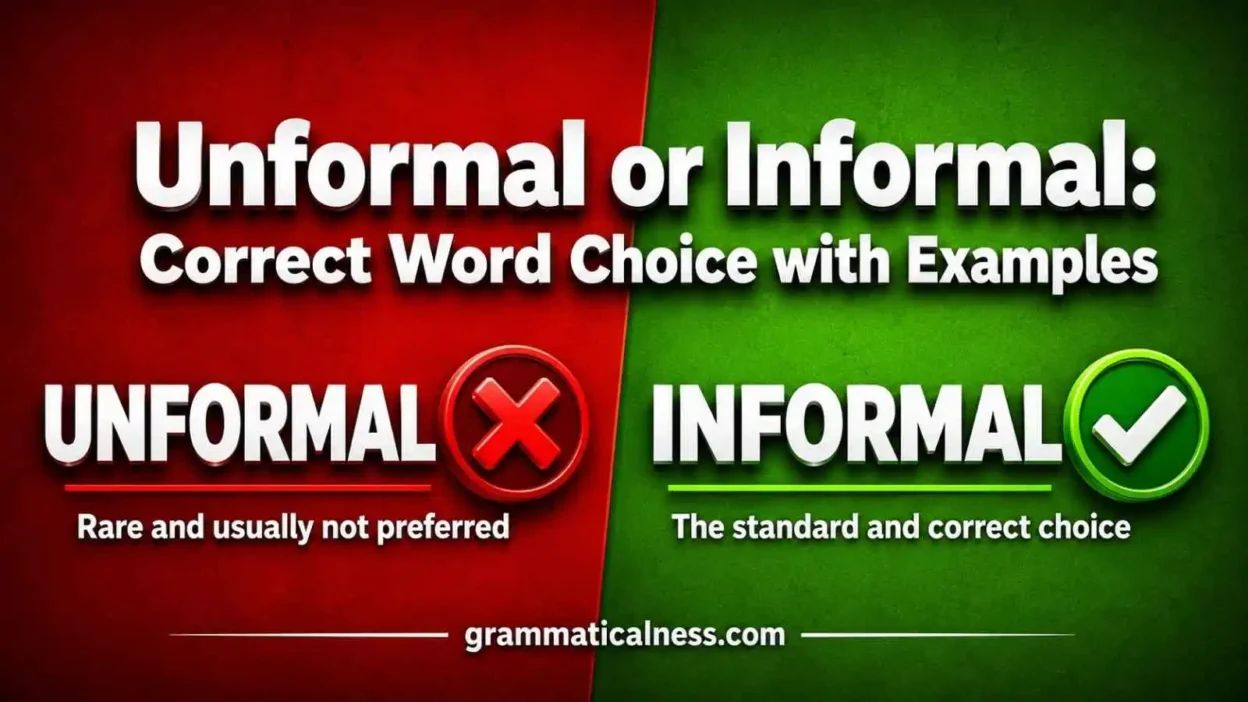
Use informal, not unformal, in modern US English. If you mean relaxed, casual, unofficial, or not highly formal, informal is the standard word.
The word unformal may appear in old or rare dictionary evidence, but it is not the normal choice today. In everyday writing, schoolwork, business email, and grammar advice, unformal will usually look like a mistake.
Quick Answer
Informal is the correct word for modern use. Write informal meeting, informal email, informal clothes, and informal language. Avoid unformal in normal US writing because readers expect informal. The safest rule is simple: when you mean “not formal,” use informal.
Why People Confuse Them
People confuse unformal and informal because English often uses un- to create opposites.
For example, we say:
• unhappy
• unclear
• unfair
• unofficial
So unformal may look logical at first. However, English does not always use the same negative prefix. Many words use in-, im-, il-, or ir- instead.
That is why we say:
• informal, not unformal
• impossible, not unpossible
• illegal, not unlegal
• irregular, not unregular
The pattern is not always predictable. You usually need to learn the standard form.
Key Differences At A Glance
| Context | Best Choice | Why |
| A relaxed meeting | informal | This is the standard modern adjective. |
| Casual clothing | informal | It naturally describes everyday dress. |
| Friendly email tone | informal | It fits personal or relaxed communication. |
| Unofficial agreement | informal | It can mean not following official form. |
| Modern US writing | informal | Readers expect this form. |
| Historical or rare wording | unformal | It may appear in older or specialized evidence, but it is not the normal choice. |
Here is the core difference:
| Feature | unformal | informal |
| Modern use | Rare and usually avoided | Standard and natural |
| Reader reaction | Often looks like an error | Sounds correct |
| Best use | Avoid in normal writing | Use for casual, relaxed, or unofficial contexts |
Meaning and Usage Difference
Informal means not formal. It can describe a relaxed setting, a casual tone, everyday clothing, unofficial action, or conversational language.
Examples:
• We had an informal meeting after lunch.
• Her email was friendly and informal.
• The office allows informal clothes on Fridays.
• They made an informal agreement before signing the contract.
Unformal is different. It may be understood because it combines un- with formal, but it is not the standard modern word. In most current US contexts, it sounds unnatural.
Avoid:
• We had an unformal meeting.
• He used an unformal tone.
• The event has an unformal dress code.
Use:
• We had an informal meeting.
• He used an informal tone.
• The event has an informal dress code.
Tone, Context, and Formality
Informal sounds natural in both everyday and professional writing when the meaning is clear. It does not always mean careless or wrong. It simply means less formal than a serious, official, or ceremonial style.
The word informal does not mean rude, careless, or unimportant. An informal email can still sound polite and professional. An informal meeting can still be useful, and an informal agreement can still matter even when it is not fully official.
Unformal, on the other hand, usually distracts the reader. Instead of focusing on your message, the reader may notice the word choice and wonder whether it is an error.
That matters in school, work, resumes, reports, and public writing. If your goal is clear English, choose informal.
Which One Should You Use?
Use informal almost every time.
Choose informal when describing:
• tone
• speech
• writing
• clothes
• meetings
• settings
• agreements
• conversations
• social events
Examples:
• The manager prefers an informal check-in before the weekly meeting.
• I sent a short, informal note to the team.
• The restaurant has an informal atmosphere.
• His presentation style was clear but informal.
Do not use unformal as a regular replacement. Even when readers understand what you mean, it will not sound polished in modern US English.
When One Choice Sounds Wrong
Unformal sounds wrong when it appears in normal phrases where informal is expected.
Wrong: The company planned an unformal lunch.
Better: The company planned an informal lunch.
Wrong: Please use an unformal tone in the text.
Better: Please use an informal tone in the text.
Wrong: The invitation says unformal dress.
Better: The invitation says informal dress.
Wrong: We reached an unformal agreement.
Better: We reached an informal agreement.
The problem is not that the idea is hard to understand. The problem is that the form does not match normal modern usage.
Common Mistakes (and Quick Fixes)
One common mistake is using unformal because it seems like the direct opposite of formal.
Mistake: This is an unformal event.
Fix: This is an informal event.
Another mistake is writing in formal when you need informal.
Mistake: The message sounds in formal.
Fix: The message sounds informal.
Use in formal only when in and formal are separate words.
Correct: She spoke in formal English during the ceremony.
Correct: The note was written in an informal style.
A third mistake is thinking informal means rude or sloppy. It does not. Informal language can be warm, clear, and respectful.
Everyday Examples
Informal: “Let’s have an informal chat before the interview.”
“The email was informal, but it was still professional.”
“Jeans are fine because the party is informal.”
“The teacher gave us an informal quiz.”
“Their agreement was informal, so they later put it in writing.”
Avoid: “Let’s have an unformal chat before the interview.”
“The email was unformal.”
“The party is unformal.”
“The teacher gave us an unformal quiz.”
“Their agreement was unformal.”
Dictionary-Style Word Details
Verb
• unformal: Not commonly used as a verb in standard US English.
• informal: Not commonly used as a verb in standard US English.
Both words are mainly discussed as adjectives in this comparison.
Noun
• unformal: Not commonly used as a noun in standard US English.
• informal: Not commonly used as a noun in ordinary modern US writing. Use informality when you need the noun.
Example:
• The informality of the meeting helped everyone relax.
Synonyms
• unformal: The closest intended alternative is informal, but unformal itself is not the recommended modern choice.
• informal: Closest plain alternatives include casual, relaxed, unofficial, conversational, everyday, and friendly, depending on the sentence.
A clear opposite of informal is formal.
Example Sentences
• unformal: Avoid it in normal modern writing. Write “informal meeting,” not “unformal meeting.”
• informal: “We held an informal meeting to discuss the first draft.”
• unformal: Avoid “unformal language” in school or work writing.
• informal: “Text messages often use informal language.”
• unformal: Avoid “unformal dress code.”
• informal: “The event has an informal dress code.”
Word History
• unformal: This form has historical evidence, but it is rare and not the usual modern US choice. Do not treat it as the normal opposite of formal.
• informal: This is the established modern adjective for “not formal,” “casual,” “relaxed,” or “unofficial.”
The safest modern choice is informal.
Phrases Containing
• unformal: No common current US phrases are built around this word.
• informal: Common phrases include informal meeting, informal email, informal language, informal clothes, informal agreement, informal poll, informal chat, and informal tone.
FAQs
Is unformal a real word?
Unformal has rare and historical use, but it is not the normal word in modern US English. Most readers expect informal when you mean not formal, casual, relaxed, or unofficial. For clear writing, use informal instead of unformal.
Which is correct: unformal or informal?
Informal is the correct choice for everyday writing. Write informal meeting, informal email, informal language, and informal clothes. Unformal may be understood, but it usually sounds unnatural or mistaken in modern English.
Why is it informal and not unformal?
English does not use one negative prefix for every word. Some words use un-, like unhappy and unclear. Other words use in-, like informal and incorrect. The standard opposite of formal is informal, not unformal.
Can I use unformal in an essay?
You should avoid unformal in an essay. Teachers, editors, and readers will usually expect informal. If you write unformal, it may look like a spelling or word-choice mistake, even if your meaning is clear.
What does informal mean?
Informal means not formal. It can describe casual speech, relaxed clothing, friendly writing, unofficial plans, or a less serious setting. For example, “We had an informal meeting” means the meeting was relaxed or not highly official.
Is informal the same as casual?
Informal and casual are close, but they are not always identical. Casual often means relaxed or everyday. Informal can also mean unofficial or not following strict rules. For example, an informal agreement may not be written or legally detailed.
What is the opposite of informal?
The opposite of informal is formal. Formal means official, serious, structured, or suitable for professional, academic, or ceremonial settings. For example, a formal letter has a more polished tone than an informal text message.
Conclusion
Choose informal when you mean not formal, casual, relaxed, unofficial, or conversational. It is the standard modern US word and works in real phrases like informal meeting, informal email, and informal language.
Avoid unformal in everyday writing. Even if the meaning is understandable, the word looks unusual and may distract readers. The simple rule is: formal becomes informal, not unformal.
Unformal has rare and historical use, but it is not the normal word in modern US English. Most readers expect informal when you mean not formal, casual, relaxed, or unofficial. For clear writing, use informal instead of unformal.
Informal is the correct choice for everyday writing. Write informal meeting, informal email, informal language, and informal clothes. Unformal may be understood, but it usually sounds unnatural or mistaken in modern English.
English does not use one negative prefix for every word. Some words use un-, like unhappy and unclear. Other words use in-, like informal and incorrect. The standard opposite of formal is informal, not unformal.
You should avoid unformal in an essay. Teachers, editors, and readers will usually expect informal. If you write unformal, it may look like a spelling or word-choice mistake, even if your meaning is clear.
Informal means not formal. It can describe casual speech, relaxed clothing, friendly writing, unofficial plans, or a less serious setting. For example, “We had an informal meeting” means the meeting was relaxed or not highly official.
Informal and casual are close, but they are not always identical. Casual often means relaxed or everyday. Informal can also mean unofficial or not following strict rules. For example, an informal agreement may not be written or legally detailed.
The opposite of informal is formal. Formal means official, serious, structured, or suitable for professional, academic, or ceremonial settings. For example, a formal letter has a more polished tone than an informal text message.