

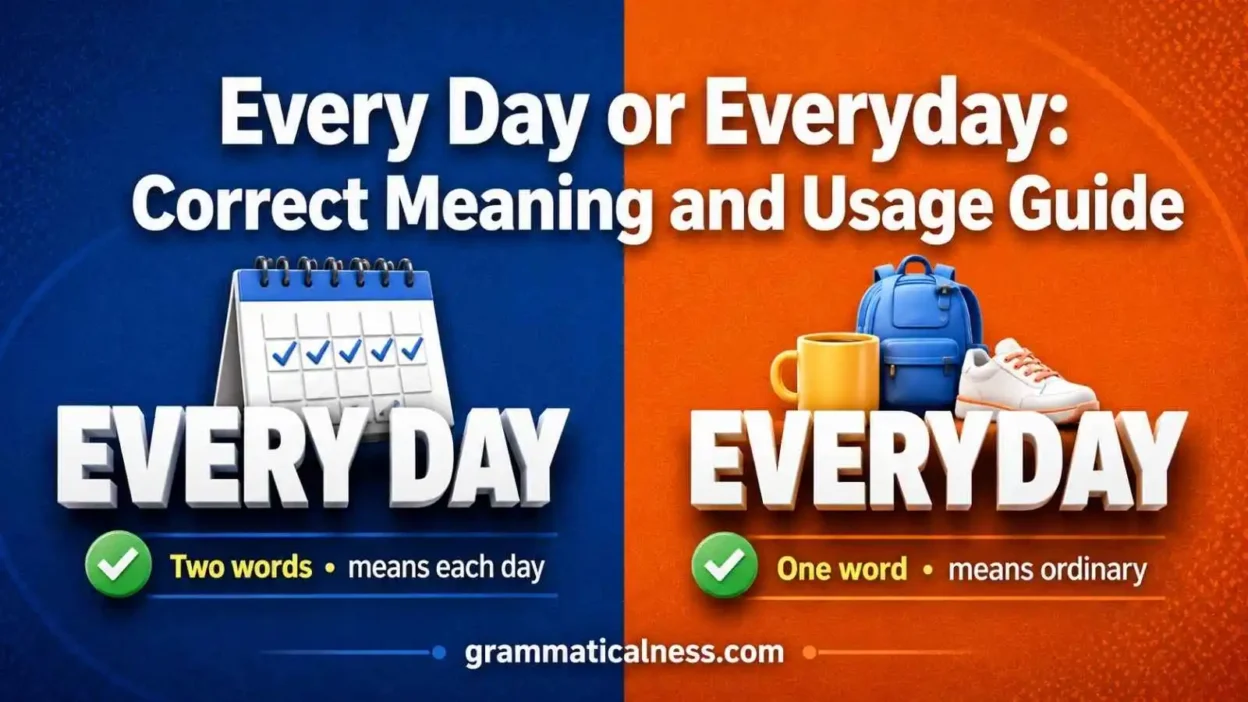
Every day and everyday are both correct, but they do not do the same job. The two-word phrase every day means each day. The one-word form everyday is usually an adjective that means ordinary, routine, or used often.
That means you would write, “I walk every day,” because the phrase tells how often you walk. You would write, “These are my everyday shoes,” because the word describes what kind of shoes they are.
The easiest question is this: Can you replace it with “each day”? If yes, use every day. If not, you probably need everyday before a noun.
Quick Answer
Use every day when you mean each day.
Example:
She checks her email every day.
Use everyday when you mean ordinary, regular, or common.
Example:
She wears everyday clothes to work.
The two forms sound very similar when spoken, so the difference matters most in writing. In standard American English, every day usually points to time or frequency. Everyday usually describes a noun.
A quick test helps: replace every with each. If the sentence still works, write two words.
Correct: I study every day.
Test: I study each day.
Correct: These are everyday habits.
Test: These are eachday habits. That does not work.
Why People Confuse Them
People confuse every day and everyday because the only visible difference is a space. In speech, the forms sound almost the same, so writers often choose the one-word form by habit.
Another reason is that both forms connect to daily life. Every day can describe something that happens daily. Everyday can describe something that belongs to normal daily life. Those ideas are close, but the grammar is different.
Think of it this way: every day tells when or how often. Everyday tells what kind.
In “I drink coffee every day,” the phrase tells how often you drink coffee. In “my everyday coffee mug,” the word describes the mug you normally use.
Key Differences At A Glance
| Context | Best Choice | Why |
| Something happens each day | every day | It means “daily” or “each day.” |
| A word comes before a noun | everyday | It describes the noun as ordinary or routine. |
| You can replace it with “each day” | every day | The meaning still works. |
| You mean “common” or “usual” | everyday | It works as an adjective. |
| The sentence talks about frequency | every day | It tells how often an action happens. |
Meaning and Usage Difference
Every day is a two-word phrase. It often works like a time phrase and means each day or daily. It usually connects to an action.
Example:
My brother runs every day before work.
Here, every day tells how often he runs.
Everyday is one word. It is most often an adjective. It describes a noun as normal, common, or part of regular life.
Example:
My brother wears everyday running shoes.
Here, everyday describes the shoes.
Compact comparison:
- Every day: two words, means each day, usually tells how often something happens.
- Everyday: one word, means ordinary or routine, usually describes a noun.
Tone, Context, and Formality
Both forms are normal in American English. The difference is not about formal versus informal writing. It is about grammar and meaning.
Use every day in casual writing, school writing, business writing, and professional writing when you mean each day. A sentence like “We meet every day at 9” sounds natural in any setting.
Use everyday when you need an adjective before a noun. Phrases like everyday life, everyday problems, everyday clothes, and everyday use are standard and natural.
The one-word form can look careless when it is used where the two-word phrase belongs. For example, “I practice everyday” is common online, but standard edited writing prefers “I practice every day.”
Which One Should You Use?
Use every day when the sentence answers how often?
I stretch every day.
They call their parents every day.
We add new notes every day.
Use everyday when the sentence answers what kind?
These are everyday sneakers.
That is an everyday problem.
The app is useful for everyday tasks.
A strong shortcut is to look at the next word. If a noun comes right after the word, everyday may be correct. If the phrase comes after a verb, every day is usually correct.
However, do not rely only on position. Focus on meaning. Ask whether you mean each day or ordinary.
When One Choice Sounds Wrong
Everyday sounds wrong when it tries to describe an action.
Wrong: I read everyday.
Correct: I read every day.
The sentence means “I read each day,” so you need two words.
Every day sounds wrong when it tries to work as an adjective before a noun.
Wrong: These are my every day shoes.
Correct: These are my everyday shoes.
The sentence means the shoes are normal or routine, so the one-word adjective is correct.
One tricky case is “every day routine.” If you mean a routine you follow each day, write “a routine I follow every day.” If you mean a normal routine, write “an everyday routine.”
Common Mistakes (and Quick Fixes)
A common mistake is writing everyday at the end of a sentence.
Wrong: She goes to the gym everyday.
Correct: She goes to the gym every day.
Another mistake is using every day before a noun when you mean ordinary.
Wrong: He bought every day clothes for the trip.
Correct: He bought everyday clothes for the trip.
Writers also confuse daily with everyday. The word daily can work as an adjective or an adverb, but everyday is usually an adjective. That is why “daily exercise” and “exercise daily” both work, while “exercise everyday” should be “exercise every day.”
Everyday Examples
Here are natural examples of every day:
I make my bed every day.
She walks the dog every day after dinner.
We check the schedule every day during the summer.
He learns a new word every day.
The store opens at 8 a.m. every day except Sunday.
Here are natural examples of everyday:
These are my everyday jeans.
The book explains everyday grammar mistakes.
Small delays are an everyday part of commuting.
This backpack is strong enough for everyday use.
The story focuses on everyday life in a small town.
Now compare the two forms together:
I use this mug every day.
This is my everyday mug.
Dictionary-Style Word Details
Verb
every day: Not used as a verb in standard American English. It is a two-word phrase, not an action word.
Example:
I practice every day.
everyday: Not commonly used as a verb in standard American English. It is usually an adjective.
Example:
We need an everyday solution.
Noun
every day: The word day is a noun, and every describes it. In many sentences, the full phrase works as a time expression.
Example:
Make every day count.
everyday: Not commonly used as a regular noun in standard everyday writing. Some writers use the everyday to mean ordinary daily life, but most readers will see everyday as an adjective.
Example:
The essay studies beauty in the everyday.
Synonyms
every day: Closest plain alternatives include daily, each day, and day after day. Helpful opposites include rarely, sometimes, and occasionally, depending on the sentence.
everyday: Closest plain alternatives include ordinary, routine, usual, regular, and commonplace. Helpful opposites include unusual, special, rare, and extraordinary.
Do not swap these alternatives blindly. “Daily shoes” does not always mean the same thing as “everyday shoes,” and “ordinary” does not mean “each day.”
Example Sentences
every day:
I write in my planner every day.
The kids ride the bus every day during the school year.
You do not need to check the report every day.
everyday:
This recipe uses everyday ingredients.
Her advice helps with everyday writing problems.
The brand makes simple bags for everyday use.
Together:
I wear these shoes every day because they are my everyday shoes.
Word History
every day: This is a regular two-word phrase made from every and day. It keeps the literal idea of each separate day.
everyday: This is a compound form based on the same words. In modern use, it works mainly as an adjective for things that are ordinary, routine, or part of normal life.
There is no need to rely on a special origin story to use the words correctly. The modern grammar difference is the useful point: every day means each day, and everyday describes something ordinary or routine.
Phrases Containing
every day:
every single day
every day this week
every day after school
every day of the year
almost every day
everyday:
everyday life
everyday clothes
everyday routine
everyday use
everyday problems
everyday language
everyday items
These phrases show the pattern clearly. Every day points to time. Everyday sits before a noun and describes it.
FAQs
Is it “every day” or “everyday”?
Both are correct, but they have different uses. Every day means each day. For example, “I drink coffee every day.” Everyday is an adjective that means ordinary, regular, or common. For example, “These are my everyday shoes.” Use two words when you mean daily. Use one word when describing a noun.
Is “I go to school everyday” correct?
No, the standard form is “I go to school every day.” In this sentence, you mean that the action happens each day. Since every day tells how often something happens, it should be two words. The one-word form everyday would only work before a noun, as in “everyday school supplies.”
What is a simple trick to remember the difference?
Replace the words with each day. If the sentence still makes sense, use every day. For example, “I exercise every day” becomes “I exercise each day,” so two words are correct. If each day sounds wrong, you probably need everyday, as in “everyday clothes.”
Can “everyday” mean daily?
Not exactly. Everyday can describe things connected to normal daily life, but it does not usually mean “daily” by itself. For actions, use every day. Write “I read every day,” not “I read everyday.” Use everyday in phrases like “everyday life,” “everyday tasks,” and “everyday problems.”
What are common examples of “everyday”?
Common examples include everyday clothes, everyday use, everyday life, everyday routine, everyday problems, and everyday language. In each phrase, everyday describes a noun. It means the thing is normal, usual, or part of regular life.
Conclusion
Every day and everyday are not interchangeable in careful writing. Use every day when you mean each day. Use everyday when you need an adjective meaning ordinary, routine, or common.
The best quick test is simple: try each day. If it fits, write every day as two words. If you are describing a noun, the one-word adjective everyday is probably the right choice.
Correct: I practice every day.
Correct: This is an everyday habit.
Once you remember that every day tells frequency and everyday describes a noun, the choice becomes much easier.
Both are correct, but they have different uses. Every day means each day. For example, “I drink coffee every day.” Everyday is an adjective that means ordinary, regular, or common. For example, “These are my everyday shoes.” Use two words when you mean daily. Use one word when describing a noun.
No, the standard form is “I go to school every day.” In this sentence, you mean that the action happens each day. Since every day tells how often something happens, it should be two words. The one-word form everyday would only work before a noun, as in “everyday school supplies.”
Replace the words with each day. If the sentence still makes sense, use every day. For example, “I exercise every day” becomes “I exercise each day,” so two words are correct. If each day sounds wrong, you probably need everyday, as in “everyday clothes.”
Not exactly. Everyday can describe things connected to normal daily life, but it does not usually mean “daily” by itself. For actions, use every day. Write “I read every day,” not “I read everyday.” Use everyday in phrases like “everyday life,” “everyday tasks,” and “everyday problems.”
Common examples include everyday clothes, everyday use, everyday life, everyday routine, everyday problems, and everyday language. In each phrase, everyday describes a noun. It means the thing is normal, usual, or part of regular life.