
Liar or lier is confusing because both words look almost the same and come from the verb lie. The important difference is meaning.
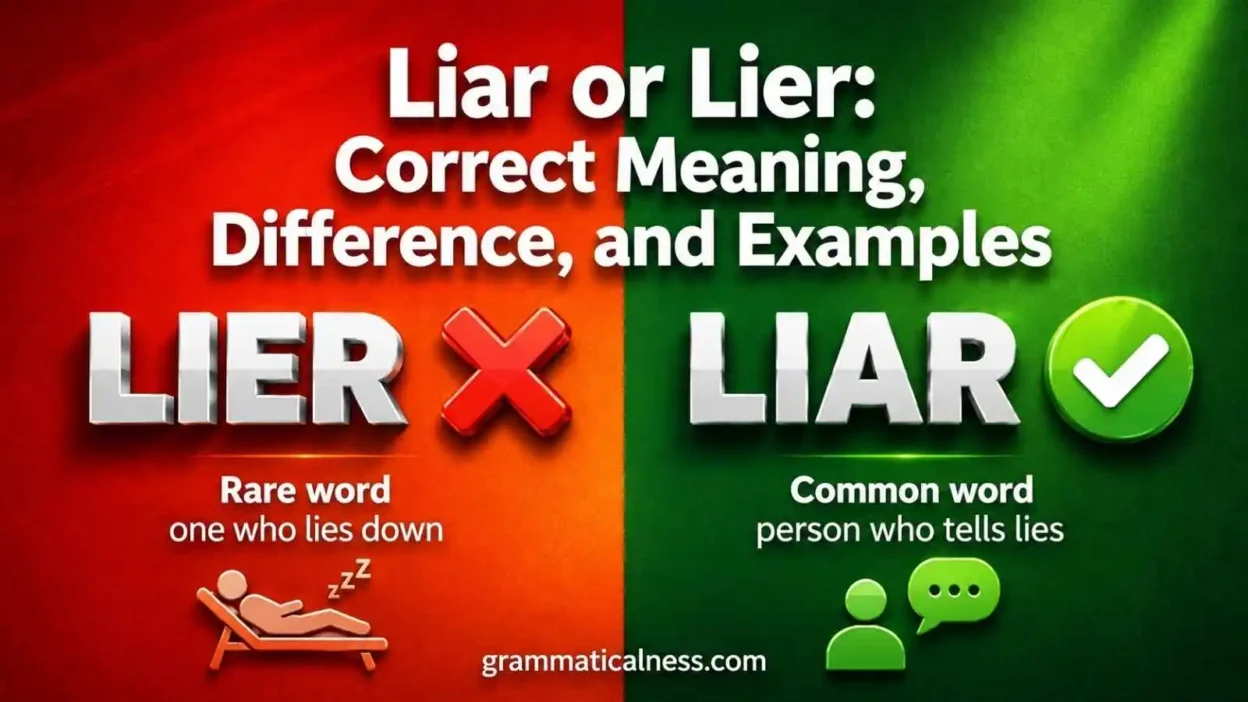
In normal US English, liar is the word you almost always need when describing someone who tells lies. Lier is a real word, but it is rare and usually refers to someone or something lying down or lying in wait. If you write “He is a lier” to mean someone is dishonest, most readers will see it as a spelling mistake.
Quick Answer
Use liar for a person who tells lies or does not tell the truth. Use lier only in the rare sense of someone or something that lies down, reclines, or lies in wait. For everyday writing, the correct choice is almost always liar.
Why People Confuse Them
People confuse these words because English uses lie in more than one way. One meaning is “to say something false.” Another meaning is “to rest in a flat or horizontal position.”
That creates two similar-looking nouns:
- liar = a person who tells lies
- lier = one that lies down or lies in wait
They are also pronounced the same in ordinary speech: LYE-er. Since the sound does not help, the spelling must carry the meaning. That is why “lier” often appears when the writer really means “liar.”
Key Differences At A Glance
| Context | Best Choice | Why |
| A person tells falsehoods | liar | This is the standard noun for a dishonest person. |
| Someone is accused of not telling the truth | liar | This is the normal word in speech and writing. |
| Someone or something is lying down | lier | This is the rare noun connected to reclining. |
| Someone is hiding in wait | lier | This rare use means one that lies in wait. |
| Everyday school, work, or casual writing | liar | Most uses are about dishonesty, not body position. |
Meaning and Usage Difference
Liar means a person who tells lies. It has a negative meaning because it describes dishonesty.
Example:
“She called him a liar after the story changed twice.”
Lier does not usually mean a dishonest person. It means someone or something that lies down, reclines, or lies in wait. This word exists, but it is uncommon in modern US English.
Example:
“The hunter was a silent lier in the grass.”
That sentence is grammatical, but it sounds unusual. In most modern writing, people would choose a clearer phrase, such as “someone lying in the grass.”
Compact comparison:
- Liar: common, clear, about dishonesty.
- Lier: rare, formal or old-fashioned, about position or lying in wait.
- Main rule: If truth is the issue, choose liar.
Tone, Context, and Formality
Liar works in everyday, formal, and informal contexts. It can sound strong or insulting, so use it carefully when writing about real people. Calling someone a liar is a serious accusation because it suggests intentional dishonesty.
Lier sounds rare and stiff in modern English. Most readers will not expect it, even when it is technically correct. In clear modern writing, it is often better to rewrite the sentence instead of using lier.
For example, instead of writing:
“The dog was a happy lier on the porch.”
Write:
“The dog was lying happily on the porch.”
The second sentence sounds more natural.
Which One Should You Use?
Use liar when the meaning is “a person who lies” in the sense of not telling the truth.
Correct:
“He lied about the payment, so no one trusted him. He was a liar.”
Use lier only when the meaning is tied to physical position or lying in wait.
Possible but rare:
“The lier stayed hidden behind the fence.”
In most cases, even when lier is technically possible, a fuller phrase sounds better. Instead of “a lier on the couch,” write “someone lying on the couch.”
For US readers, liar is the safe choice for dishonesty. Lier should be used only when you truly need its rare meaning.
When One Choice Sounds Wrong
Lier sounds wrong when you mean someone is dishonest.
Wrong:
“She is a lier who changes her story every day.”
Correct:
“She is a liar who changes her story every day.”
Liar sounds wrong when you mean someone is simply lying down.
Wrong:
“The tired liar rested on the sofa.”
Correct if you mean position:
“The tired person was lying on the sofa.”
Even though lier can refer to someone lying down, it often sounds unnatural. A rewritten sentence is usually smoother than forcing the word lier.
Common Mistakes (and Quick Fixes)
Mistake 1: Using lier for dishonesty
Wrong: “He is a lier.”
Correct: “He is a liar.”
Mistake 2: Thinking lier is always fake
Better: Lier is real, but rare. It does not normally mean a dishonest person.
Mistake 3: Using lier when a clearer phrase works better
Awkward: “The cat was a quiet lier near the window.”
Better: “The cat was lying quietly near the window.”
Mistake 4: Forgetting the spelling of liar
Remember: a person who tells lies is a liar, with -ar at the end.
Everyday Examples
Here are natural examples with liar:
- “I believed him at first, but he turned out to be a liar.”
- “Calling someone a liar can damage trust fast.”
- “She was not a liar; she had misunderstood the question.”
- “The report proved that the witness was a liar.”
- “No one wants to be known as a liar at work.”
Here are rare examples with lier:
- “The lier stayed hidden until the path was clear.”
- “In the old story, the lier waited behind the rocks.”
- “A snake can be a silent lier in tall grass.”
These lier examples are correct in meaning, but they sound literary or unusual. For everyday writing, a clearer phrase is usually better.
Dictionary-Style Word Details
Verb
liar: Not used as a verb in standard US English. Liar is a noun. It comes from the verb lie, meaning to tell a falsehood.
lier: Not used as a verb in standard US English. Lier is a noun. It comes from the other meaning of lie, meaning to recline or to be positioned somewhere.
Noun
liar: A countable noun meaning a person who tells lies.
Example: “The liar finally admitted the truth.”
lier: A rare countable noun meaning one that lies down, reclines, or lies in wait.
Example: “The lier remained still in the brush.”
Synonyms
liar: Close synonyms include fibber, deceiver, fabricator, and prevaricator. These words differ in tone, so they are not always perfect replacements. A simple opposite is truth-teller.
lier: Exact everyday synonyms are not common. Closest plain alternatives include one lying down, recliner, or one lying in wait, depending on the sentence. A clear antonym usually does not help because the word describes position or hidden placement, not a moral quality.
Example Sentences
liar:
- “He is not a reliable source if he is a proven liar.”
- “She felt hurt when her friend called her a liar.”
- “The email made him look like a liar.”
lier:
- “The lier waited silently behind the wall.”
- “The animal was a quiet lier in the shade.”
- “The old tale describes a lier hidden near the road.”
Word History
liar: The word is tied to the older English verb meaning to tell lies. Its spelling may surprise readers because it ends in -ar, not -er.
lier: The word is tied to the other meaning of lie, the meaning connected with reclining, resting, or lying in wait. Its history is real, but its modern use is limited.
The useful takeaway is simple: the two words share a connection to lie, but they follow different meanings of that verb.
Phrases Containing
liar: Common phrases include pathological liar, compulsive liar, dirty liar, and liar, liar, pants on fire. Some are serious, while others are childish or informal.
lier: There are no common everyday phrases with lier in modern US English. You may see wording related to “lying in wait,” but writers usually use the phrase itself instead of the noun lier.
FAQs
Is it liar or lier?
Use liar when you mean a person who tells lies. This is the normal and correct word in everyday US English. Lier is a real word, but it does not usually mean a dishonest person. It refers to someone or something lying down or lying in wait.
Is lier a real word?
Yes, lier is a real word, but it is rare. It means one that lies down, reclines, or lies in wait. Most people do not use it in everyday writing, so it can look like a spelling mistake when the intended meaning is “dishonest person.”
What does liar mean?
A liar is a person who says something false, usually on purpose. For example, “He promised he was telling the truth, but he was a liar.” The word has a strong negative meaning, so use it carefully.
What does lier mean?
A lier is someone or something that lies down or lies in wait. For example, “The lier stayed hidden in the tall grass.” This use is correct, but it sounds old-fashioned or unusual in modern English.
Can lier mean someone who lies?
Not when lies means “tells falsehoods.” For that meaning, the correct word is liar. If you write “She is a lier,” readers will likely think you misspelled liar.
Why is liar spelled with -ar?
English spelling is not always predictable. The noun for a person who tells lies is spelled liar, not lier. A simple memory tip is: a liar tells a lie, but the word ends in -ar.
Which word should I use in daily writing?
Use liar in almost every normal situation. Choose lier only if you specifically mean someone or something lying down or lying in wait.
Conclusion
The choice between liar and lier depends on meaning, not preference. Liar means someone who tells lies, and it is the word most writers need. Lier is a rare real word for someone or something lying down or lying in wait. For clear modern US English, use liar when dishonesty is the point. Avoid lier unless you truly mean the rare reclining or hidden-waiting sense.
Use liar when you mean a person who tells lies. This is the normal and correct word in everyday US English. Lier is a real word, but it does not usually mean a dishonest person. It refers to someone or something lying down or lying in wait.
Yes, lier is a real word, but it is rare. It means one that lies down, reclines, or lies in wait. Most people do not use it in everyday writing, so it can look like a spelling mistake when the intended meaning is “dishonest person.”
A liar is a person who says something false, usually on purpose. For example, “He promised he was telling the truth, but he was a liar.” The word has a strong negative meaning, so use it carefully.
A lier is someone or something that lies down or lies in wait. For example, “The lier stayed hidden in the tall grass.” This use is correct, but it sounds old-fashioned or unusual in modern English.
Not when lies means “tells falsehoods.” For that meaning, the correct word is liar. If you write “She is a lier,” readers will likely think you misspelled liar.
English spelling is not always predictable. The noun for a person who tells lies is spelled liar, not lier. A simple memory tip is: a liar tells a lie, but the word ends in -ar.
Use liar in almost every normal situation. Choose lier only if you specifically mean someone or something lying down or lying in wait.