
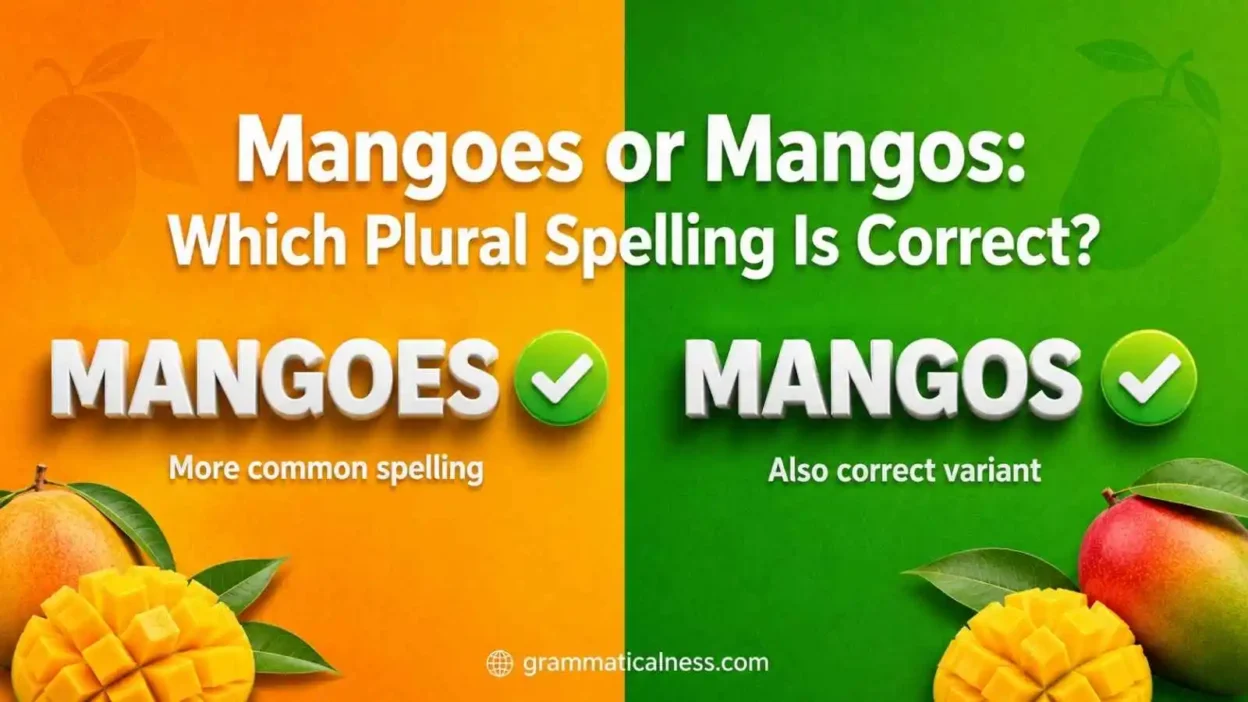
If you are choosing between mangoes or mangos, the good news is simple: both spellings are correct.
They mean the same thing. Both refer to more than one mango. The difference is not meaning. It is spelling, style, and reader expectation.
In everyday US English, you can write either one. Still, one form may fit your sentence better depending on where the word appears and who will read it.
Quick Answer
Use mangoes if you want the safer, more traditional-looking plural.
Use mangos if you prefer the shorter spelling, especially in recipes, menus, labels, or a brand voice that already uses it.
Both are standard plural forms:
• We bought three ripe mangoes.
• We bought three ripe mangos.
Neither sentence is wrong. The best choice is the one that fits your document and stays consistent.
Why People Confuse Them
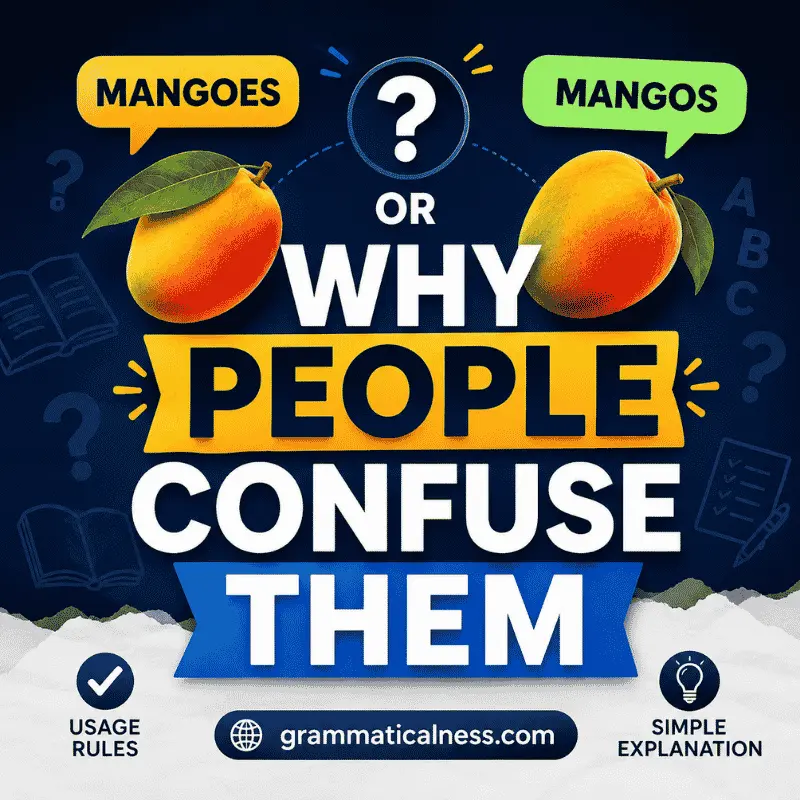
The confusion comes from the final -o in mango.
Some English nouns ending in -o add -es in the plural, such as tomato → tomatoes. Others add only -s, such as piano → pianos.
Mango allows both:
• mango → mangoes
• mango → mangos
That is why both forms look possible. In this case, both actually are possible.
The main mistake is thinking one spelling must be wrong just because the other looks more familiar.
Key Differences At A Glance
| Context | Best Choice | Why |
| School writing | mangoes | It is the more familiar classroom choice for many readers. |
| Formal writing | mangoes | It looks traditional and is often the safer default. |
| Recipes | mangoes or mangos | Both work; follow the style of the recipe site or cookbook. |
| Menus and labels | mangos | The shorter form is common in food branding and display text. |
| General US writing | mangoes or mangos | Both are accepted plural forms. |
| One document or article | pick one form | Consistency looks cleaner than switching back and forth. |
| Possessive meaning | mangoes’ or mangos’ | Use an apostrophe only for ownership, not for a simple plural. |
Meaning and Usage Difference
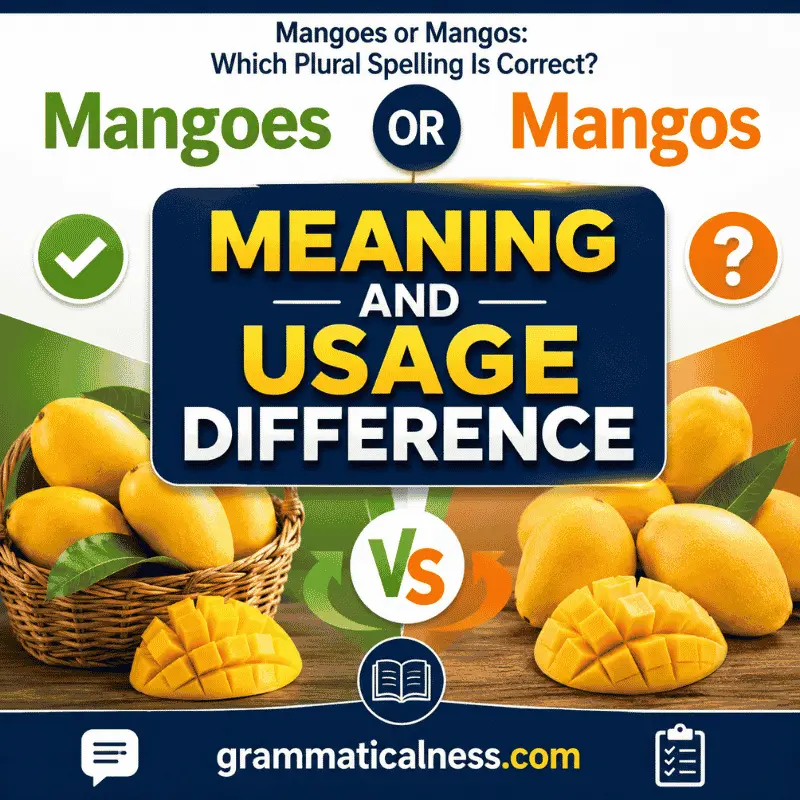
There is no meaning difference between mangoes and mangos.
Both terms mean “more than one mango” and function as plural nouns. They usually refer to the fruit, though in some contexts they can also refer to mango trees.
The pronunciation is also the same in normal speech: MANG-goze. Readers will not hear a difference. They will only see one in writing.
A useful way to think about it:
• Mangoes looks more traditional.
• Mangos looks shorter and simpler.
That is a style difference, not a grammar difference.
Merriam-Webster lists both mangoes and mangos as correct plural forms: Merriam-Webster Dictionary — Mango
Tone, Context, and Formality
Mangoes often feels a little more polished or expected in edited writing. It is a good choice for school assignments, formal articles, reports, and careful explanations.
Mangos often feels clean, modern, and practical. It can look natural on a menu, produce sign, package label, recipe card, or food brand page.
This does not mean mangoes is formal and mangos is slang. It also does not mean mangos is casual only. Both are standard.
The best tone comes from consistency. Do not write mangoes in one paragraph and mangos in the next unless you are directly comparing the two spellings.
Which One Should You Use?
For most writers, the safest default is mangoes.
Choose mangoes when you are writing:
• a school paper
• a formal article
• a grammar explanation
• a polished recipe intro
• a sentence where readers may expect the -es ending
Choose mangos when you are writing:
• a short menu item
• a produce label
• a brand page
• a recipe title with tight space
• content that already uses the shorter form
Here is the simple rule: both are correct, but do not mix them without a reason.
When One Choice Sounds Wrong
Neither mangoes nor mangos is wrong by itself.
One can feel wrong when it clashes with the rest of the writing.
If your article already uses mangoes, suddenly switching to mangos may look like an error. If a brand or menu consistently uses mangos, switching to mangoes may look off-brand.
The real wrong form is mango’s when you mean more than one mango.
Wrong: I bought five mango’s.
Right: I bought five mangoes.
Right: I bought five mangos.
Use mango’s only when one mango owns or has something:
• The mango’s skin was soft.
Common Mistakes (and Quick Fixes)
Mistake: Treating mangos as incorrect.
Fix: It is a valid plural spelling.
Mistake: Treating mangoes as the only possible plural.
Fix: It is safe and common, but not the only accepted form.
Mistake: Adding an apostrophe for a plural.
Fix: Write mangoes or mangos, not mango’s.
Mistake: Mixing both spellings in the same article.
Fix: Pick one and use it throughout.
Mistake: Using a singular verb with either plural.
Fix: Write mangoes are or mangos are, not mangoes is.
Everyday Examples
• The grocery store had ripe mangoes near the entrance.
• The grocery store had ripe mangos near the entrance.
• Add two diced mangoes to the salsa.
• Add two diced mangos to the salsa.
• These mangoes are sweet enough for smoothies.
• These mangos are sweet enough for smoothies.
• I packed oranges, bananas, and mangoes for the picnic.
• I packed oranges, bananas, and mangos for the picnic.
• The market sold out of honey mangoes by noon.
• The market sold out of honey mangos by noon.
Both versions work because the meaning stays the same.
| Feature | mangoes | mangos |
| Part of speech | plural noun | plural noun |
| Meaning | more than one mango | more than one mango |
| Pronunciation | MANG-goze | MANG-goze |
| Best use | traditional or formal writing | menus, labels, branding, simple style |
| Main advice | safe default | acceptable shorter form |
Dictionary-Style Word Details
Verb
• mangoes: Not commonly used as a verb in standard US English. In normal writing, mangoes is a plural noun.
• mangos: Not commonly used as a verb in standard US English. In normal writing, mangos is a plural noun.
Noun
• mangoes: A plural noun meaning more than one mango. Example: The mangoes are ripe.
• mangos: A plural noun meaning more than one mango. Example: The mangos are ripe.
Both forms take a plural verb when they are the subject:
• Mangoes are on sale.
• Mangos are on sale.
Synonyms
• mangoes: Exact spelling equivalent: mangos. Closest plain alternatives: mango fruit, ripe mango fruit, fresh mango fruit.
• mangos: Exact spelling equivalent: mangoes. Closest plain alternatives: mango fruit, ripe mango fruit, fresh mango fruit.
There is no useful direct antonym for either spelling. A different fruit name, such as apples or peaches, is not an antonym. It is just another noun.
Example Sentences
• mangoes: The smoothie shop uses fresh mangoes every morning.
• mangos: The smoothie shop uses fresh mangos every morning.
• mangoes: Slice the mangoes before adding them to the salad.
• mangos: Slice the mangos before adding them to the salad.
• mangoes: These mangoes smell sweet and ready to eat.
• mangos: These mangos smell sweet and ready to eat.
Word History
• mangoes: This plural follows the older-looking -es pattern used by some English nouns ending in -o.
• mangos: This plural follows the simpler -s pattern also used by many English nouns ending in -o.
The singular word mango came into English through earlier language contact connected with South Asia and Portuguese. For this comparison, the important point is not the exact origin story. The important point is that modern dictionaries recognize both plural spellings.
Why Does Mango Have Two Plural Forms?
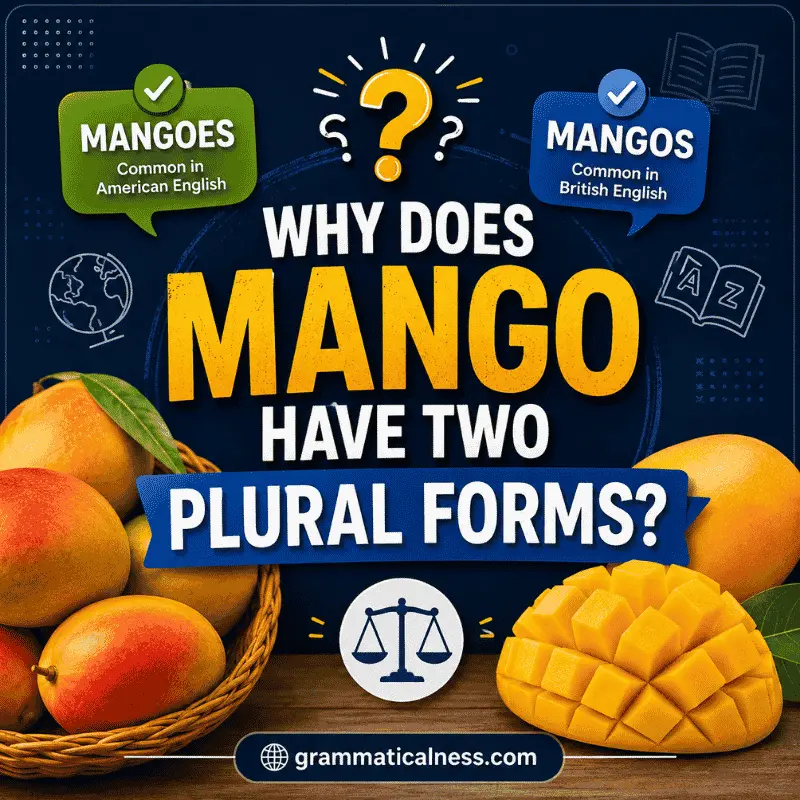
English nouns ending in -o do not all form their plurals in the same way. Some add -es, as in tomatoes and potatoes, while others add only -s, as in pianos, videos, and photos.
The word mango developed with both plural patterns in English. Over time, mangoes and mangos both became established, which is why modern dictionaries accept either spelling.
The plural photos follows a different pattern. Because photo is a shortened form of photograph, English speakers regularly form its plural by adding only -s. That is why photos is standard, while photoes is not.
This variation shows that English plural spelling depends on established usage as well as general rules.
Phrases Containing
• mangoes: fresh mangoes, ripe mangoes, sliced mangoes, dried mangoes, mangoes for smoothies, mangoes on sale
• mangos: fresh mangos, ripe mangos, sliced mangos, dried mangos, mangos for smoothies, mangos on sale
Both sets of phrases are correct. Choose the spelling that matches your style.
FAQs
Both mangoes and mangos are correct plural forms of mango. They mean the same thing: more than one mango.
Mangoes is usually the safer choice in school, formal, or polished writing. Mangos is also correct and often appears in menus, labels, recipes, and food branding.
No. Mangos is not wrong. It is an accepted plural spelling of mango, even though some readers may be more used to seeing mangoes.
Many people write mangoes because some nouns ending in -o form the plural with -es, such as tomatoes and potatoes. Mango can follow that pattern, but it can also simply add -s.
Either spelling works in a recipe. Use mangoes for a more traditional style, or mangos if you want a shorter, cleaner menu-style look.
No. Mango’s is not the plural. Use mangoes or mangos when talking about more than one mango. Use mango’s only for possession, as in “the mango’s skin.”
No. Mangoes and mangos are pronounced the same way: MANG-goze. The difference is only in spelling.
Conclusion
Mangoes and mangos are both correct plural forms of mango.
Use mangoes when you want the safer, more traditional form. Use mangos when you want the shorter form, especially in menus, labels, recipes, or brand writing.
The meaning is the same. The pronunciation is the same. The biggest rule is simple: choose one spelling and keep it consistent.