

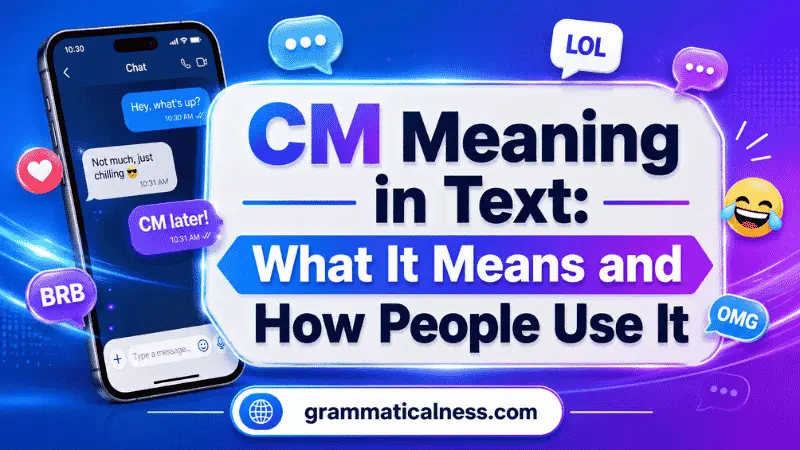
You may see “CM” in a text from a friend, a group chat, or a quick online message. In most casual texting, CM means “call me.” It is a short request asking the other person to switch from typing to a phone or voice call.
The meaning is simple, but the same two letters can represent other things in work, school, science, or technical conversations. A message like “CM when you get home” almost certainly means “call me.” A sentence about a 10 cm object clearly uses cm as the symbol for centimeter.
This guide explains the main CM meaning in text and shows natural examples. It also helps you recognize other meanings without guessing. You will learn when CM sounds natural and when the full phrase is clearer. It also explains how to respond when someone sends it.
Quick Answer
CM meaning in text usually means “call me.” It is an informal way to ask someone to phone or voice-call you. It works best in casual messages.
TL;DR
• CM usually means “call me” in personal texts.
• It is informal and mainly used in written messages.
• Context decides the meaning when CM is ambiguous.
• Lowercase cm is the standard symbol for centimeter.
• Write “call me” fully when clarity matters.
What Does CM Mean in Text?
In ordinary personal texting, CM = call me. The sender wants you to contact them by phone or another voice-calling method rather than continue typing.
For example, “I have news. CM when you’re free” means the person wants to talk by voice. The abbreviation can sound casual, direct, and efficient because it turns a two-word request into two letters.
CM is especially easy to understand when nearby words mention time or availability. Phrases such as “CM later,” “CM after work,” or “CM when you can” all point toward the same meaning.
How People Use CM in Messages
People usually place CM where the full phrase “call me” could appear. It can stand alone, begin a short request, or appear before a time expression.
Common patterns include:
• “CM later.”
• “CM when you get home.”
• “Please CM after class.”
• “Need to tell you something. CM.”
• “CM when you have a minute.”
The tone depends on the rest of the message. “CM when you can” sounds relaxed. “CM ASAP” sounds more urgent because ASAP means “as soon as possible.” Current CM-focused results also use this construction to describe a request for a prompt call.
CM does not automatically tell you why the person wants a call. It only signals the preferred next action. If the reason is important, adding context can make the request clearer.
Examples of CM in Text Conversations
Here are natural examples showing how CM can work in everyday messages.
Making plans
A: Are we still meeting at 7?
B: I need to change the place. CM when you’re free.
Here, CM means the details may be easier to explain by phone.
Sharing private news
A: Did you hear back from them?
B: Yes. CM when you get home.
The sender may prefer not to discuss the details in writing.
Asking for help
A: I can’t figure out the form.
B: CM and I’ll walk you through it.
A voice conversation may be faster than sending several messages.
Requesting a later call
A: Can you talk now?
B: I’m in class. CM around 4.
In this example, CM works as a brief request connected to a specific time. These examples follow the documented “call me” use found in texting references.
Other Meanings of CM
CM does not have one universal meaning. The surrounding topic can change what the letters represent.
| Context | Likely meaning | Clue |
| Personal text | Call me | A request to talk by phone |
| Measurement | centimeter | A number appears before lowercase cm |
| Workplace | Community Manager or Content Manager | Discussion concerns a job or role |
| Technical work | Configuration management | Discussion concerns technical systems |
The measurement form deserves special attention. In standard metric writing, the symbol for centimeter is lowercase cm, not uppercase CM. It normally follows a number, as in “12 cm.”
Workplace initials are more variable. Current usage pages document CM for roles such as Community Manager and Content Manager. A particular team may use the letters differently, so the conversation topic remains important.
Configuration management is another established technical expansion of CM documented by NIST. It is unrelated to the casual texting request “call me.”
How to Tell What CM Means From Context
Start with the words around CM. If someone says “CM tonight,” “CM when free,” or “need to talk, CM,” the meaning is probably “call me.”
Next, look at the setting. A school problem about length points to centimeter. A company chat about staffing may point to a job title. A technical document may use CM for a specialized term.
You can also check capitalization and sentence position. Lowercase “cm” after a number strongly signals a measurement. NIST specifically uses forms such as “75 cm” and notes that unit symbols do not change in the plural.
If the meaning still is not clear, ask. A short reply such as “Do you mean call you?” prevents confusion. It is better than guessing.
Is CM Slang, an Abbreviation, or Both?
In texting, CM is best described as an informal abbreviation for “call me.” It is formed from the first letters of the two words. Texting references consistently categorize it with other shortened message expressions.
It is mainly useful in writing. Most people would simply say “call me” aloud rather than pronounce the letters C and M.
Calling CM “text slang” is also reasonable in casual explanations. It belongs to the shorthand style common in messages and online chat. Still, “abbreviation” is the more precise structural label.
Common Mistakes and When Not to Use CM
The biggest mistake is assuming CM always means “call me.” The letters have several established uses, so context should come first.
Another mistake is confusing uppercase CM with lowercase cm. When you mean centimeter, use cm after the number. For example, write “The box is 30 cm wide.”
Avoid CM when the reader may not know the abbreviation. It can also be too abrupt in formal or important communication. Current usage references consistently describe the “call me” sense as informal.
In a professional email, “Please call me when you have a moment” is usually clearer. CM can also create unnecessary concern when sent alone. Adding a reason or time can make the request friendlier and easier to understand.
Mini Quiz
- What does CM most often mean in a casual personal text?
- Which is clearer for measurement: “15 CM” or “15 cm”?
- What does “CM when you’re free” most likely ask you to do?
- What should you do when CM has no clear meaning from context?
Answer key:
- Call me.
- 15 cm.
- Call the sender when you are available.
- Ask for clarification.
FAQs
CM most commonly means “call me” in a personal text. The sender is asking you to contact them by phone or voice call.
No. CM can represent different terms depending on the setting. Context, capitalization, and surrounding words help identify the intended meaning.
In a direct message or casual chat, CM may still mean “call me.” In professional social-media discussions, CM can also refer to Community Manager.
“CM” meaning “call me” is informal. It fits casual texts and chats better than formal emails, school papers, or official messages.
CM means “call me.” CMB commonly means “call me back,” which more specifically asks for a return call.
If the meaning is clearly “call me,” you can call or reply with a time that works. If the message is unclear, ask whether they want you to call.
Conclusion
For most personal messages, CM meaning in text is “call me.” It is a quick, informal request to move the conversation from typing to a voice call.
Because CM can have other meanings, use the surrounding words and situation as your guide. When clarity matters, writing “call me” in full is the safest choice.


