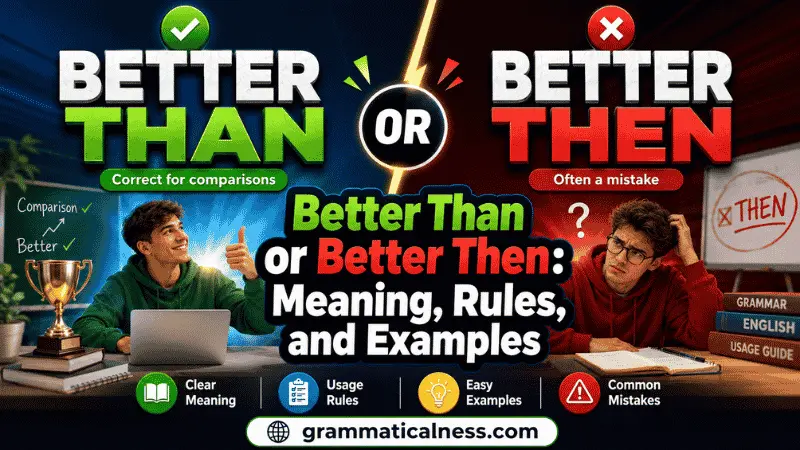
A single vowel changes the job of these two expressions. Better than introduces a comparison. Better then does not serve as an alternative comparison phrase, although those two words can appear together when then refers to a time or a later action.
That distinction matters in sentences about quality, skill, preference, health, and improvement. Once you identify whether the sentence compares two things or points to a time, the correct choice becomes clear.
Quick Answer
Use better than when comparing one person, thing, action, or situation with another.
- This camera is better than my old one.
- Jordan explains the process better than I do.
Use better then only when then has its own time or sequence meaning.
- I was sleeping better then.
- Make the introduction better, then review the conclusion.
For an ordinary comparison, better then is incorrect.
Why People Confuse Them
Than and then differ by one letter and can sound similar in fast conversation. Both are real words, so an incorrect choice may still look familiar.
The confusion also grows because better often appears near both words. It naturally takes than when a comparison follows, but it can appear before then when a speaker refers to a past time or gives the next step.
Key Differences At A Glance
| Feature | better than | better then |
| Main purpose | Introduces a comparison | Refers to time or sequence when the words happen to appear together |
| Grammatical relationship | A recognized comparative structure | Not a fixed comparison structure |
| Typical meaning | Superior, preferable, or more effective in comparison | Better at that time, or improve something and afterward act |
| Example | This option is better than the first. | I felt better then. |
Meaning and Usage Difference
Better than combines the comparative word better with than, which introduces the second part of an unequal comparison.
- The updated app works better than the previous version.
- A written plan may be better than a verbal promise.
- Lena handled the question better than anyone expected.
Depending on the sentence, better may describe a noun or modify an action. The comparison structure remains the same.
Better then is not a substitute for better than. It appears only when better completes one idea and then adds a time, result, or sequence meaning.
- I managed stress better then.
- The team played better then than it does now.
- Make the wording better, then submit the final copy.
In the last example, the comma helps show that then begins the next step.
Tone, Context, and Formality
Better than is standard in casual and formal American English. It works in conversation, messages, schoolwork, reports, and professional communication.
Better then is not an informal spelling of the comparison phrase. It is acceptable only when the sentence truly needs the time or sequence meaning of then.
Pronunciation can contribute to the mistake. In careful speech, then sounds like “then,” while than may sound like “than” or a weaker “thuhn” in quick speech. Meaning, not sound alone, should guide the spelling.
Which One Should You Use?
| Context | Best Choice | Why |
| Comparing two products | better than | Than introduces the second item in the comparison. |
| Comparing someone’s performance | better than | The sentence measures one performance against another. |
| Writing better than ever, expected, before, or nothing | better than | Each expression makes an explicit or implied comparison. |
| Referring to a past period | better then | Then means “at that time.” |
| Describing a next action | better, then | Then means “after that,” and punctuation often separates it. |
| Comparing the past with the present | better then than now | The first word points to time; the second introduces the comparison. |
Ask one question: Am I comparing, or am I pointing to a time or next step? Choose than for comparison and then for time or sequence.
When One Choice Sounds Wrong
Better then sounds wrong when a noun, pronoun, clause, amount, or expectation follows as the second part of a comparison.
Incorrect: This restaurant is better then the one downtown.
Correct: This restaurant is better than the one downtown.
Incorrect: The meeting went better then expected.
Correct: The meeting went better than expected.
The reverse mistake also occurs. If the sentence means “at that time,” than does not fit.
Incorrect: I was feeling better than.
Correct: I was feeling better then.
Common Mistakes (and Quick Fixes)
Writers often type better then ever, but ever creates an implied comparison with all earlier times. The correct expression is better than ever.
The same rule applies to better than before, better than expected, better than nothing, and better than me.
Do not remove then when it supplies a real time meaning. In “I understood the lesson better then,” the sentence means the understanding was stronger at that point in time.
Also watch punctuation. “Improve the opening, then check the ending” contains a sequence, not a comparison.
Everyday Examples
Better than examples:
- Today’s traffic was better than yesterday’s.
- This chair supports my back better than the other one.
- Her revised email sounds better than the first draft.
- Cooking at home is better than ordering takeout every night.
- The repair cost less and worked better than we expected.
Better then examples:
- My schedule was simpler, and I slept better then.
- He knew the neighborhood better then than he does today.
- The medication had started working, so she felt better then.
- Make the headline better, then shorten the opening paragraph.
- We communicated better then, before the team became so large.
Dictionary-Style Word Details
Verb
- better than: Not commonly used as a verb phrase. Better can function as a verb elsewhere, but better than normally forms part of a comparison.
- better then: Not a verb phrase. Better and then keep separate grammatical jobs when they appear together.
Noun
- better than: Not commonly used as a noun phrase in this comparison.
- better then: Not commonly used as a noun phrase. Then can function as a noun in expressions such as “until then,” but that does not make better then a noun.
Synonyms
- better than: Closest plain alternatives include superior to, preferable to, more suitable than, and more effective than, depending on context. A useful opposite is worse than.
- better then: No fixed synonym exists because it is not one set expression. In time contexts, the closest alternative is better at that time. In sequence contexts, it may mean improve it, afterward.
Example Sentences
- better than: The new checkout process is better than the old one.
- better than: She remembers names better than I do.
- better then: I had fewer responsibilities and slept better then.
- better then: The system worked better then than it does after the update.
Word History
Than and then are historically related, and their spellings were not always kept as separate as they are today. Modern English gives them distinct roles: than introduces comparisons, while then refers mainly to time, order, or consequence.
Better is the comparative form connected with good and well. Therefore, better than follows the normal modern comparison pattern. Better then appears only when the separate meaning of then is required.
Phrases Containing
- better than: better than ever; better than expected; better than nothing; better than before; better late than never.
- better then: No standard fixed phrase. Natural time-based strings include felt better then, slept better then, and worked better then. A sequence often appears with punctuation, as in make it better, then send it.
FAQs
Yes. When better introduces a comparison between people, things, actions, amounts, or situations, than is the correct connector. Write “This route is better than the highway” and “She communicates better than I do.” Then does not perform that comparison job.
Yes, but only when then refers to a time or next step rather than introducing a comparison. “I was sleeping better then” means your sleep was better at that time. In “Make it better, then send it,” the comma separates the sequence.
Yes. Better than me is common and accepted when than functions like a preposition. Better than I am is also correct and makes the implied clause explicit. Choose the version that sounds natural and keeps the intended comparison clear.
Write better than ever. The phrase compares the present quality, condition, or performance with every earlier point, so it requires than. Better then ever does not express that comparison and is incorrect in standard American writing.
No. Formality does not turn then into a comparison word. Better than works in texts, conversation, school assignments, reports, and professional messages. Better then remains limited to sentences where then genuinely means at that time, afterward, or in that case.
Replace than with “in comparison with” and then with “at that time.” If “in comparison with” preserves the meaning, choose better than. If “at that time” works, better then may be correct. Also check whether a comma is needed before sequence-based then.
Conclusion
Use better than whenever the sentence compares quality, skill, suitability, results, or preference. Use better then only when then independently means “at that time” or introduces what happens next.
The fastest check is simple: if the sentence means better in comparison with, choose than. If it means better at that time, choose then.