

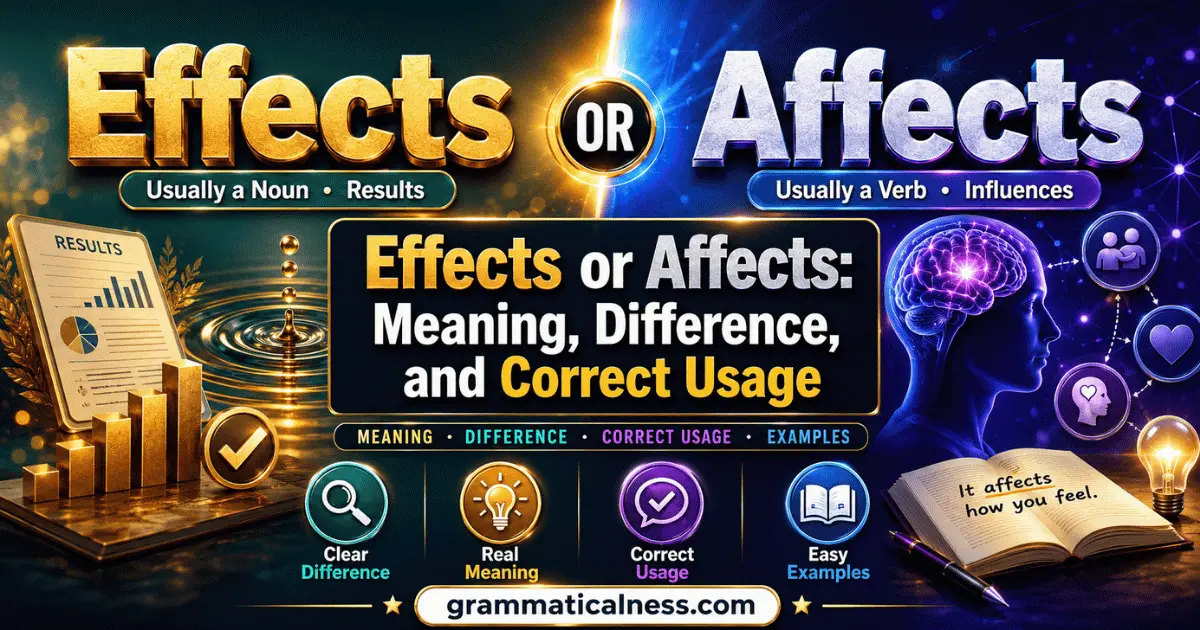
Both effects and affects are correct English words, but they usually perform different jobs.
In everyday writing, effects most often means results, consequences, or outcomes. Affects most often means influences, changes, or has an impact on something.
For example:
- Lack of sleep affects concentration.
- Lack of sleep can have several negative effects.
The final -s adds another layer to the familiar affect-and-effect confusion. Understanding what job the word performs in your sentence makes the choice much easier.
Quick Answer
Use affects when a singular subject influences or changes someone or something.
Use effects when you mean multiple results, consequences, impressions, or belongings.
There are two less-common exceptions. Effects can be a verb meaning “brings about,” while affects can be a specialized plural noun referring to emotional expressions or states.
| Context | Best Choice | Why |
| Something influences another thing | affects | Usually a third-person singular verb |
| Multiple results or consequences | effects | Usually a plural noun |
| Belongings or possessions | effects | Used in expressions such as personal effects |
| Something brings a result into existence | effects | Less-common verb meaning brings about |
| Multiple emotional expressions in psychology | affects | Specialized plural noun |
A useful everyday pattern is:
Something affects something, and that influence produces effects.
Why People Confuse Them
The words look almost identical, sound very similar in normal speech, and share the general idea of change or influence.
The ending also creates confusion. Both words end in -s, but that -s does different grammatical work.
In affects, it usually marks a present-tense verb used with a singular third-person subject:
- Stress affects sleep.
- Weather affects traffic.
In effects, it usually makes the noun effect plural:
- Stress has several effects.
- The storm caused widespread effects.
Because English allows both base words to have less-common grammatical roles, a simple spelling trick is helpful but not perfect.
Key Differences At A Glance
- effects — usually a plural noun meaning results, consequences, impressions, or belongings.
- affects — usually a verb meaning influences or causes a change in.
- effects as a verb — means brings about, produces, or accomplishes.
- affects as a noun — appears mainly in specialized psychological contexts involving emotional expression or states.
For most everyday sentences, first ask whether you need an action or a result.
An action that influences something usually affects it. The results of that action are usually its effects.
Meaning and Usage Difference
The most common meaning of affects is “influences” or “causes a change in.”
Consider:
- Inflation affects household budgets.
- Screen time affects some people’s sleep.
- Heavy rain affects morning traffic.
In each example, the word describes what one thing does to another.
Effects, by contrast, most commonly refers to results or consequences:
- The medication caused several side effects.
- Researchers examined the long-term effects of the change.
- The storm’s effects were visible throughout the neighborhood.
A useful sentence test is to replace the word mentally.
If influences fits, choose affects:
“Noise influences concentration.”
“Noise affects concentration.”
If results or consequences fits, choose effects:
“The results of the storm lasted for days.”
“The effects of the storm lasted for days.”
There is one important exception with effects as a verb:
- The new leadership effects major changes.
Here, effects means “brings about” or “causes to happen.” This use is less common than the ordinary plural noun.
Tone, Context, and Formality
In their usual roles, neither word is especially formal.
Affects appears naturally in everyday, academic, business, medical, and professional writing:
- The delay affects our schedule.
- Temperature affects battery performance.
The plural noun effects is equally common:
- We noticed the effects immediately.
- The report examines the economic effects of the decision.
The verb effects, meaning “brings about,” tends to sound more formal:
- The agreement effects a transfer of ownership.
- The reform effects substantial change.
In casual writing, people often use causes, creates, or brings about instead.
As a noun, affect has a specialized use connected with emotion and observable emotional expression. Its plural, affects, is therefore much less common in ordinary conversation.
Which One Should You Use?
Choose affects when the subject is doing the influencing.
- This decision affects everyone.
- Cold weather affects the battery.
- Her schedule affects when we can meet.
Choose effects when you can count or describe the results.
- The change had several unexpected effects.
- We are still feeling the effects of the storm.
- The medicine may cause mild side effects.
Also use effects for possessions in established expressions:
- The traveler collected his personal effects.
A harder case appears with change:
- The policy affects change.
- The policy effects change.
Both can be grammatical, but they do not mean the same thing.
Affects change means the policy influences change that exists or is occurring.
Effects change means the policy causes or brings the change about.
When One Choice Sounds Wrong
Some sentences become much easier when you identify whether the missing word names an action or a result.
“The medication has several affects.”
In ordinary medical usage, this sounds wrong because the sentence refers to consequences. Write:
“The medication has several effects.”
“The weather effects my mood.”
This is usually wrong because the intended meaning is “influences.” Write:
“The weather affects my mood.”
“The new manager affects major improvements.”
This says the manager influences the improvements. That may be possible, but when the intended meaning is “brings them about,” write:
“The new manager effects major improvements.”
Context determines the meaning rather than the first letter alone.
Common Mistakes (and Quick Fixes)
A common mistake is writing affects after words such as side, lasting, or negative when the writer means consequences.
Incorrect: The treatment caused several side affects.
Correct: The treatment caused several side effects.
Another mistake is using effects whenever a singular subject comes before the word simply because it looks like a verb.
Incorrect: Stress effects my sleep.
Correct: Stress affects my sleep.
Use effects as a verb only when you genuinely mean brings about or causes to happen.
Correct: The agreement effects an immediate change in ownership.
Finally, remember that personal effects refers to personal belongings. In that expression, affects is not the normal choice.
Everyday Examples
Here are natural examples showing the distinction:
- Rising prices affect how families plan their monthly budgets.
- The economic effects may continue for months.
- Traffic affects my morning commute.
- We could still see the effects of yesterday’s storm.
- Music affects my concentration differently depending on the task.
- The medication may produce unwanted side effects.
- A schedule change affects everyone on the team.
- The company studied the long-term effects of remote work.
- The new procedure effects a complete transfer of responsibility.
- Guests were asked to collect their personal effects before leaving.
The pattern remains consistent in most everyday writing: affects describes influence, while effects names the resulting outcomes.
Dictionary-Style Word Details
Verb
effects: A valid third-person singular form of the verb effect. It means brings about, produces, accomplishes, or causes something to happen.
Example: The new agreement effects an immediate change.
This use is correct but less common and usually more formal than the ordinary noun use.
affects: The common third-person singular form of affect. It means influences, acts on, or causes a change in someone or something.
Example: Humidity affects how comfortable the room feels.
Noun
effects: Most commonly the plural of effect, meaning results, consequences, or things produced by a cause.
Example: The storm had lasting effects.
It can also mean belongings, especially in personal effects or similar expressions.
affects: A valid but specialized plural noun. In psychology and related fields, affect can refer to emotional experience or observable emotional expression, making affects possible when discussing multiple such states or expressions.
This noun use is uncommon in ordinary everyday English.
Synonyms
effects, when meaning results:
Closest plain alternatives include results, consequences, outcomes, impacts, depending on context.
When used as a verb, closest alternatives include causes, produces, brings about, accomplishes.
affects, when used as a verb:
Closest plain alternatives include influences, changes, alters, impacts.
For the specialized noun affects, no single everyday synonym matches every technical use. Emotional states or emotional expressions may serve as plain-language alternatives depending on context.
Example Sentences
effects:
- Exercise can have positive effects on overall well-being.
- The special effects made the movie scene more convincing.
- The traveler packed his personal effects before checking out.
- The agreement effects a change in the payment structure.
affects:
- Lack of sleep affects my ability to focus.
- The new schedule affects every employee on the morning shift.
- Weather often affects weekend travel plans.
- The condition affects how the body processes certain nutrients.
Word History
effects: This form comes from the base word effect. The English word developed from French and Latin sources connected with Latin effectus and efficere, carrying ideas such as accomplishment, result, and bringing something about.
affects: This form comes from the base word affect. Its history traces to Latin afficere and related forms associated with acting on, influencing, or producing an effect on something.
The historical relationship helps explain why the words are connected in meaning, but modern grammar gives them different common roles.
Phrases Containing
effects:
Common expressions include:
- side effects
- special effects
- personal effects
- lasting effects
- harmful effects
- positive effects
- long-term effects
affects:
The word appears more often in regular grammatical patterns than in fixed expressions:
- affects me
- affects everyone
- affects the outcome
- affects how
- affects your health
- affects performance
In specialized psychological writing, positive affects and negative affects may also occur when affect is being used as a technical noun.
FAQs
Affects usually works as a verb meaning “influences” or “changes something.” Effects usually works as a plural noun meaning “results” or “consequences.” For example, “Weather affects traffic” describes influence, while “The storm had several effects” describes results.
In most everyday sentences, affects me is correct because you mean that something influences you. For example, “Lack of sleep affects me at work.” Effects me would be unusual because the verb effect means to bring something about rather than simply influence it.
The correct expression is side effects. Here, effects means unwanted or additional results caused by medicine, treatment, or another action. For example, “This medication may cause mild side effects.”
Yes. Effects can function as a verb meaning “brings about,” “produces,” or “causes something to happen.” For example, “The new policy effects major changes.” This use is correct but less common than effects as a plural noun.
Yes, but this use is uncommon in everyday English. In psychology, affect can refer to emotional experience or observable emotional expression. Therefore, affects can appear as its plural form in specialized professional or academic contexts.
Think of affects as an action and effects as results. Something usually affects another thing, and that influence may produce effects. This shortcut works in most everyday sentences, although the less-common verb effects and specialized noun affects remain valid exceptions.
Conclusion
Choosing between effects or affects becomes easier once you identify the word’s job.
Use affects most often as a verb meaning influences or changes:
“Stress affects sleep.”
Use effects most often as a plural noun meaning results or consequences:
“Stress can have several harmful effects.”
Remember the two exceptions when context requires them. Effects can mean “brings about” as a verb, while affects can be a specialized plural noun in psychology.
For everyday writing, the simplest reliable pattern is: something affects something, and that influence can produce effects.