
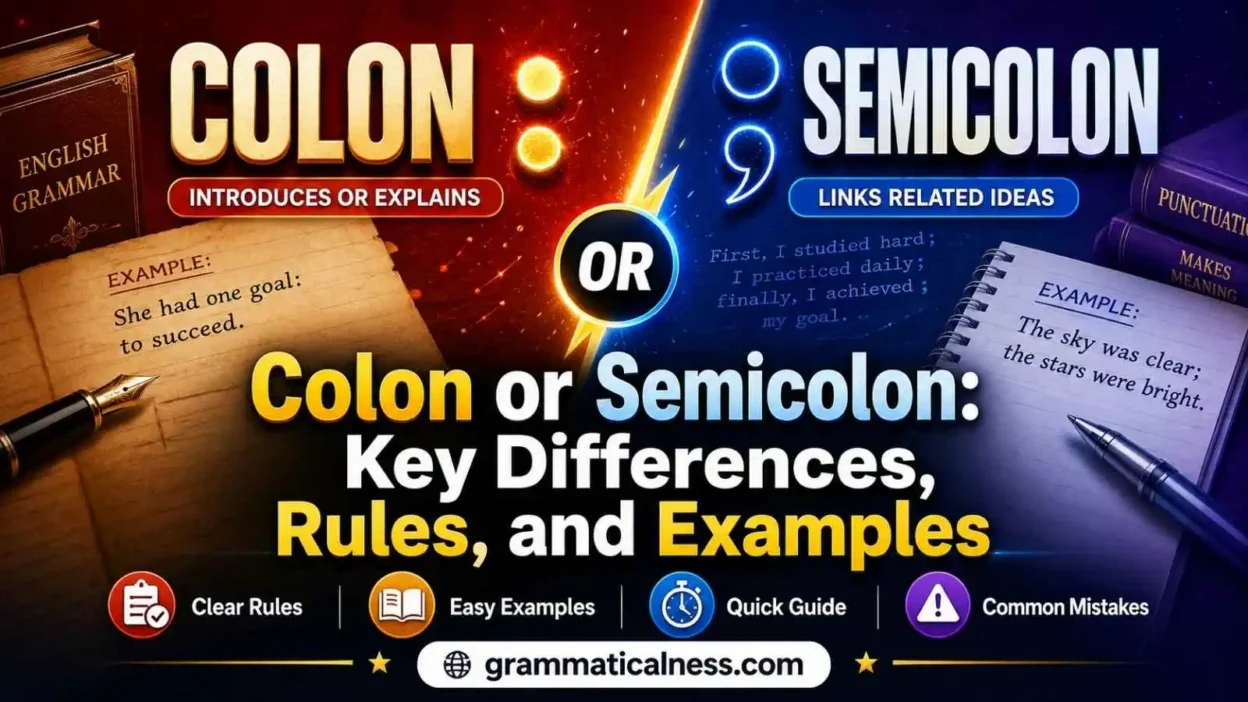
A colon and a semicolon are punctuation marks with different jobs. A colon points forward to information that explains, identifies, or lists something. A semicolon links two complete, closely related thoughts or separates complicated list items.
The correct choice depends on the relationship between the words on each side.
Quick Answer
Use a colon (:) when the second part introduces, explains, defines, or expands on the first part.
Use a semicolon (;) to connect two closely related independent clauses without a coordinating conjunction. Semicolons also separate list items that already contain commas.
Compare:
- We need three supplies: paper, tape, and scissors.
- The supply room is locked; Maria has the key.
Why People Confuse Them
The marks look similar, and both can appear between related parts of a sentence. Their names may also make the semicolon sound like a smaller colon, but that is not a reliable usage rule.
When two complete clauses appear together, either mark may sometimes be grammatical, but the meaning changes. A colon makes the second clause an explanation or result of the first. A semicolon presents two related thoughts with more equal weight.
Key Differences At A Glance
| Context | Best Choice | Why |
| Introducing a list after a complete clause | Colon | It points forward to the items |
| Introducing an explanation or definition | Colon | The second part clarifies the first |
| Joining closely related complete clauses | Semicolon | It connects equal, independent thoughts |
| Separating list items that contain commas | Semicolon | It prevents confusion |
| Writing a time such as 8:30 | Colon | It separates hours and minutes |
| Punctuating before “however” between clauses | Semicolon | Both clauses are complete |
Meaning and Usage Difference
A colon signals that what follows explains, illustrates, defines, or restates what came before. A semicolon creates a firm connection between two independent clauses. Each clause could stand as a separate sentence.
| Feature | colon | semicolon |
| Symbol | : | ; |
| Main sentence job | Introduces or explains | Connects or separates |
| Clause relationship | Second part expands the first | Both parts have similar grammatical weight |
| List use | Introduces a list | Divides complex list items |
Compare:
- The meeting was canceled: the manager was sick.
- The meeting was canceled; the team went home.
The colon introduces the reason. The semicolon links two related events without making the second a direct explanation.
Tone, Context, and Formality
Both marks are standard in American English. A colon creates expectation and places emphasis on what follows. A semicolon creates a measured connection and may feel more polished or literary than two short sentences.
Capitalization after a colon can depend on house style. Lowercase is common before a phrase or list. A capital may be used before a complete sentence, quotation, or specially emphasized statement. After a semicolon, the next word normally begins with lowercase unless it is a proper noun or another word that is always capitalized.
Which One Should You Use?
Choose a colon when you can read the mark as “here it is,” “namely,” or “as follows.”
The apartment has one major problem: the kitchen is too small.
Choose a semicolon when both sides are complete sentences and you want a close connection without adding and, but, or another coordinating conjunction.
The apartment is affordable; the neighborhood is expensive.
For a list, ask whether you are introducing the list or separating complicated items. A colon introduces; semicolons separate.
The tour includes three stops: Austin, Texas; Santa Fe, New Mexico; and Phoenix, Arizona.
When One Choice Sounds Wrong
A semicolon is wrong before a simple list.
Incorrect: Please bring three items; a notebook, a pen, and an ID.
Correct: Please bring three items: a notebook, a pen, and an ID.
A colon is usually wrong when the words before it do not form a complete thought in a regular sentence.
Incorrect: My favorite snacks are: popcorn and pretzels.
Correct: I have two favorite snacks: popcorn and pretzels.
A semicolon is also wrong when one side cannot stand alone.
Incorrect: Because traffic was heavy; we arrived late.
Correct: Because traffic was heavy, we arrived late.
Common Mistakes (and Quick Fixes)
Using a colon after a verb
Wrong: The package contains: a charger and a cable.
Fix: The package contains a charger and a cable.
Joining complete clauses with only a comma
Wrong: The store was closing, we hurried inside.
Fix: The store was closing; we hurried inside.
Using a semicolon before a coordinating conjunction
Standard: The store was closing, so we hurried inside.
Forgetting the comma after a transition
Correct: The forecast looked clear; however, the game was postponed.
The semicolon separates the clauses, while the comma sets off however.
Everyday Examples
Colon examples
- Jenna had one request: arrive before noon.
- The recipe needs four ingredients: eggs, flour, milk, and sugar.
- The reason was simple: nobody confirmed the reservation.
- The webinar begins at 6:30 p.m.
Semicolon examples
- I sent the form yesterday; the office has not replied.
- The coffee was cold; I drank it anyway.
- We could drive tonight; otherwise, we can leave early tomorrow.
- The guests came from Portland, Maine; Portland, Oregon; and Portland, Texas.
Meaning-changing comparison
- I know what caused the outage: a damaged cable.
- I know what caused the outage; the repair crew is already working.
The colon introduces the answer. The semicolon links two related statements.
Dictionary-Style Word Details
Verb
- colon: Not commonly used as a verb for punctuation in standard US English.
- semicolon: Not commonly used as a verb. Editors usually say “add a semicolon.”
Noun
- colon: A two-dot punctuation mark that introduces information and separates parts of times, ratios, and certain formats.
- semicolon: A punctuation mark made of a dot above a comma. It links related independent clauses and separates complex list items.
Synonyms
Neither term has a true one-word synonym in its punctuation meaning.
- colon: Closest plain alternatives include “introducing mark” and “two-dot punctuation mark.”
- semicolon: Closest plain alternatives include “clause-linking mark” and “complex-list separator.”
Clear antonyms do not apply because these marks are not opposites.
Example Sentences
- colon: Use a colon after the complete introduction: “We need one volunteer: Carlos.”
- semicolon: Use a semicolon between related clauses: “Carlos volunteered; the team thanked him.”
Word History
- colon: The punctuation name came through Latin from a Greek word connected with a limb, section, or clause.
- semicolon: The name combines semi- with colon. The mark became established through Renaissance printing.
Phrases Containing
- colon: “use a colon,” “colon before a list,” “colon after a salutation,” “colon-separated time”
- semicolon: “use a semicolon,” “semicolon between clauses,” “semicolon before however,” “semicolon-separated list”
FAQs
What is the main difference between a colon and a semicolon?
A colon introduces information that explains, identifies, or expands on what comes before it. A semicolon connects two closely related independent clauses or separates complicated list items.
Example with a colon:
She brought one essential item: her passport.
Example with a semicolon:
She packed early; her brother waited until morning.
Should I use a colon or semicolon before a list?
Use a colon to introduce a list when the words before it form a complete sentence.
Correct:
The office needs three supplies: paper, ink, and folders.
Do not normally place a colon directly after a verb or preposition.
Incorrect:
The office needs: paper, ink, and folders.
Can a semicolon introduce a list?
A semicolon does not normally introduce a simple list. However, semicolons can separate list items when those items already contain commas.
Example:
The conference welcomed guests from Austin, Texas; Denver, Colorado; and Miami, Florida.
A colon may still introduce the entire list.
Do you use a colon or semicolon before “however”?
Use a semicolon before however when it connects two independent clauses. Place a comma after however.
Correct:
The restaurant was busy; however, we found a table.
You may also divide the thoughts into two sentences:
The restaurant was busy. However, we found a table.
Is a semicolon stronger than a comma?
Yes. A semicolon creates a stronger break than a comma but a softer break than a period. It can join two related complete sentences without a coordinating conjunction.
Correct:
The deadline is Friday; we should finish the report today.
A comma alone would create a comma splice:
The deadline is Friday, we should finish the report today.
Conclusion
Use a colon to point forward to an explanation, definition, example, or list. Use a semicolon to connect closely related complete clauses or divide complex list items.
Ask what relationship the second part has to the first. If it explains or introduces, choose the colon. If it stands as a related but equal complete thought, choose the semicolon.
A colon introduces information that explains, identifies, or expands on what comes before it. A semicolon connects two closely related independent clauses or separates complicated list items.
Example with a colon:
She brought one essential item: her passport.
Example with a semicolon:
She packed early; her brother waited until morning.
Use a colon to introduce a list when the words before it form a complete sentence.
Correct:
The office needs three supplies: paper, ink, and folders.
Do not normally place a colon directly after a verb or preposition.
Incorrect:
The office needs: paper, ink, and folders.
A semicolon does not normally introduce a simple list. However, semicolons can separate list items when those items already contain commas.
Example:
The conference welcomed guests from Austin, Texas; Denver, Colorado; and Miami, Florida.
A colon may still introduce the entire list.
Use a semicolon before however when it connects two independent clauses. Place a comma after however.
Correct:
The restaurant was busy; however, we found a table.
You may also divide the thoughts into two sentences:
The restaurant was busy. However, we found a table.
Yes. A semicolon creates a stronger break than a comma but a softer break than a period. It can join two related complete sentences without a coordinating conjunction.
Correct:
The deadline is Friday; we should finish the report today.
A comma alone would create a comma splice:
The deadline is Friday, we should finish the report today.