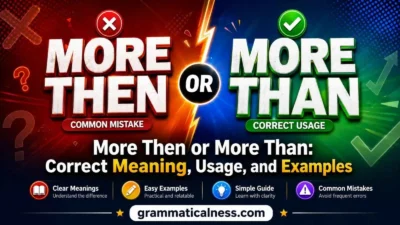
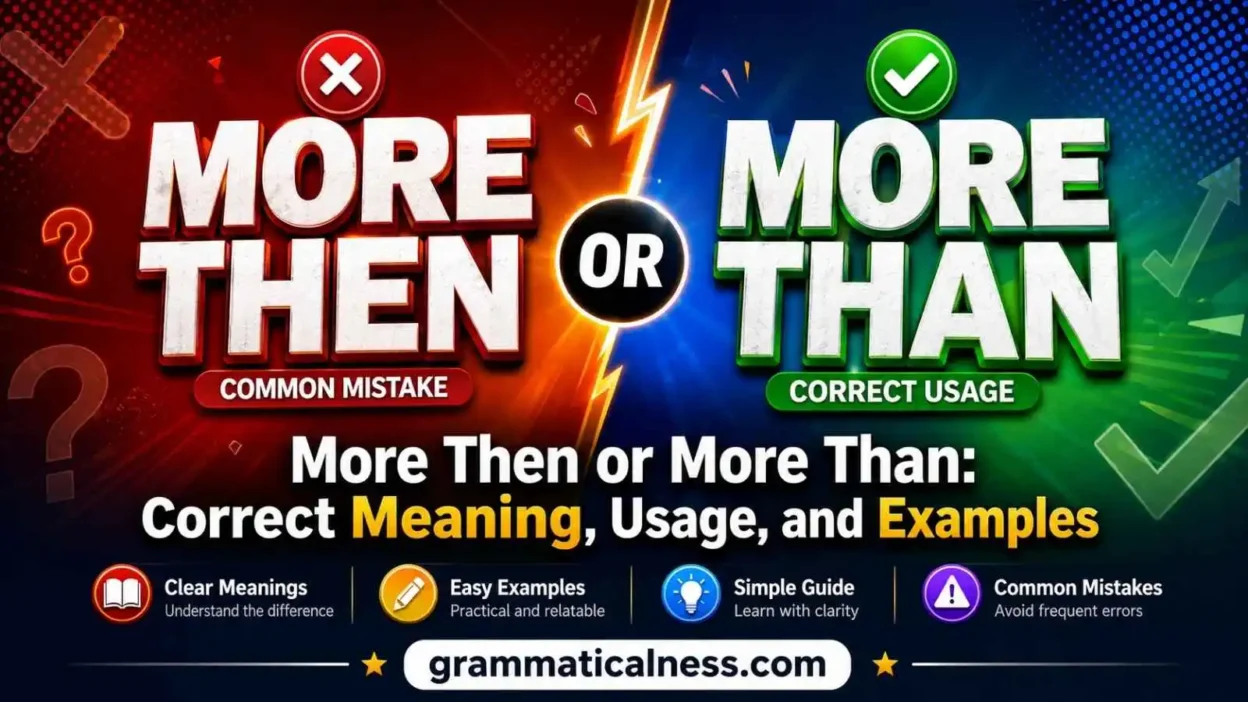
The correct choice is usually more than because than introduces a comparison or a quantity limit.
Use it in sentences such as “The repair cost more than $500” and “She enjoys reading more than watching television.”
More then is usually a mistake in those structures. However, the two words can occasionally appear together when more completes one idea and then refers to time, sequence, or a result.
Quick Answer
Use more than when comparing things, describing an amount above a limit, or strengthening an idea.
Use more then only when the words have separate jobs. In that case, more means an additional amount, while then means “at that time,” “next,” or “in that case.”
For most everyday sentences, more than is the correct choice.
Why People Confuse Them
The confusion comes from the similarity between than and then. They differ by only one letter and may sound close during fast conversation.
Than can have a reduced sound similar to “thuhn” when it is not stressed. Then normally sounds like “then.” Because speakers do not always pronounce than strongly, writers may type the more familiar-looking then.
Another problem is that both words can appear after more. However, their grammatical jobs remain different. Than completes a comparison, while then points to time, order, or a result.
Key Differences At A Glance
| Context | Best Choice | Why |
| Comparing two choices | more than | Than introduces the second part of the comparison. |
| Describing an amount above a number | more than | The phrase means “over” or “exceeding.” |
| Expressing a stronger degree | more than | It strengthens an adjective or feeling. |
| Using expressions such as “ever” or “enough” | more than | These are established comparison or degree patterns. |
| Showing what happens next | more then | The words may appear separately, usually across a clause break. |
| Referring to a previous time | more then | Then can mean “at that time.” |
Meaning and Usage Difference
The central difference is whether the sentence expresses a comparison or uses then as a time or sequence word.
- more than: A standard combination used for comparisons, quantities, limits, preferences, and degrees.
- more then: Not normally a fixed expression. It is possible only when more and then perform separate functions.
In “Lena has more experience than Carlos,” the sentence compares two people. In “The package weighs more than 20 pounds,” the phrase identifies an amount above a limit.
The expression can also strengthen an attitude or quality. “I am more than willing to help” means the speaker is very willing or completely prepared to help.
By contrast, consider “We need more, then we can leave.” Here, more refers to an additional amount. After the comma, then introduces the next result. The sentence does not use more then as a comparison phrase.
Tone, Context, and Formality
More than is neutral and standard in casual conversation, schoolwork, business communication, journalism, and formal writing. It does not sound unusually formal or informal.
More then is not a casual substitute for more than. Changing the vowel changes the grammatical function.
A valid sequence containing more followed by then may appear in any register, but it usually needs enough context or punctuation to keep the meaning clear. Without that support, readers will probably interpret it as a typing or spelling error.
There is no meaningful US-versus-UK preference in this distinction. Standard English uses than for comparisons and then for time, order, and results.
Which One Should You Use?
Choose more than when you can replace the expression with “over,” “above,” “exceeding,” or “compared with.”
“The concert lasted more than two hours” can be understood as “The concert lasted over two hours.”
Choose more then only when then can be replaced with “at that time,” “next,” or “in that case.”
For example, “Sales were strongest in December, and we earned more then” means the company earned more at that time. The word then refers back to December.
A second test is punctuation. When then introduces the next clause, a comma may separate it from more: “Order more, then update the inventory record.”
When One Choice Sounds Wrong
More then sounds wrong when the sentence compares people, things, amounts, actions, or qualities.
“She has more then five appointments” is incorrect because the sentence describes a quantity above five. Write “She has more than five appointments.”
“We need you more then ever” is also incorrect. The expression compares the present need with the level of need at other times, so the correct form is “more than ever.”
More than sounds wrong when the writer means “next.” For example, “Finish your application, more than submit the fee” does not work. The correct sentence is “Finish your application, then submit the fee.”
Common Mistakes (and Quick Fixes)
A common mistake is writing more then before a number. Amounts above a limit take more than: “more than 50 guests,” “more than three days,” and “more than $1,000.”
Writers also misspell expressions that show strong willingness or emotion. Use “more than happy,” “more than grateful,” “more than ready,” and “more than willing.”
Another error is assuming then is an informal version of than. It is not. Informal and formal writing follow the same basic distinction.
For a quick correction, ask whether the sentence compares or exceeds something. If it does, choose than. If the word points to a time, next step, or result, choose then.
Everyday Examples
Quantity: The fundraiser collected more than $8,000 in one weekend.
Preference: I enjoy working from home more than commuting downtown.
Comparison: This year’s health plan costs more than the previous plan.
Degree: We are more than prepared for Friday’s presentation.
Emphasis: Your support is more than appreciated.
Sequence: Add more, then check the total again.
Conditional result: If the team practices more, then its timing should improve.
Past-time reference: Business was busiest during the holidays, and the store hired more then.
Dictionary-Style Word Details
Verb
more then: The combination does not function as a verb. A sentence may place the adverb then after a verb phrase ending in more, but the words remain separate.
more than: The expression does not function as a verb. It normally introduces a comparison, amount, or degree.
Noun
more then: It is not normally a noun expression. Although then can have a noun-like role in phrases such as “until then,” that role does not make more then a noun.
more than: It is not normally used as a noun. It works as a comparison or quantity expression within a larger sentence.
Synonyms
more then: The combination has no fixed synonym because it has no single fixed meaning. Depending on the sentence, alternatives for then include “at that time,” “next,” “after that,” and “in that case.”
more than: Closest plain alternatives include “over,” “above,” “greater than,” and “exceeding” for quantities. In expressions of degree, possible alternatives include “very,” “fully,” or “beyond.” The clearest quantitative opposite is less than.
Example Sentences
more then: “We need more, then we can finish the shipment.” “If you contribute more, then we will reach the goal.” “Demand peaked in July, and the factory produced more then.”
more than: “More than 200 customers attended the opening.” “She values honesty more than popularity.” “The staff was more than ready for the inspection.”
Word History
more then: This is not a separate established expression with its own independent history. It consists of more followed by then when the sentence requires both words separately.
more than: The expression combines more with the comparison word than. Than and then developed from historically related English forms, but modern standard usage assigns them different functions.
Phrases Containing
more then: There are no common fixed expressions built around this combination. Valid appearances depend on the sentence, such as “more, then continue” or “more then,” meaning “more at that time.”
more than: Common expressions include “more than ever,” “more than enough,” “more than likely,” “more than willing,” “more than one,” “no more than,” and “nothing more than.”
FAQs
Is it more then or more than?
More than is correct when you are comparing two things, describing an amount above a number, or emphasizing a feeling. For example, write “more than five minutes,” “more than ready,” and “more than ever.” More then is usually incorrect in these situations.
Can more then ever be correct?
No. The correct expression is more than ever. It compares the current degree of something with its degree at previous times. For example, “She needs support more than ever” means she needs a greater amount of support now.
Is it more then happy or more than happy?
The correct expression is more than happy. It means very happy, fully willing, or pleased to do something. For example, “I would be more than happy to answer your questions.”
Can more then ever be grammatically correct?
The words more and then can appear next to each other when they have separate functions, but not in the expression more then ever. For example, “Order more, then check the total” is correct because then means “next.”
Is it no more then or no more than?
The correct form is no more than. It can mean “not exceeding” or “only.” For example, “The meeting lasted no more than 20 minutes” means it did not last longer than 20 minutes.
How can I remember the difference between more then and more than?
Remember that than is used for comparisons. Both than and comparison contain the letter a. Use then for time or order, as in “first complete the form, then submit it.” When more compares amounts or degrees, choose more than.
Conclusion
Use more than for comparisons, quantities, limits, preferences, and expressions of degree. It is correct in sentences such as “more than ten people,” “more than ready,” and “more than ever.”
Do not replace than with then in those structures.
The words more then can occasionally appear together, but they do not form a competing comparison expression. They are correct only when more completes one idea and then means “at that time,” “next,” or “in that case.”
When a sentence compares or exceeds something, more than is the dependable choice.
More than is correct when you are comparing two things, describing an amount above a number, or emphasizing a feeling. For example, write “more than five minutes,” “more than ready,” and “more than ever.” More then is usually incorrect in these situations.
No. The correct expression is more than ever. It compares the current degree of something with its degree at previous times. For example, “She needs support more than ever” means she needs a greater amount of support now.
The correct expression is more than happy. It means very happy, fully willing, or pleased to do something. For example, “I would be more than happy to answer your questions.”
The words more and then can appear next to each other when they have separate functions, but not in the expression more then ever. For example, “Order more, then check the total” is correct because then means “next.”
The correct form is no more than. It can mean “not exceeding” or “only.” For example, “The meeting lasted no more than 20 minutes” means it did not last longer than 20 minutes.
Remember that than is used for comparisons. Both than and comparison contain the letter a. Use then for time or order, as in “first complete the form, then submit it.” When more compares amounts or degrees, choose more than.