

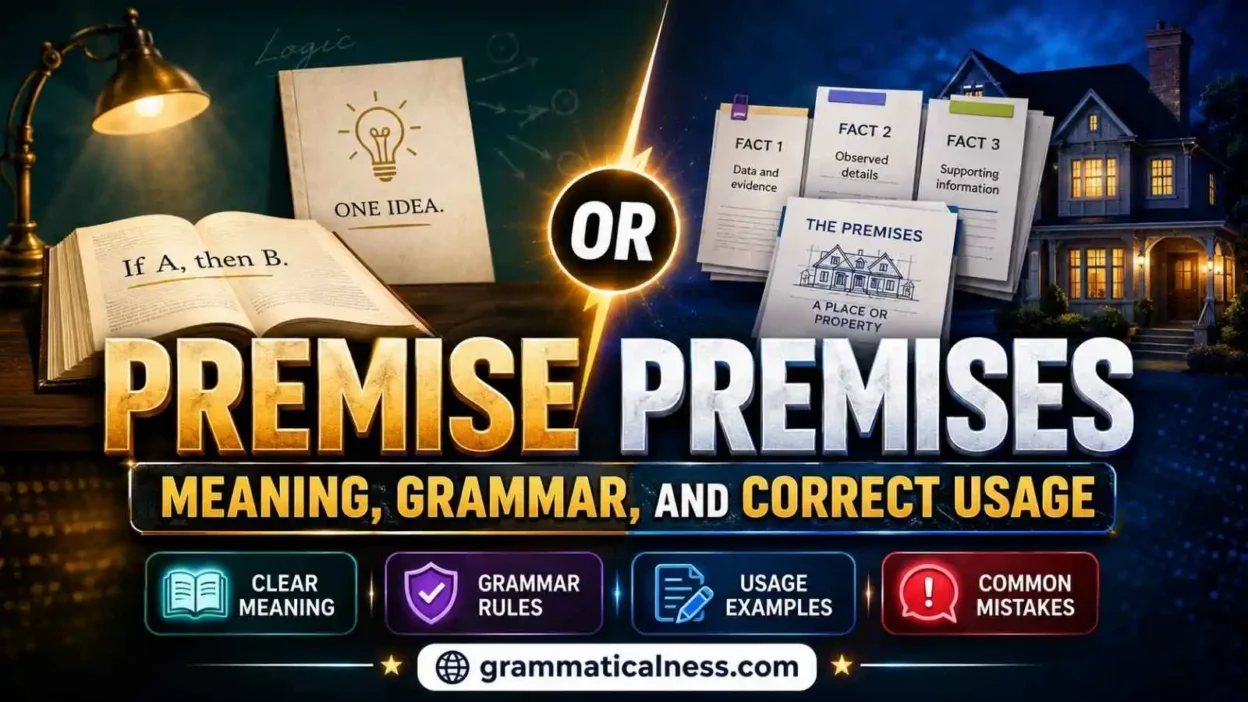
Both premise and premises are correct English words, but the right choice depends on what you are describing.
A premise is usually an idea, assumption, or starting point. Premises can be the plural of that word, but it also has a separate property meaning. This second meaning causes most of the confusion.
Quick Answer
Use premise for one idea, assumption, proposition, or story setup. Use premises for two or more propositions or for a building and its surrounding property.
A theory may rest on one premise. An argument may contain several premises. A business may also ask visitors to leave the premises, even when it operates at only one location.
Why People Confuse Them
The confusion begins because premises performs two different jobs.
First, it is the regular plural of premise. One supporting statement is a premise, while several supporting statements are premises.
Second, premises can mean a building, land, or an entire business location. In this property sense, it may describe one site. Writers sometimes remove the final s because they assume one location should be a premise. Standard usage does not follow that pattern.
The terms also look almost identical, although their usual noun pronunciations differ. Premise sounds like PREM-iss, while premises sounds like PREM-uh-siz.
Key Differences At A Glance
| Context | Best Choice | Why |
| One idea or assumption | premise | It is a singular countable noun. |
| One supporting statement in an argument | premise | One proposition is one premise. |
| Two or more supporting statements | premises | It is the plural of premise. |
| The setup of a movie, book, or show | premise | The word describes the central starting concept. |
| A building, business site, or surrounding land | premises | This is the established property meaning. |
| Something located at a physical site | on the premises or on-premises | The expression refers to a location, not an assumption. |
| Basing an argument on an assumption | premise | It can function as a formal verb. |
Meaning and Usage Difference
The clearest distinction depends on whether you mean an idea, several ideas, or physical property.
- Premise: one idea, assumption, proposition, or creative setup.
- Premises: two or more ideas or propositions.
- Premises: a building, land, or business property, including one physical location.
As a noun, premise often introduces the foundation of an argument: “The proposal rests on the premise that demand will increase.”
It also describes the basic setup of a creative work: “The series has a clever premise.”
When several supporting claims are involved, use premises: “The conclusion follows from two premises.”
The property sense works differently. A store, school, office, warehouse, or private site may be called premises. Although the location can be singular in reality, the word normally takes a plural verb: “The premises are closed.”
Premise can also be a formal verb meaning to base a theory or argument on something. The verb is often pronounced prih-MIZE, although PREM-iss is also recorded. For example, “The report premises its forecast on stable fuel prices.”
Tone, Context, and Formality
Premise is common in academic, professional, critical, and creative discussions. It can sound formal when referring to reasoning, but it is natural in everyday comments about movies, books, and television shows.
“The premise of the comedy is simple” sounds completely ordinary.
Premises meaning property has a more official or businesslike tone. It commonly appears in safety notices, leases, company policies, security instructions, and public signs.
“Food may not be removed from the premises” sounds more formal than “Food may not be taken outside the building.”
Neither form is limited to one national variety of English. The main difference is meaning and number, not a general American-versus-British preference.
Which One Should You Use?
Ask what the word represents.
When you mean one central belief, proposition, or story setup, choose premise. Write “the premise of the argument,” “a false premise,” or “the movie’s premise.”
When you mean several supporting ideas, choose premises. Write “the argument contains three premises.”
When you mean a physical location, building, or property, choose premises. Write “Visitors must remain on the premises” or “The company moved to larger premises.”
For equipment or services kept at a company’s physical site, on-premises is the safer choice in careful writing: “The company uses on-premises servers.” After a verb, the phrase is normally open: “The servers are located on the premises.”
When One Choice Sounds Wrong
Premise sounds wrong when it is used as a singular property word.
“The restaurant premise closes at midnight” incorrectly makes premise mean a business location. Write “The restaurant premises close at midnight,” “The restaurant closes at midnight,” or “The building closes at midnight.”
Premises sounds wrong when you mean one central idea.
“The premises of the movie is interesting” suggests several propositions and also creates an agreement problem. Write “The premise of the movie is interesting.”
“The premises is secure” is also unsuitable in standard edited English. Because property-related premises is plural in form, write “The premises are secure.”
The form on-premise is widespread in technology writing. However, many careful usage references still prefer on-premises because the intended meaning is “located on the property,” not “located on an assumption.”
Common Mistakes (and Quick Fixes)
Mistake: Using premise for one building.
Fix: Use premises, property, site, or building, depending on the sentence.
Mistake: Assuming premises always means property.
Fix: Remember that it can also mean two or more propositions: “Both premises support the conclusion.”
Mistake: Pairing property-related premises with a singular verb.
Fix: Use plural agreement: “The premises are clean” and “These premises have two entrances.”
Mistake: Using premises for one story concept.
Fix: Use premise: “The novel’s premise immediately caught my attention.”
Mistake: Writing on premise when you mean at a physical location.
Fix: In careful general writing, use “on the premises” after a verb or “on-premises” before a noun.
Everyday Examples
- Premise as an assumption: The budget assumes that sales will remain steady.
- Premise in reasoning: A questionable premise weakens her conclusion.
- Premise in entertainment: With an unusual but engaging premise, the podcast quickly captures attention.
- Premises as a logical plural: During class, the professor asked us to identify the argument’s premises.
- Premises as property: Security cameras monitor the entire premises.
- Premises for one location: Across town, the bakery moved to new premises.
On the premises: Employees may park on the premises after 6:00 a.m.
On-premises before a noun: The clinic maintains an on-premises laboratory.
Dictionary-Style Word Details
Verb
Premise: A formal verb meaning to base an argument, theory, plan, or conclusion on a stated idea. Example: “They premised the policy on the belief that fewer restrictions would encourage growth.”
Premises: The third-person singular present form of the verb premise. Example: “The author premises the entire argument on one disputed claim.” This use is correct but relatively formal.
Property-related premises is a noun, not a verb.
Noun
Premise: A singular countable noun referring to an assumption, proposition, basis for reasoning, or central story setup.
Premises: The plural of premise when several propositions or assumptions are involved. It is also a plural-form noun referring to land, buildings, or a physical site.
In the property sense, premises may refer to one location but normally keeps plural agreement.
Synonyms
Premise: Closest plain alternatives include assumption, proposition, basis, starting point, and sometimes hypothesis. These choices are not exact matches in every sentence. A story concept or setup may be a suitable alternative in entertainment contexts.
Premises: In the property sense, closest plain alternatives include property, site, grounds, facility, and building. The best replacement depends on whether the sentence includes the land, the structure, or the entire location.
Neither word has one exact antonym. In formal reasoning, conclusion contrasts with premise, but it is a different part of an argument rather than a universal lexical opposite.
Example Sentences
- Premise as a central idea: The campaign rests on the premise that customers value convenience.
- Premise as a story concept: I liked the film’s premise more than its ending.
- Used as a verb: The analysis was premised on complete and accurate records.
- Plural form in an argument: The first two premises do not support the final conclusion.
- Property or business location: Smoking is prohibited anywhere on the premises.
- Another property example: These premises are inspected every six months.
Word History
Premise: The word developed from Latin elements connected with placing or sending something before another thing. That history fits its reasoning sense: a premise is placed before a conclusion as its foundation.
Premises: The property meaning developed through legal documents. The plural originally referred to matters or descriptions stated earlier in a document. Because those earlier sections often described land and buildings, the premises gradually became a term for the property itself.
This history explains why one location can still be called premises.
Phrases Containing
Premise: Common combinations include basic premise, central premise, false premise, fundamental premise, major premise, minor premise, story premise, premise that, and premise something on.
Premises: Common expressions include on the premises, off the premises, business premises, school premises, commercial premises, licensed premises, vacate the premises, on-premises equipment, and off-premises services.
FAQs
Is premise or premises correct?
Both words are correct, but they have different uses. Use premise for one idea, assumption, argument point, or story concept. Use premises for more than one proposition or for a building, business location, land, or property.
What is the plural of premise?
The plural of premise is premises. For example, an argument may contain one premise or several premises. In this meaning, the word refers to the statements or assumptions that support a conclusion.
Can premises refer to one building?
Yes. Premises can refer to one building, one property, or one business location. For example, “Visitors must remain on the premises” may describe a single office, store, school, or warehouse.
Should I write “the premises is” or “the premises are”?
Use the premises are in standard English. Although premises may refer to one location, it remains plural in grammatical form. Write, “The premises are secure,” not “The premises is secure.”
Is it on premise or on premises?
Use on the premises when something is located at a physical site. For example, “Security guards are on the premises.” Before a noun, on-premises is the safer form in careful writing, as in “on-premises storage” or “on-premises equipment.”
Can premise be used as a verb?
Yes. Premise can be a formal verb meaning to base an argument, belief, or plan on something. For example, “The proposal is premised on lower operating costs.” The form premises can also be a verb, as in “The author premises the argument on one assumption.”
What does premise mean in a movie or book?
In entertainment, a premise is the central setup or starting idea of a story. It explains the basic situation that drives the plot. For example, a show may have a simple premise but develop complex characters and conflicts.
Conclusion
Use premise when referring to one idea, assumption, proposition, or story setup. Use premises when referring to several propositions or to a building and its surrounding property.
The property meaning is the important exception to the simple singular-plural pattern. Even one business location can be called premises, and the word normally takes a plural verb: “The premises are open.”
Both words are correct, but they have different uses. Use premise for one idea, assumption, argument point, or story concept. Use premises for more than one proposition or for a building, business location, land, or property.
The plural of premise is premises. For example, an argument may contain one premise or several premises. In this meaning, the word refers to the statements or assumptions that support a conclusion.
Yes. Premises can refer to one building, one property, or one business location. For example, “Visitors must remain on the premises” may describe a single office, store, school, or warehouse.
Use the premises are in standard English. Although premises may refer to one location, it remains plural in grammatical form. Write, “The premises are secure,” not “The premises is secure.”
Use on the premises when something is located at a physical site. For example, “Security guards are on the premises.” Before a noun, on-premises is the safer form in careful writing, as in “on-premises storage” or “on-premises equipment.”
Yes. Premise can be a formal verb meaning to base an argument, belief, or plan on something. For example, “The proposal is premised on lower operating costs.” The form premises can also be a verb, as in “The author premises the argument on one assumption.”
In entertainment, a premise is the central setup or starting idea of a story. It explains the basic situation that drives the plot. For example, a show may have a simple premise but develop complex characters and conflicts.