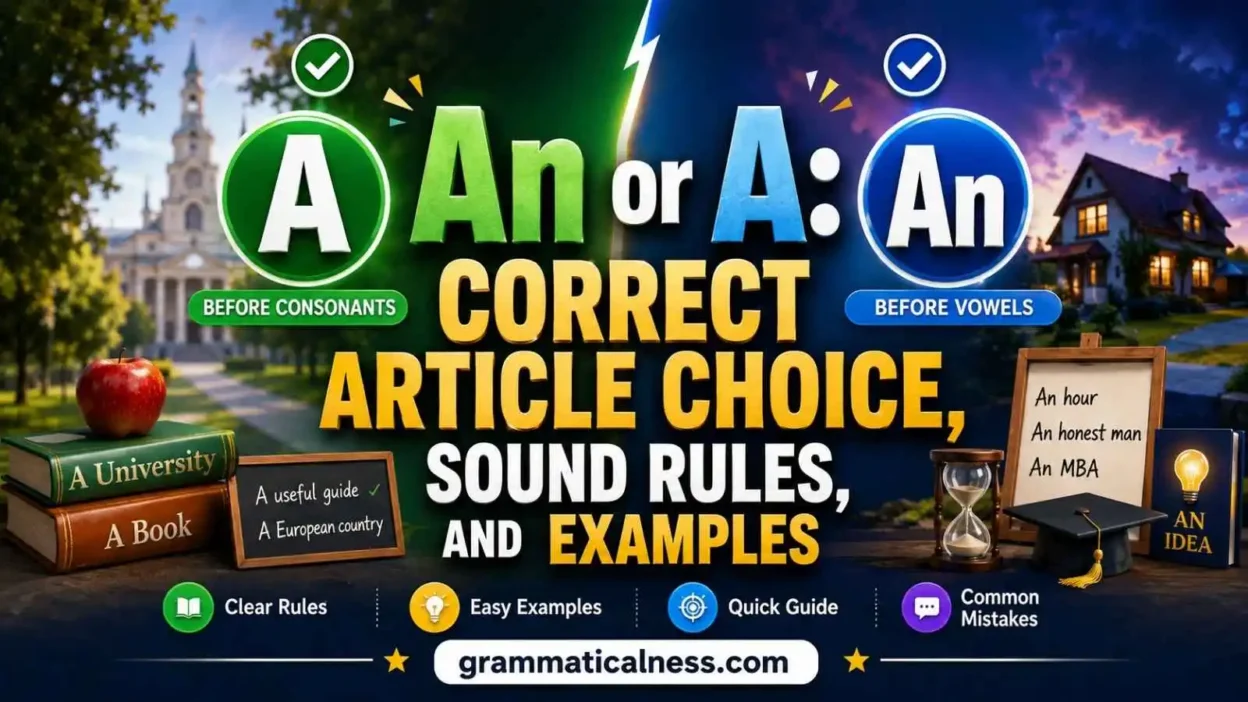
Choosing between an and a looks simple, but it often causes mistakes because English spelling can mislead you. The correct choice depends on the sound that comes right after the article, not just the first letter you see.
Both words are correct. They are two forms of the same indefinite article. Use an before a vowel sound, as in an apple or an hour. Use a before a consonant sound, as in a dog or a university.
Quick Answer
Use an before a word that begins with a vowel sound: an idea, an umbrella, an honest answer. Use a before a word that begins with a consonant sound: a car, a house, a user. The sound matters more than the written letter.
Why People Confuse Them
People often learn a shorter rule: use an before vowels and a before consonants. That rule is close, but it is not complete.
English has words that start with a vowel letter but a consonant sound. For example, user begins with the letter u, but it sounds like “you.” That is why a user is correct.
English also has words that start with a consonant letter but a vowel sound. In hour, the h is silent, so the word begins with the sound in our. That is why an hour is correct.
Abbreviations add another layer. You choose based on how the abbreviation is read aloud. Write an FBI agent because F is pronounced “eff,” which begins with a vowel sound.
Key Differences At A Glance
| Context | Best Choice | Why |
| Before a consonant sound | a | The next sound is hard or consonant-like |
| Before a vowel sound | an | The next sound flows from a vowel |
| Before silent “h” | an | The word starts with the next vowel sound |
| Before pronounced “h” | a | The word starts with an “h” sound |
| Before “u” sounding like “you” | a | “You” begins with a consonant sound |
| Before an abbreviation read letter by letter | Depends | Choose by the first spoken letter sound |
| Before an abbreviation pronounced as a word | Depends | Choose by the first sound of that word |
Meaning and Usage Difference
An and a do not have different meanings. They both introduce one nonspecific person, place, thing, or idea.
Use an when the next word begins with a vowel sound:
an artist
an email
an old truck
an honest mistake
Use a when the next word begins with a consonant sound:
a teacher
a laptop
a useful tip
a one-bedroom apartment
Pronunciation matters because these articles are spoken quickly in normal English. A is usually pronounced like “uh.” When stressed, it can sound like the letter name “ay.” An is usually pronounced like “un.” When stressed, it can sound like “ann.”
The sound after the article controls the choice. That sound may come from a noun, an adjective, a number, or an abbreviation.
Correct: an old car
Correct: a red apple
In the first example, old comes right after the article and begins with a vowel sound. In the second, red comes right after the article and begins with a consonant sound.
Tone, Context, and Formality
There is no real tone difference between an and a. One is not more polite, casual, academic, or professional than the other. The correct choice depends on sound.
In careful writing, readers expect the article to match standard pronunciation. That is why an hour looks natural, while a hour looks wrong.
Some expressions vary because pronunciation varies. For example, historic begins with a pronounced h for many US speakers, so a historic event is the safer modern choice. If someone truly drops the h sound, an historic event may match that speaker’s pronunciation. Still, many US readers expect a historic event in edited writing.
For everyday US English, let the spoken sound guide you.
Which One Should You Use?
Use an when the next sound is a vowel sound:
an app
an update
an emergency
an MBA
an SUV
Use a when the next sound is a consonant sound:
a phone
a meeting
a user
a URL
a one-time charge
A fast test helps: say the next word out loud. If it starts with a smooth vowel sound, choose an. If it starts with a consonant sound, choose a.
| Feature | an | a |
| Main use | Before vowel sounds | Before consonant sounds |
| Meaning | One nonspecific thing | One nonspecific thing |
| Sound test | an apple, an hour | a banana, a user |
| Common trap | Silent “h” words | “u” and “one” words |
| Formality | Neutral | Neutral |
When One Choice Sounds Wrong
A apple sounds wrong because apple begins with a vowel sound. The correct phrase is an apple.
An user sounds wrong because user begins with a “you” sound. The correct phrase is a user.
A hour sounds wrong because the h is silent. The correct phrase is an hour.
An one-time fee sounds wrong because one begins with a “w” sound. The correct phrase is a one-time fee.
The mistake usually happens when a writer looks only at the first letter. Instead, listen to the first sound.
Common Mistakes (and Quick Fixes)
Use a university, not an university, because university begins with a “you” sound.
Write an umbrella, not a umbrella, because umbrella begins with a vowel sound.
The correct form is an honest answer, not a honest answer, because the h in honest is silent.
Choose a house, not an house, because the h in house is pronounced.
Say an FBI agent, not a FBI agent, because F is read as “eff,” which begins with a vowel sound.
Use a URL, not an URL, when reading URL as “you-are-ell,” because that pronunciation begins with a consonant sound.
Everyday Examples
I need an answer before Friday.
She booked a hotel near the airport.
He waited an hour for the train.
They hired a new designer.
That was an awkward pause.
We created a useful checklist.
My sister bought an electric car.
The team needs a one-page summary.
She sent an email after the meeting.
He opened a bank account online.
We met an honest contractor.
The company released a user guide.
I saw an owl behind the barn.
They planned a European vacation.
She is an MBA student.
He works for a NASA contractor.
Dictionary-Style Word Details
Verb
an: Not used as a verb in standard US English.
a: Not used as a verb in standard US English when it functions as the article in this comparison.
Noun
an: Not commonly used as a noun in standard US English, except when discussing the word itself, as in “The word an goes before a vowel sound.”
a: Can be a noun when referring to the letter A or a school grade, as in “She got an A.” In the article-choice comparison, however, a is a determiner, not a noun.
Synonyms
an: No exact synonym fits all uses. Closest plain alternatives are one, one unspecified, or any single, depending on the sentence.
a: No exact synonym fits all uses. Closest plain alternatives are also one, one unspecified, or any single.
A clear opposite is hard to name because an and a are grammar words. The closest contrast is the, which points to something specific instead of something nonspecific.
Example Sentences
an: We need an estimate before we approve the repair.
an: She made an honest mistake on the form.
an: The office hired an HR specialist.
a: I found a quiet coffee shop downtown.
a: He wrote a useful note for the team.
a: They charged a one-time setup fee.
Word History
an: The form an is historically tied to the older idea of “one.” In modern English, it is the form used before vowel sounds.
a: The form a developed as the shorter form used before consonant sounds. Today, a and an work as sound-based forms of the same indefinite article.
Phrases Containing
an: an hour, an honest answer, an apple, an emergency, an unusual request, an MBA
a: a user, a university, a house, a one-time fee, a European trip, a useful guide
FAQs
Is it “an” or “a” before a vowel?
Use an before a vowel sound, not always before a vowel letter. For example, an apple, an idea, and an umbrella are correct because the next word begins with a vowel sound. However, a university is correct because university starts with a “you” sound.
Is it “a hour” or “an hour”?
The correct phrase is an hour. The h in hour is silent, so the word begins with the vowel sound in “our.” Since an comes before vowel sounds, an hour is the natural and correct choice.
Is it “a user” or “an user”?
The correct phrase is a user. Even though user starts with the letter u, it begins with a “you” sound. That sound works like a consonant sound, so a user is correct.
Should I use “a” or “an” before abbreviations?
It depends on how the abbreviation is spoken. Use an if the first spoken sound is a vowel sound, as in an FBI agent or an MBA program. Use a if the first sound is consonant-like, as in a URL or a NASA project.
Is “an historic event” correct?
In modern US English, a historic event is usually the better choice because most speakers pronounce the h in historic. If someone does not pronounce the h, an historic event may match that pronunciation, but a historic event is safer in everyday writing.
What is the easiest way to choose between “an” and “a”?
Say the next word out loud. If it starts with a vowel sound, use an. If it starts with a consonant sound, use a.
Conclusion
The choice between an and a is not about meaning. Both words introduce one nonspecific thing. The difference is sound.
Use an before vowel sounds: an apple, an hour, an FBI agent. Use a before consonant sounds: a car, a user, a one-time fee. When spelling and sound disagree, trust the sound.
Use an before a vowel sound, not always before a vowel letter. For example, an apple, an idea, and an umbrella are correct because the next word begins with a vowel sound. However, a university is correct because university starts with a “you” sound.
The correct phrase is an hour. The h in hour is silent, so the word begins with the vowel sound in “our.” Since an comes before vowel sounds, an hour is the natural and correct choice.
The correct phrase is a user. Even though user starts with the letter u, it begins with a “you” sound. That sound works like a consonant sound, so a user is correct.
It depends on how the abbreviation is spoken. Use an if the first spoken sound is a vowel sound, as in an FBI agent or an MBA program. Use a if the first sound is consonant-like, as in a URL or a NASA project.
In modern US English, a historic event is usually the better choice because most speakers pronounce the h in historic. If someone does not pronounce the h, an historic event may match that pronunciation, but a historic event is safer in everyday writing.
Say the next word out loud. If it starts with a vowel sound, use an. If it starts with a consonant sound, use a.