
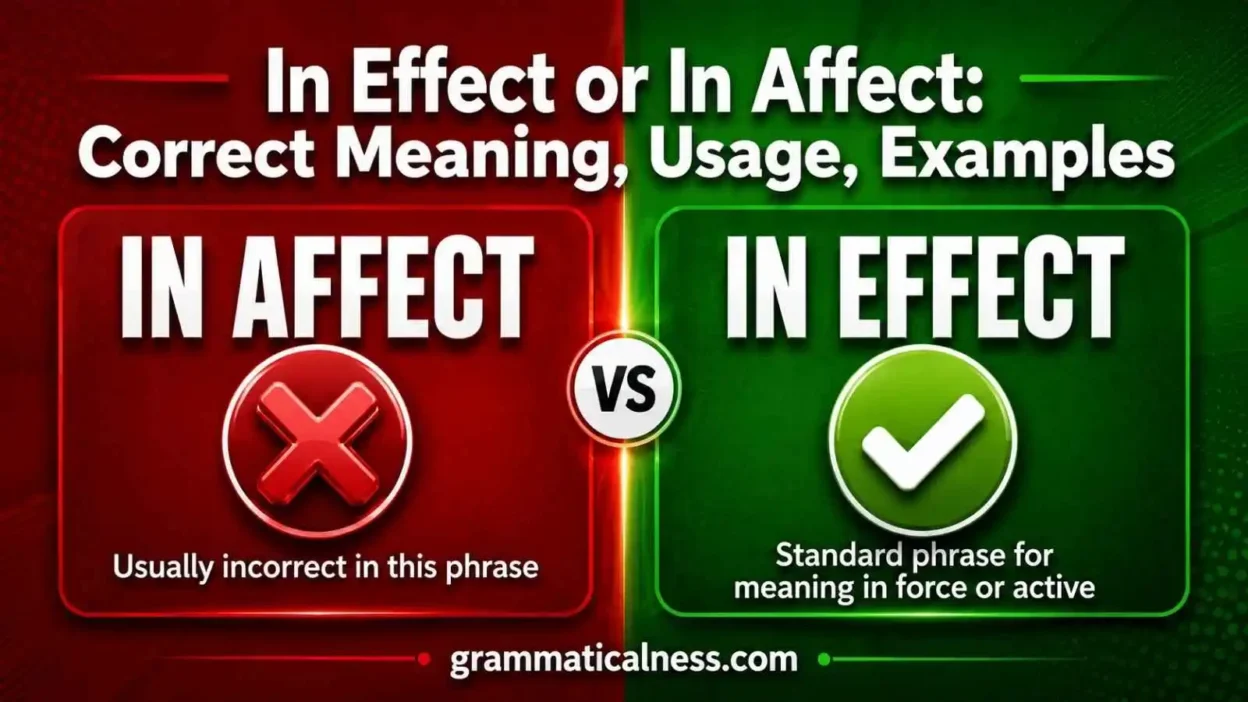
The correct phrase is usually in effect. Use it when a rule, law, policy, agreement, or change is active. You can also use it when you mean “in practice,” “essentially,” or “for practical purposes.”
In affect is not the standard phrase for those meanings. It may appear in rare clinical or psychology writing when affect means emotional expression or emotional state. However, most everyday writers do not need that use.
Quick Answer
Use in effect in standard American English. It means something is active, operating, or true in practical terms. In affect is usually wrong when you mean “in force” or “essentially.” Only use in affect in specialized wording about emotional state, such as “changes in affect.”
Correct: The new policy is in effect today.
Incorrect: The new policy is in affect today.
Why People Confuse Them
People confuse these phrases because effect and affect look and sound similar. They also form a famous word pair: affect is usually a verb, while effect is usually a noun.
That general rule helps, but this phrase has its own pattern. In in effect, the word effect works as a noun inside a fixed phrase. The phrase does not mean “to influence.” It means “active,” “operating,” or “true in practice.”
The confusion grows because affect can also be a noun in psychology. Still, that noun use does not make in affect a normal replacement for in effect.
Key Differences At A Glance
| Context | Best Choice | Why |
| A law is active | in effect | Means in force or operating |
| A company policy is active | in effect | Standard phrase for rules and policies |
| A change is practically true | in effect | Means essentially or in practice |
| A medicine starts working | take effect | Uses effect, not affect |
| A clinical note about emotion | in affect | Possible only when affect means emotional state |
| Everyday writing | in effect | Clear, standard, and expected |
Meaning and Usage Difference
In effect has two common meanings.
First, it can mean active or in force.
Example: The parking rule is in effect after 6 p.m.
Second, it can mean in practice, essentially, or for practical purposes.
Example: The delay was, in effect, a cancellation.
In affect does not carry either of those meanings in normal writing. It is not the phrase you want for laws, rules, plans, or practical results.
There is one narrow exception. In psychology or clinical writing, affect can be a noun. It means a person’s observable emotional expression or emotional state. In that setting, a sentence may use the words in affect, but only as part of a larger clinical idea.
Example: The report noted changes in affect after treatment.
That sentence is not using in affect as an idiom. It simply uses in before the noun affect.
| Feature | in effect | in affect |
| Standard everyday phrase | Yes | No |
| Means active or operating | Yes | No |
| Means essentially or in practice | Yes | No |
| Uses effect as a noun | Yes | No |
| Possible clinical wording | No special clinical meaning | Yes, only with noun affect |
Pronunciation can help a little. In effect is usually said like “in ih-FEKT.” The clinical noun affect is often said with stress at the front, like “AF-ekt.” Still, spelling and meaning matter more than sound here.
Tone, Context, and Formality
In effect works in casual, professional, legal, academic, and business writing. It is common in sentences about rules, deadlines, policies, contracts, schedules, and practical results.
Examples:
- The refund policy is still in effect.
- The new schedule goes into effect Monday.
- The change was, in effect, a pay cut.
In affect sounds wrong in ordinary writing because readers expect effect in this phrase. It may look like a simple spelling mistake, especially in business or school writing.
In clinical or psychology contexts, affect as a noun is formal and specialized. It is not a general substitute for effect.
Which One Should You Use?
Use in effect almost every time.
Choose in effect when you mean:
- in force
- active
- operating
- currently applying
- essentially
- in practice
- for practical purposes
Use in affect only when you are writing about emotional state or emotional expression and the sentence truly needs the noun affect.
Most writers should use this simple test:
If you can replace the phrase with active, in force, essentially, or in practice, choose in effect.
Example: The new rule is active today.
Correct: The new rule is in effect today.
When One Choice Sounds Wrong
In affect sounds wrong when the sentence is about a rule, law, plan, change, result, or real-world condition.
Wrong: The discount is in affect until Friday.
Correct: The discount is in effect until Friday.
Wrong: The curfew went into affect at midnight.
Correct: The curfew went into effect at midnight.
Wrong: The update is, in affect, a full redesign.
Correct: The update is, in effect, a full redesign.
The word affect belongs in sentences where it means “influence” as a verb.
Correct: The delay may affect our travel plans.
It also belongs in specialized noun use.
Correct: The clinician observed a flat affect.
Common Mistakes (and Quick Fixes)
Mistake: The rule is in affect.
Fix: The rule is in effect.
Mistake: The policy goes into affect tomorrow.
Fix: The policy goes into effect tomorrow.
Mistake: This will take affect next week.
Fix: This will take effect next week.
Mistake: The decision will effect every employee.
Fix: The decision will affect every employee.
Mistake: The weather had no affect on attendance.
Fix: The weather had no effect on attendance.
A useful pattern is this: effect often follows words like an, the, any, into, take, and in.
Examples:
- an effect
- the effect
- any effect
- into effect
- take effect
- in effect
Everyday Examples
The new school policy is in effect starting today.
The road closure remains in effect through Friday night.
The coupon is no longer in effect.
The mayor’s order went into effect at noon.
The medication should take effect within an hour.
The change is, in effect, a new rule for all employees.
Her silence was, in effect, a refusal.
The lease is still in effect until August.
The storm may affect evening flights.
The study measured changes in affect after the therapy sessions.
Dictionary-Style Word Details
Verb
In effect: Not used as a verb. The phrase is built with the noun effect. The single word effect can be a formal verb meaning “to bring about,” as in “effect change,” but that is different from in effect.
In affect: Not used as a standard verb phrase. The single word affect is usually a verb meaning “to influence” or “to cause a change in.”
Noun
In effect: This phrase uses effect as a noun. It can mean active, operating, result, or practical reality.
In affect: This wording is correct only when affect is a noun. It usually appears in psychology or clinical writing and means emotion or emotional expression. This noun means emotional expression or emotional state.
Synonyms
In effect: Closest plain alternatives include in force, active, operating, essentially, effectively, in practice, and for practical purposes. The best synonym depends on the sentence.
In affect: No true synonym fits it as a fixed phrase because it is not a standard everyday phrase. When affect is the psychology noun, closest plain alternatives include emotional expression, emotional state, or observable mood.
Example Sentences
In effect
The mask requirement is still in effect at the clinic.
The new fee is, in effect, a price increase.
In affect
The therapist noted improvement in affect over several weeks.
Researchers studied small changes in affect during the interview.
Word History
In effect: The phrase comes from the noun effect, which has long been used for result, operation, force, and practical outcome. Standard dictionaries record in effect as the established phrase.
In affect: The noun affect has a specialized history in psychology and medical writing. Because that use is narrow, in affect did not become the common phrase for “in force” or “in practice.”
Phrases Containing
In effect: Common phrases include be in effect, remain in effect, go into effect, take effect, and put into effect.
In affect: This is not a common fixed phrase. It may appear in specialized wording such as changes in affect, variation in affect, or improvement in affect.
FAQs
Is it “in effect” or “in affect”?
The correct phrase is in effect in standard American English. Use it when something is active, operating, or true in practical terms. For example, “The new rule is in effect today.” In affect is usually incorrect unless you are writing in a specialized psychology context.
What does “in effect” mean?
In effect means “active,” “in force,” “operating,” or “essentially.” It can describe a rule, law, policy, or agreement that currently applies. It can also mean “in practice,” as in “The change was, in effect, a pay cut.”
Is “in affect” ever correct?
Yes, but only in a narrow context. In psychology or clinical writing, affect can be a noun meaning emotional expression or emotional state. A sentence like “The therapist noticed changes in affect” can be correct. However, this is not the same as the common phrase in effect.
Do you say “go into effect” or “go into affect”?
Say go into effect. This phrase means that a rule, policy, law, or change starts to apply. For example, “The new pricing plan goes into effect on Monday.” Go into affect is incorrect in normal writing.
What is a simple way to remember the difference?
Use effect when you mean a result, condition, or active rule. Use affect when you mean “to influence” as a verb. In the phrase in effect, always choose effect because the phrase means something is active or true in practice.
Can I use “in effect” in formal writing?
Yes. In effect works well in formal, professional, legal, academic, and everyday writing. It is clear and standard when discussing policies, rules, agreements, decisions, and practical results.
Conclusion
The right choice is in effect for normal writing. Use it when something is active, operating, legally or officially applying, or true in practical terms.
Avoid in affect when talking about rules, policies, laws, results, or practical meaning. It is usually a mistake in those contexts. The only real exception is specialized clinical wording where affect means emotional state or expression.
The correct phrase is in effect in standard American English. Use it when something is active, operating, or true in practical terms. For example, “The new rule is in effect today.” In affect is usually incorrect unless you are writing in a specialized psychology context.
In effect means “active,” “in force,” “operating,” or “essentially.” It can describe a rule, law, policy, or agreement that currently applies. It can also mean “in practice,” as in “The change was, in effect, a pay cut.”
Yes, but only in a narrow context. In psychology or clinical writing, affect can be a noun meaning emotional expression or emotional state. A sentence like “The therapist noticed changes in affect” can be correct. However, this is not the same as the common phrase in effect.
Say go into effect. This phrase means that a rule, policy, law, or change starts to apply. For example, “The new pricing plan goes into effect on Monday.” Go into affect is incorrect in normal writing.
Use effect when you mean a result, condition, or active rule. Use affect when you mean “to influence” as a verb. In the phrase in effect, always choose effect because the phrase means something is active or true in practice.
Yes. In effect works well in formal, professional, legal, academic, and everyday writing. It is clear and standard when discussing policies, rules, agreements, decisions, and practical results.