
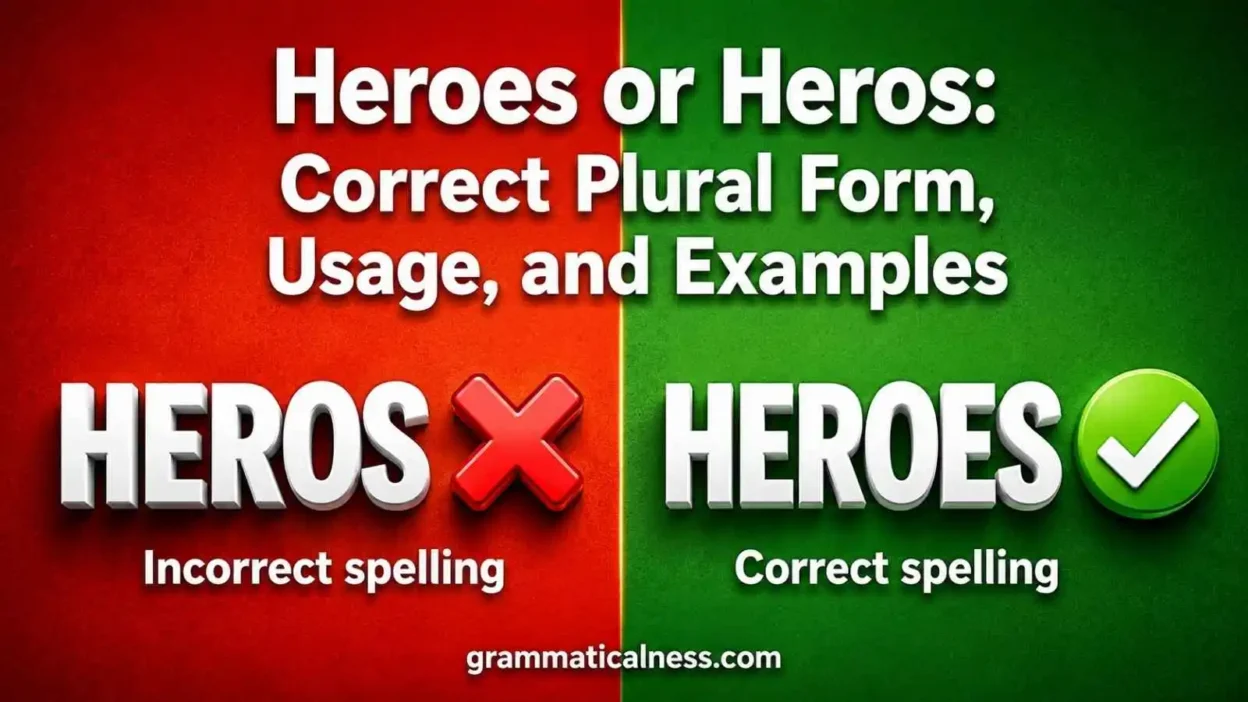
The choice between heroes and heros is simple in most writing. When you mean brave people, admired people, or main characters in stories, heroes is the correct plural.
The spelling heros has a much narrower use. It may appear in some food writing for hero sandwiches, but it usually looks wrong when the meaning is people or characters.
Quick Answer
Heroes is the standard plural of hero. Write heroes when you mean brave people, admired people, role models, or main characters. Heros is rare and mainly appears in food contexts for hero sandwiches. In everyday US English, heros is usually a spelling mistake unless the sentence clearly talks about sandwiches.
Why People Confuse Them
Many English nouns that end in o form the plural by adding s. For example, photo becomes photos, and piano becomes pianos.
Because of that pattern, some writers assume hero should become heros. However, the normal plural is heroes, with es at the end.
Sound also causes confusion. Heroes and heros are usually pronounced the same way, so the difference matters most in writing.
Key Differences At A Glance
| Context | Best Choice | Why |
| Brave people | heroes | This is the standard plural of hero. |
| Main characters | heroes | Story characters called heroes use this plural. |
| Public praise | heroes | This spelling looks correct and polished. |
| School or work writing | heroes | Readers expect this form in normal English. |
| Food menu context | heros | This can mean hero sandwiches in narrow use. |
| General writing | heroes | Heros usually looks like a mistake. |
Meaning and Usage Difference
Heroes is a plural noun. It means more than one hero. A hero can be a brave person, an admired person, or the main character in a story.
Examples:
Correct
The firefighters were treated as heroes.
The movie has three heroes with different goals.
Teachers can become everyday heroes in their students’ lives.
The form heros is not the normal plural when you mean people. Most readers will see it as a misspelling in essays, articles, captions, emails, and stories.
A narrow exception exists in food writing. Some delis or menus may use heros to mean hero sandwiches.
Example:
Correct in a food context: We ordered two meatball heros for lunch.
For clearer writing, hero sandwiches is often better than heros, especially if your readers may not know the regional food term.
| Feature | Heroes | Heros |
| Main meaning | More than one brave or admired person | Rare plural for hero sandwiches |
| Best use | People, characters, role models | Food menus or sandwich writing |
| Standard spelling | Yes | Not for people or characters |
| Reader reaction | Natural and correct | Often looks misspelled |
Tone, Context, and Formality
In formal and casual writing, heroes is the safe choice. It works in school papers, news stories, workplace messages, social posts, and personal tributes.
You can use it in serious sentences:
The city honored its local heroes.
Many families remember war heroes with deep respect.
The novel gives its heroes hard choices.
By contrast, heros has a limited and informal feel. Outside a menu or sandwich discussion, it can make a sentence look unedited.
That difference matters because the two forms sound alike. Readers judge the choice by spelling, not pronunciation.
Which One Should You Use?
Choose heroes almost every time. It is the right form for people, characters, workers, soldiers, athletes, parents, teachers, volunteers, and role models.
Here are natural uses:
The team thanked its heroes after the rescue.
My daughter’s heroes are nurses and firefighters.
Comic books often give their heroes personal struggles.
Choose heros only when you clearly mean hero sandwiches.
Example:
The deli sells turkey heros and meatball heros.
Even in that context, consider writing hero sandwiches if you want the meaning to be clear for all readers.
When One Choice Sounds Wrong
The spelling heros sounds fine when spoken because it usually sounds like heroes. The problem appears on the page.
Wrong: The veterans were honored as American heros.
Correct: The veterans were honored as American heroes.
Wrong: The book has several unlikely heros.
Correct: The book has several unlikely heroes.
Wrong: Health care heros deserve our respect.
Correct: Health care heroes deserve our respect.
In a sandwich sentence, heros can work, but it may still feel regional or informal.
Possible: We ordered three Italian heros.
Clearer: We ordered three Italian hero sandwiches.
Common Mistakes (and Quick Fixes)
Mistake 1: Using heros for brave people
Wrong: The town celebrated its local heros.
Correct: The town celebrated its local heroes.
Mistake 2: Using heros for story characters
Wrong: The game lets players choose different heros.
Correct: The game lets players choose different heroes.
Mistake 3: Following the wrong plural pattern
Wrong: The article was about real-life heros.
Correct: The article was about real-life heroes.
Mistake 4: Using heros in a tribute post
Wrong: Remembering the heros who served.
Correct: Remembering the heroes who served.
Mistake 5: Making the sandwich meaning unclear
Unclear: The shop sells hot heros.
Clearer: The shop sells hot hero sandwiches.
Everyday Examples
Correct :
Firefighters are often seen as everyday heroes.
The school honored the heroes who helped during the storm.
My favorite movies have heroes who make mistakes and learn from them.
Several local heroes volunteered after the flood.
The coach called the seniors the heroes of the season.
Many children see their parents as heroes.
We picked up two chicken parm heros before the game.
The menu lists cold heros, wraps, and salads.
Incorrect: The hospital thanked its health care heros.
Correct: The hospital thanked its health care heroes.
Incorrect: The author created three strong heros.
Correct: The author created three strong heroes.
Dictionary-Style Word Details
Verb
Heroes: Not commonly used as a verb in standard US English. In this comparison, heroes is a plural noun.
Heros: Not commonly used as a verb in standard US English. When used for people, it is usually a misspelling. In food writing, it may work as a plural noun for hero sandwiches.
Noun
Heroes: A plural noun meaning more than one hero. It can refer to brave people, admired people, or main characters.
Example: The documentary tells the story of local heroes.
Heros: A rare plural noun for hero sandwiches in some US food contexts. It should not be used for brave people or story characters in normal writing.
Example: The deli special includes two hot heros.
Synonyms
Heroes: Closest plain alternatives include champions, role models, protectors, leaders, and protagonists when the sentence is about story characters.
Possible opposites depend on context. In stories, villains may work as an opposite. In courage-based writing, cowards may fit, but only in direct contrast.
Heros: Closest plain alternatives in the sandwich sense include subs, submarine sandwiches, hoagies, and grinders. These food terms vary by region. There is no useful direct opposite for heros in this sense.
Example Sentences
Heroes
The award ceremony honored the city’s unsung heroes.
The novel gives its heroes difficult choices.
Many kids see their parents as everyday heroes.
Heros
The shop sells meatball heros, turkey heros, and roast beef heros.
Before the game, we ordered two heros.
Outside food writing, replace heros with heroes.
Word History
Heroes: The word hero comes from older Greek and Latin forms. In modern English, heroes is the expected plural for a brave person, admired person, or main character.
Heros: This spelling is not the normal modern plural for people. It appears mainly as a rare or specialized form, especially in the sandwich sense. For most writing, the practical rule is simple: use heroes for people and characters.
Phrases Containing
Heroes:
everyday heroes
local heroes
war heroes
national heroes
unsung heroes
fictional heroes
heroes and villains
Heros:
meatball heros
Italian heros
turkey heros
hot heros
cold heros
For broad audiences, hero sandwiches is often clearer than heros.
FAQs
Is heroes or heros correct?
Heroes is correct when you mean more than one hero. Use it for brave people, admired people, role models, or main characters in stories. Heros is not the standard plural for people or characters. It appears only in rare food contexts, usually when referring to hero sandwiches.
Why is the plural of hero heroes?
The plural of hero is heroes because many English nouns ending in o add es in the plural. Similar examples include potato/potatoes and tomato/tomatoes. Although some words ending in o take only s, hero normally takes es.
Is heros ever a real word?
Yes, but only in limited contexts. Heros can appear as a plural for hero sandwiches, especially on some menus or in regional food writing. However, if you mean brave people, admired people, or story characters, heros is usually a misspelling.
Can I write heros for superheroes?
No. The correct plural is heroes, even in superheroes. Write comic-book heroes, movie heroes, or superheroes. The spelling heros looks incorrect in this context.
Are heroes and heros pronounced differently?
Usually, no. Heroes and heros sound the same in everyday speech. That is one reason people confuse them. The difference matters mainly in writing, where heroes is the expected spelling for people and characters.
What is a simple way to remember heroes?
Think of this rule: people are heroes. If you are writing about brave people, role models, public servants, athletes, fictional characters, or superheroes, use heroes. Only use heros when the sentence clearly talks about hero sandwiches.
Which sentence is correct: “They are my heroes” or “They are my heros”?
The correct sentence is: They are my heroes. Use heroes when talking about people you admire.
Conclusion
For people and characters, heroes is the correct plural. It works in formal writing, casual writing, stories, captions, tributes, and everyday examples.
The spelling heros belongs only in a narrow food context when it means hero sandwiches. If your sentence is about brave people, admired people, or main characters, choose heroes every time.
Heroes is correct when you mean more than one hero. Use it for brave people, admired people, role models, or main characters in stories. Heros is not the standard plural for people or characters. It appears only in rare food contexts, usually when referring to hero sandwiches.
The plural of hero is heroes because many English nouns ending in o add es in the plural. Similar examples include potato/potatoes and tomato/tomatoes. Although some words ending in o take only s, hero normally takes es.
Yes, but only in limited contexts. Heros can appear as a plural for hero sandwiches, especially on some menus or in regional food writing. However, if you mean brave people, admired people, or story characters, heros is usually a misspelling.
No. The correct plural is heroes, even in superheroes. Write comic-book heroes, movie heroes, or superheroes. The spelling heros looks incorrect in this context.
Usually, no. Heroes and heros sound the same in everyday speech. That is one reason people confuse them. The difference matters mainly in writing, where heroes is the expected spelling for people and characters.
Think of this rule: people are heroes. If you are writing about brave people, role models, public servants, athletes, fictional characters, or superheroes, use heroes. Only use heros when the sentence clearly talks about hero sandwiches.
The correct sentence is: They are my heroes. Use heroes when talking about people you admire.