Any time or anytime is a common word-choice question because both forms look right in many sentences. The difference is not pronunciation. They sound the same. The real difference is grammar.
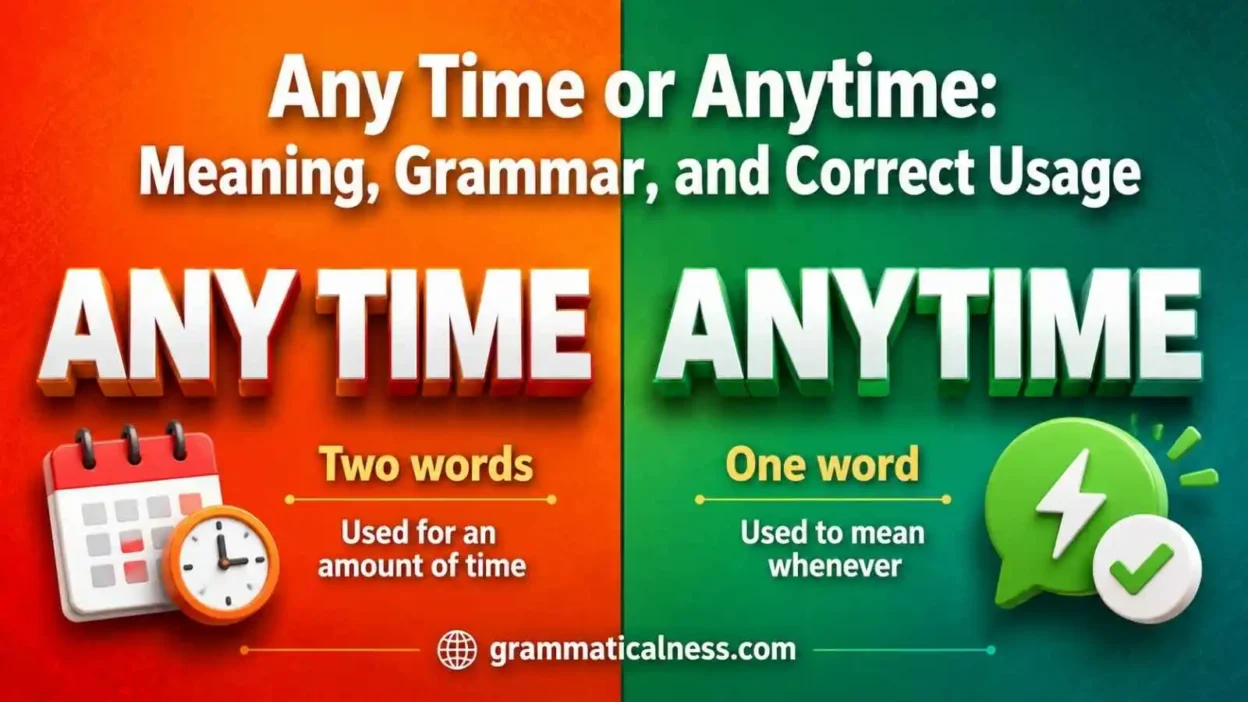
Use anytime when you mean “whenever” or “at any time.” Use any time when you are talking about an amount of time or when the words follow a preposition such as at.
The safest rule is simple: any time works in more situations, but anytime is natural when it acts like an adverb.
Quick Answer
Both forms are correct, but they are not always used the same way. Anytime is usually an adverb meaning “whenever.” Any time is a two-word phrase used when time is a noun, especially in phrases like at any time, have any time, or need any time.
Correct: You can call me anytime.
Correct: You can call me at any time.
Wrong: You can call me at anytime.
Why People Confuse Them
People confuse any time and anytime because the difference disappears in speech. You hear the same sound either way.
The confusion appears only in writing. In one sentence, the word acts like an adverb:
You can stop by anytime.
In another sentence, time is a real noun:
Do you have any time today?
The space matters because it shows how the words work in the sentence. When any describes the noun time, keep the two words separate.
Key Differences At A Glance
| Context | Best Choice | Why |
| Means “whenever” | anytime | It acts like an adverb. |
| After the preposition “at” | any time | A preposition needs a noun phrase after it. |
| Means “any amount of time” | any time | “Time” is the noun being described. |
| Casual invitation | anytime | It sounds natural and direct. |
| Formal writing | any time | It is usually the safer choice. |
| Response to “thank you” | Any time | This is the common two-word reply. |
Meaning and Usage Difference
Any time is a phrase made from any plus the noun time. It often means “any amount of time.”
Examples:
I don’t have any time before the meeting.
Do you need any time to think about it?
We can schedule it at any time next week.
In these sentences, time works like a noun. You could ask, “How much time?” That is the clue.
Anytime is one word. It usually means “whenever” or “at any time.”
Examples:
Text me anytime.
The package could arrive anytime today.
Anytime you need help, send me a message.
Here, anytime tells when something can happen. It acts more like whenever than like the noun time.
Small comparison:
| Feature | any time | anytime |
| Main role | noun phrase | adverb |
| Core meaning | any amount of time | whenever |
| Works after “at” | yes | no |
| Common tone | neutral, safe | natural, slightly casual |
Tone, Context, and Formality
In everyday US English, anytime sounds natural in friendly, direct sentences.
You can call me anytime.
Stop by anytime after lunch.
We are open anytime during the event.
This form is common in conversation, texts, emails, and casual workplace writing.
Any time often sounds a little more formal or careful, especially in complete phrases.
You may contact our office at any time.
Employees may request support at any time.
Do you have any time available on Friday?
The two-word form is also safer when you are unsure. It may sound more formal in some sentences, but it is less likely to create a grammar problem.
Which One Should You Use?
Use anytime when you can replace it with whenever.
Correct: You can visit anytime.
Test: You can visit whenever.
Correct: Anytime you want to talk, I’m here.
Test: Whenever you want to talk, I’m here.
Use any time when the sentence means “any amount of time.”
Correct: I don’t have any time today.
Correct: We wasted too much time, and now we don’t have any time left.
Use any time after at.
Correct: You can cancel at any time.
Correct: The alarm may go off at any time.
Do not write at anytime.
When One Choice Sounds Wrong
Some sentences clearly need any time because time is a noun.
Wrong: I don’t have anytime to talk.
Correct: I don’t have any time to talk.
Wrong: Do you have anytime this afternoon?
Correct: Do you have any time this afternoon?
These are not adverb uses. They are about having time available.
Other sentences clearly need the two-word phrase because of at.
Wrong: You can reach us at anytime.
Correct: You can reach us at any time.
Wrong: The door may close at anytime.
Correct: The door may close at any time.
In casual writing, anytime is fine when it means “whenever,” but it should not replace every use of any time.
Common Mistakes (and Quick Fixes)
Mistake 1: Using anytime after at
Wrong: Call customer support at anytime.
Fix: Call customer support at any time.
Mistake 2: Using anytime for an amount of time
Wrong: I didn’t have anytime to finish the report.
Fix: I didn’t have any time to finish the report.
Mistake 3: Treating the forms as always interchangeable
Weak: You can use either one every time.
Better: Use the one-word form for “whenever,” but use the two-word form when time is a noun.
Mistake 4: Using the casual form in a very formal sentence
Less formal: Contact the legal office anytime.
More formal: Contact the legal office at any time.
Everyday Examples
You can call me anytime after 6.
I don’t have any time before class.
The office may contact you at any time.
Anytime you need a ride, let me know.
Do you have any time to review this email?
The update could arrive anytime today.
We can meet anytime next week except Monday.
Please do not waste any time.
You may leave the room at any time.
Thanks for helping me. Any time.
Notice the pattern. When the sentence means “whenever,” anytime usually works. When the sentence is about available time, needed time, wasted time, or a phrase after at, choose any time.
Dictionary-Style Word Details
Verb
• any time: Not used as a verb in standard US English. It is a two-word phrase, not an action word.
• anytime: Not used as a verb in standard US English. It is usually an adverb, not an action word.
Noun
• any time: Can work as a noun phrase because time is the noun. Example: Do you have any time tomorrow?
• anytime: Not commonly used as a noun in standard US English. In most normal sentences, it works as an adverb.
Synonyms
• any time: Closest plain alternatives depend on the sentence. For “at any time,” use whenever or at any moment. For “any amount of time,” use any available time or any free time.
• anytime: Closest plain alternatives are whenever, at any time, and at any moment.
There is no single clean opposite that works for every use. In some sentences, never may be the opposite of anytime, but it does not fit all meanings.
Example Sentences
• any time: I don’t have any time to stop for coffee.
• any time: You may change your password at any time.
• any time: Any time after Tuesday works for me.
• anytime: You can text me anytime.
• anytime: The train could arrive anytime now.
• anytime: Anytime you are ready, we can begin.
Word History
• any time: This form is easy to understand from its parts: any plus time. It remains the normal choice when time is acting as a noun.
• anytime: This is the closed one-word form used mainly for the adverb meaning “whenever” or “at any time.”
The practical history is simple: English often keeps a two-word noun phrase for one use and a closed one-word form for another use. For this pair, the writing choice depends more on grammar than on sound.
Phrases Containing
• any time: at any time, any time now, any time today, any time you need help, any time after lunch
• anytime: call anytime, visit anytime, anytime soon, anytime now, anytime you want
Be careful with at any time. The word at should be followed by the two-word form.
FAQs
Is “any time” or “anytime” correct?
Both are correct, but they are used differently. Anytime means “whenever.” Any time is used when time works as a noun or when the phrase follows at.
What is the difference between “any time” and “anytime”?
Anytime is usually an adverb, as in “Call me anytime.” Any time is a two-word phrase, as in “Do you have any time today?” The two-word form is also correct after at.
Is “at anytime” correct?
No. The correct form is at any time. Since at is a preposition, it should be followed by the noun phrase any time, not the adverb anytime.
Can I say “call me anytime”?
Yes. Call me anytime is correct because anytime means “whenever.” It sounds natural in everyday US English.
Should I write “I don’t have anytime” or “I don’t have any time”?
Write I don’t have any time. In this sentence, time is a noun, so the two-word form is correct.
Is “anytime” formal?
Anytime is common and natural, but it can sound more casual. In formal writing, any time is often the safer choice, especially in phrases like at any time.
Is “anytime soon” correct?
Yes. Anytime soon is common in US English. It means “soon” or “in the near future,” often in negative sentences like “I don’t expect a reply anytime soon.”
What is the easiest way to remember the difference?
Use anytime when you mean whenever. Use any time when you mean any amount of time or when the phrase comes after at.
Conclusion
The easiest way to choose between any time and anytime is to check the job the words are doing.
Use anytime when it means “whenever.”
You can call me anytime.
Use any time when you mean “any amount of time” or when the phrase follows at.
I don’t have any time today.
You can call me at any time.
When in doubt, the two-word form is the safer choice, but the one-word form is natural when it clearly means “whenever.”
Both are correct, but they are used differently. Anytime means “whenever.” Any time is used when time works as a noun or when the phrase follows at.
Anytime is usually an adverb, as in “Call me anytime.” Any time is a two-word phrase, as in “Do you have any time today?” The two-word form is also correct after at.
No. The correct form is at any time. Since at is a preposition, it should be followed by the noun phrase any time, not the adverb anytime.
Yes. Call me anytime is correct because anytime means “whenever.” It sounds natural in everyday US English.
Write I don’t have any time. In this sentence, time is a noun, so the two-word form is correct.
Anytime is common and natural, but it can sound more casual. In formal writing, any time is often the safer choice, especially in phrases like at any time.
Yes. Anytime soon is common in US English. It means “soon” or “in the near future,” often in negative sentences like “I don’t expect a reply anytime soon.”
Use anytime when you mean whenever. Use any time when you mean any amount of time or when the phrase comes after at.