
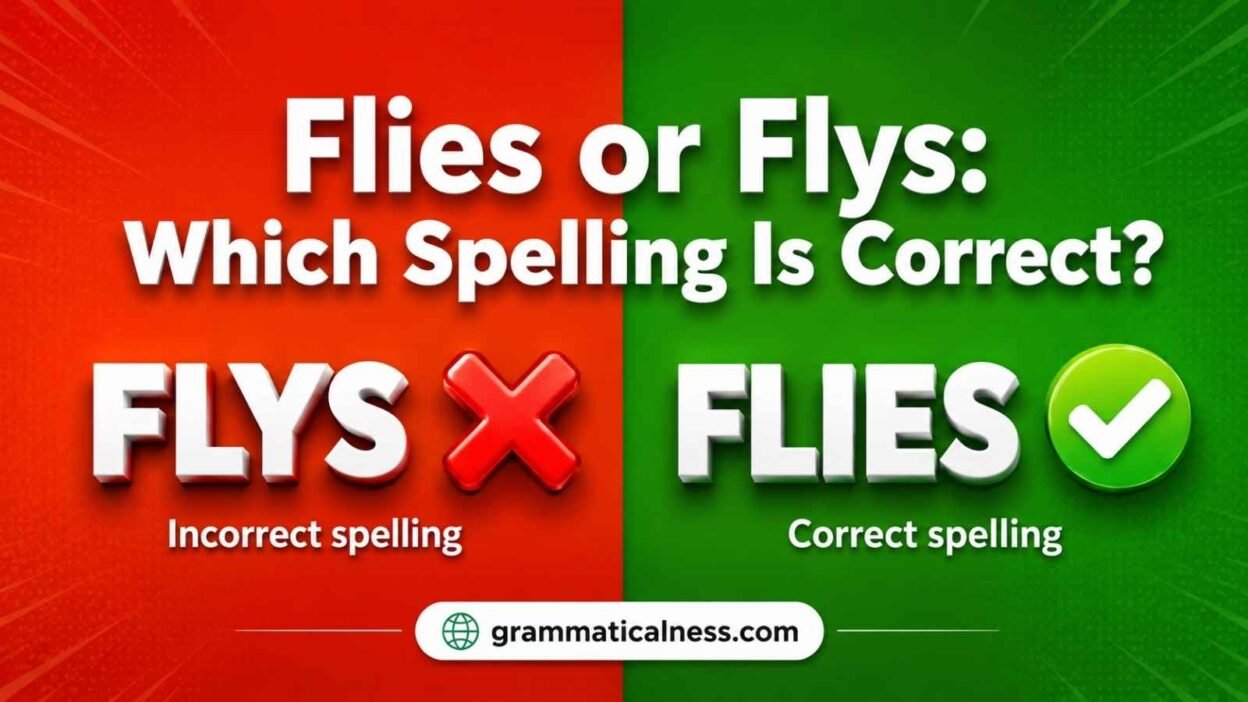
Flies is the correct choice in standard US English.
Use flies when you mean more than one fly, as in “There are flies near the trash can.” Also use flies when the subject is singular and the verb is “fly,” as in “She flies to Denver every month.”
Flys is usually a spelling mistake. Most writers should not use it unless it appears in a name, brand, quoted text, or a very rare special context.
Quick Answer
Choose flies almost every time.
Flies can be a noun or a verb:
A noun: “Two flies landed on the picnic table.”
A verb: “He flies home every Friday.”
Flys is not the standard spelling for either of those uses. Do not write “two flys,” “time flys,” or “she flys.”
The simple memory rule is this: when fly changes form, the y usually changes to ies.
Why People Confuse Them
The confusion is easy to understand. Many English words become plural by adding s: cat becomes cats, desk becomes desks, and car becomes cars.
So it may feel natural to write flys.
But fly ends in a consonant plus y. In this pattern, English usually changes y to ies. That is why fly becomes flies.
The same spelling pattern appears in words like:
city → cities
baby → babies
try → tries
cry → cries
That pattern helps explain why flies looks different from fly.
👉 “Many English learners also get confused between common spelling variations like flies vs flys, which is clearly explained in our detailed guide on how to correctly use flies in grammar.”
Key Differences At A Glance
| Feature | flies | flys |
| Standard US spelling | Yes | No, not for normal use |
| Plural of the insect | Yes: “flies” | No: “flys” is wrong here |
| Verb with he, she, it, or a singular noun | Yes: “she flies” | No: “she flys” is wrong |
| Best use in school or work writing | Use it | Avoid it |
| Pronounced differently? | No | No, if read aloud |
Both forms would sound like “flyz” if spoken. The problem is not sound. The problem is spelling and standard usage.
Meaning and Usage Difference
Flies has two common jobs.
First, it is the plural noun form of fly, the insect.
Example: “Flies kept landing on the watermelon.”
Second, it is the present-tense verb form used with he, she, it, or one singular noun.
Example: “My cousin flies from Dallas to Phoenix for work.”
In both cases, flies is correct.
Flys does not do those jobs in standard modern US English. It may appear in names, quoted writing, or rare special uses, but those are not the everyday spelling choices most readers need.
So the real difference is not tone or meaning. The real difference is that flies is the standard form, while flys is usually a misspelling.
Tone, Context, and Formality
Flies works in every normal setting: casual texts, school papers, emails, reports, captions, and formal writing.
You can write:
“Fruit flies showed up after we left bananas on the counter.”
“The pilot flies regional routes.”
“Time flies when the semester gets busy.”
These all sound natural.
Flys looks careless in normal writing. It can make a sentence seem unedited, even if the meaning is still clear.
There is no useful US-versus-UK split here for the everyday choice. For normal writing, US readers expect flies.
Which One Should You Use?
Use flies unless you are copying an exact name or quoting text that already uses flys.
| Context | Best Choice | Why |
| More than one insect | flies | It is the correct plural noun |
| A person travels by plane | flies | It is the correct verb form |
| A bird, insect, or plane moves through the air | flies | Singular subjects take “flies” |
| The saying about time passing quickly | flies | The correct phrase is “time flies” |
| Fruit flies or house flies | flies | Compound insect names still use “flies” |
| A brand, last name, or quoted title spelled “Flys” | flys | Keep exact spelling when accuracy requires it |
| A school paper or work email | flies | It is the standard spelling readers expect |
When One Choice Sounds Wrong
Flys sounds wrong in writing because readers expect flies in common noun and verb uses.
Wrong: “The flys are in the kitchen.”
Right: “The flies are in the kitchen.”
Wrong: “She flys to Chicago twice a month.”
Right: “She flies to Chicago twice a month.”
Wrong: “Time flys during summer break.”
Right: “Time flies during summer break.”
Flies is not just for bugs. It is also the verb form in sentences with singular subjects.
Correct: “The drone flies over the field.”
Correct: “My brother flies for a small airline.”
Correct: “The rumor flies around the office every year.”
Common Mistakes (and Quick Fixes)
Mistake: “There are too many flys outside.”
Fix: “There are too many flies outside.”
Mistake: “My dad flys to Atlanta on Mondays.”
Fix: “My dad flies to Atlanta on Mondays.”
Mistake: “Time flys when we are together.”
Fix: “Time flies when we are together.”
Mistake: “The restaurant has fruit flys near the soda machine.”
Fix: “The restaurant has fruit flies near the soda machine.”
Mistake: “A player hit three sacrifice flys this month.”
Fix: “A player hit three sacrifice flies this month.”
When in doubt, ask one question: “Am I changing the word fly?” If yes, flies is probably the spelling you need.
Everyday Examples
“Flies kept buzzing around the grill during the cookout.”
“She flies from Miami to New York for client meetings.”
“The app update flies through setup in less than a minute.”
“Time flies when the kids are home for spring break.”
“Fruit flies showed up after the peaches got too ripe.”
“He flies a small plane on weekends.”
“The ballplayer hit two deep flies to center field.”
“The flag flies over the school every morning.”
“News flies fast in a small town.”
“The camper zipped the tent shut so flies would stay out.”
Dictionary-Style Word Details
Verb
• flies: A present-tense verb form of fly used with he, she, it, or a singular noun.
Example: “She flies to Boston every fall.”
• flys: Not commonly used as a verb in standard US English.
Example to avoid: “She flys to Boston.”
Noun
• flies: The standard plural noun form of fly. It can refer to more than one insect, more than one high baseball hit, or other plural uses of the noun fly.
Example: “Two flies landed on the porch light.”
• flys: Not the normal plural noun in standard US English. It may appear in exact names or rare special uses, but everyday writers should use flies.
Synonyms
• flies as insects: closest plain alternatives include “flying insects” or “houseflies,” depending on the exact meaning. These are not always exact replacements.
Antonyms do not clearly fit.
• flies as a verb: closest plain alternatives include “travels by air,” “soars,” “glides,” or “moves through the air,” depending on the sentence.
Antonyms may include “lands” or “stays grounded” in some contexts, but they do not fit every use.
• flys: No standard synonym is needed for normal US writing because it is usually corrected to flies.
Example Sentences
• flies: “The flies disappeared after we covered the food.”
• flies: “Maya flies to Seattle for training next week.”
• flies: “Time flies during the holidays.”
• flies: “The center fielder caught two deep flies.”
• flys: “Flys” should usually be changed to “flies” unless it is part of an exact name or quoted spelling.
Word History
• flies: Comes from fly, a long-standing English word used for movement through the air and for the insect. The spelling flies follows the common pattern that changes final y to ies in forms like this.
• flys: Not the standard modern spelling for the plural noun or the present-tense verb. Some rare or older uses may be listed, but they do not change the everyday rule for US writers.
Phrases Containing
• flies: “time flies,” “fruit flies,” “house flies,” “as the crow flies,” “drop like flies,” “no flies on someone,” “sacrifice flies.”
• flys: No common standard US-English phrase needs flys. If you see it in a name or title, keep the exact spelling only because it is a name or title.
FAQs
Is it “flies” or “flys”?
Flies is correct in standard US English. Use it for both the plural noun and the verb form: “The flies are outside” and “She flies to Denver.”
Is “flys” a word?
Flys is usually treated as a misspelling in everyday writing. Most readers expect flies. Only keep flys if it is part of an exact name, brand, title, or quoted text.
What is the plural of “fly”?
The plural of fly is flies.
Correct: “Fruit flies are in the kitchen.”
Incorrect: “Fruit flys are in the kitchen.”
Is it “time flies” or “time flys”?
The correct phrase is time flies.
Example: “Time flies when you are having fun.”
Why does “fly” become “flies”?
Because fly ends in a consonant plus y. In many English words like this, the y changes to ies.
fly → flies
try → tries
cry → cries
baby → babies
Do “flies” and “flys” sound different?
No. If read aloud, they would sound the same. The difference is in spelling and standard usage.
Can “flies” be a verb?
Yes. Flies is the verb form used with he, she, it, or a singular noun.
Example: “The plane flies over the city.”
Can “flies” be a noun?
Yes. Flies is also the plural noun form of fly.
Example: “The flies gathered near the fruit bowl.”
Should I ever use “flys”?
Usually, no. Use flies in normal writing. Use flys only when you must preserve exact spelling in a name, title, brand, or quote.
What is the easiest way to remember the correct spelling?
Remember this simple pattern: when fly changes form, y changes to ies.
So write flies, not flys.
Conclusion
Use flies, not flys, in standard US English.
Write flies for more than one insect: “The flies are annoying.”
Write flies for the verb with a singular subject: “She flies home tomorrow.”
Write time flies, not “time flys.”
The rule is simple: when fly changes into its plural noun or singular present verb form, it becomes flies.