
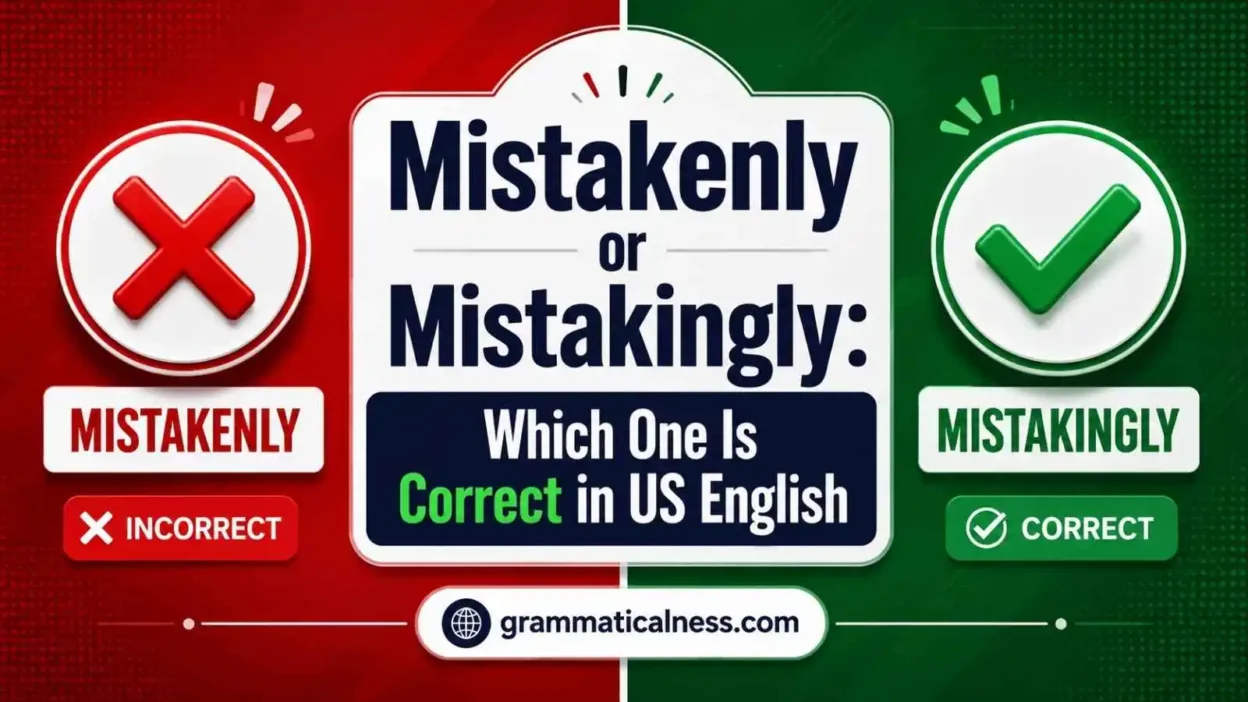
The correct choice is mistakenly.
Use mistakenly when you mean “by mistake,” “in error,” or “because of a wrong belief.”
Mistakingly may look logical, and it does appear in some reference records, but it is not the normal choice in standard US English. Most readers will see it as odd, old-fashioned, or simply wrong.
Quick Answer
Choose mistakenly in almost every modern sentence.
Correct: I mistakenly sent the file to the wrong person.
Avoid: I mistakingly sent the file to the wrong person.
There is no useful everyday meaning difference that makes mistakingly better. For clear writing, mistakenly is the safe and expected word.
Why People Confuse Them
The confusion makes sense.
People see the verb form mistaking and add -ly, creating mistakingly. That pattern feels possible because many English adverbs end in -ly.
But the standard adverb is built from mistaken, not mistaking. That gives us mistakenly.
The words also sound close. Mistakenly sounds like mi-STAY-kuhn-lee. Mistakingly sounds like mi-STAY-king-lee. That small sound difference can be easy to miss when speaking quickly.
Key Differences At A Glance
Compact comparison:
- mistakenly: standard adverb; use it in emails, schoolwork, reports, messages, and everyday speech.
- mistakingly: rare form; avoid it in normal US writing because it distracts readers.
- Main difference: not meaning, but acceptance and naturalness.
- Best rule: when in doubt, write mistakenly.
Meaning and Usage Difference
Mistakenly means something happened because someone was wrong, confused, or acting under a false belief.
Examples:
I mistakenly thought the meeting was at 3 p.m.
The store mistakenly charged me twice.
She mistakenly saved the old version of the file.
Mistakingly points toward the same basic idea, but it is not the form readers expect. It does not give your sentence a sharper or more formal meaning.
So the real difference is simple: mistakenly is the standard word; mistakingly is the form to avoid.
Tone, Context, and Formality
Mistakenly works in formal and informal writing.
You can use it in a work email:
I mistakenly attached the draft instead of the final copy.
You can also use it in a casual text:
I mistakenly ordered two coffees.
Mistakingly can make the sentence look less polished. In a resume, report, school essay, customer email, or public post, it may pull attention away from your message.
That does not mean the reader will fail to understand you. It means the word choice may look careless.
Which One Should You Use?
| Context | Best Choice | Why |
| Work email | mistakenly | It sounds natural and professional. |
| School essay | mistakenly | It is the standard adverb. |
| Text message | mistakenly | It is still the clearest choice. |
| Customer service reply | mistakenly | It keeps the tone clean and polite. |
| Legal or official writing | mistakenly | It avoids distraction. |
| Any sentence with “sent,” “charged,” “believed,” or “assumed” | mistakenly | These are common, natural uses. |
Use mistakenly for all normal writing.
Use mistakingly only if you are quoting someone’s exact wording or discussing the word itself.
When One Choice Sounds Wrong
Mistakingly often sounds wrong because readers expect mistakenly after verbs like believed, assumed, sent, charged, deleted, and reported.
Awkward: The payment was mistakingly processed twice.
Better: The payment was mistakenly processed twice.
Awkward: I mistakingly believed the deadline was Monday.
Better: I mistakenly believed the deadline was Monday.
The problem is not that the sentence becomes impossible to understand. The problem is that the word choice feels unnatural.
Common Mistakes (and Quick Fixes)
Mistake: Adding -ly to mistaking.
Fix: Use mistakenly.
Mistake: Using mistakingly to sound more formal.
Fix: It does not sound more formal. It usually sounds less natural.
Mistake: Using mistakenly when you only mean “by accident.”
Fix: Mistakenly can work, but accidentally may be clearer when no wrong belief is involved.
Example:
I accidentally bumped the table.
I mistakenly thought the table was ours.
Both can describe an error, but mistakenly often suggests a wrong idea, assumption, or choice.
Everyday Examples
I mistakenly sent the message before I finished writing it.
He mistakenly thought the restaurant closed at 9 p.m.
The bank mistakenly charged a late fee.
We mistakenly booked the hotel for the wrong weekend.
She mistakenly clicked “reply all.”
The package was mistakenly delivered to our neighbor.
I mistakenly assumed the update had already been installed.
In each sentence, mistakenly sounds clear and natural. Replacing it with mistakingly would make the sentence feel off.
Dictionary-Style Word Details
Verb
- mistakenly: Not used as a verb. It is an adverb. The related verb is mistake.
- mistakingly: Not commonly used as a verb in standard US English. It is treated as an adverb form, but it is not the normal choice.
Noun
- mistakenly: Not a noun. Do not write “a mistakenly.”
- mistakingly: Not a noun. Do not use it as a thing, object, or person.
Synonyms
- mistakenly: closest plain alternatives include wrongly, by mistake, in error, and sometimes accidentally.
- mistakingly: best replacement is mistakenly. If you need a plainer phrase, use by mistake or in error.
Helpful opposites for some uses of mistakenly include intentionally, deliberately, and on purpose. These fit best when the meaning is “not by mistake.”
Example Sentences
- mistakenly: I mistakenly left my badge at home.
- mistakenly: The form was mistakenly marked as complete.
- mistakingly: Avoid this form in standard writing: I mistakingly left my badge at home.
- mistakingly: Use mistakenly instead: I mistakenly left my badge at home.
Word History
- mistakenly: Formed from mistaken plus -ly. It became the standard adverb for “by mistake” or “wrongly.”
- mistakingly: Formed from mistaking plus -ly. It looks logical, but it did not become the normal modern form.
No useful word-history detail changes the advice for today’s readers: use mistakenly.
Phrases Containing
- mistakenly: mistakenly believed, mistakenly assumed, mistakenly sent, mistakenly charged, mistakenly deleted, mistakenly reported.
- mistakingly: No common standard phrase needs this form. In normal writing, replace it with mistakenly.
Conclusion
Mistakenly is the word you should use.
Mistakingly may look possible, but it is rare and distracting in modern US English. It does not add a useful meaning, tone, or grammar advantage.
Write mistakenly when something is done by mistake, based on a wrong belief, or reported in error.
Best choice: I mistakenly used the wrong address.