
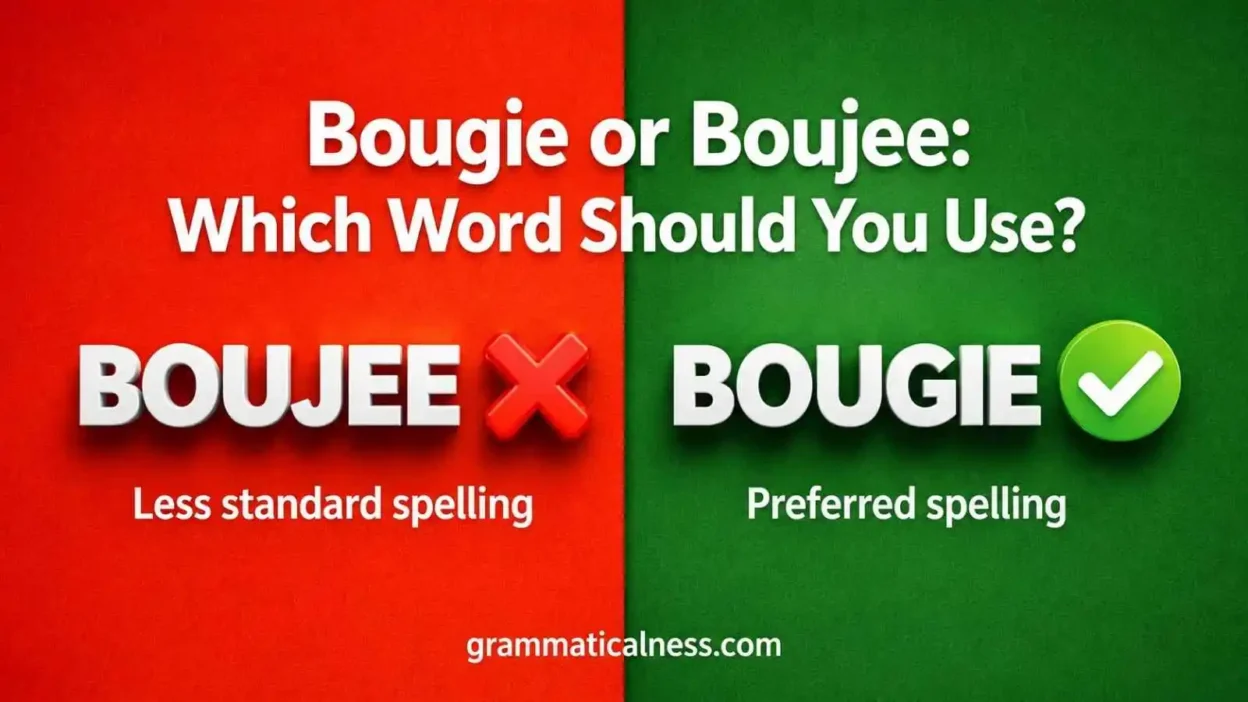
Bougie is the safer default spelling in most US writing. Boujee is also used, but it feels more casual, trendy, and tied to music, captions, memes, and playful style.
Both words usually describe someone or something that seems fancy, high-class, luxury-focused, or a little too interested in status. The difference is not a strict grammar rule. It is mostly about spelling, tone, and setting.
Quick Answer
Use bougie when you want the more established spelling.
Use boujee when you want a more casual, pop-culture feel.
A simple way to choose:
Bougie works better in everyday writing, articles, reviews, and general conversation.
Boujee works better in captions, jokes, texts, and playful comments about style or luxury.
Example:
“Those $18 smoothies are too bougie for me.”
“New boots, nice dinner, feeling boujee tonight.”
Why People Confuse Them
People confuse bougie and boujee because they sound very similar and often point to the same basic idea: fancy taste, status, luxury, or acting above one’s usual level.
The spelling bougie looks closer to the older word family connected with bourgeois. The spelling boujee looks more like the way many people say it out loud.
That is why the question is not really “Which one has the only correct meaning?” The better question is “Which spelling fits this sentence, tone, and audience?”
Key Differences At A Glance
| Context | Best Choice | Why |
| General US writing | bougie | More established and easier to defend |
| Social media caption | boujee | More playful and trend-aware |
| Restaurant or lifestyle review | bougie | Sounds natural without looking too slangy |
| Text to a friend | boujee | Casual and expressive |
| Formal report or serious essay | neither | Use plain words like fancy, luxurious, or pretentious |
| A teasing comment | bougie | Often works well for mild criticism |
| A proud style moment | boujee | Often sounds more fun and celebratory |
Meaning and Usage Difference
Bougie usually means fancy, upper-class-seeming, status-conscious, or a little pretentious.
It can describe people:
“She got called bougie for refusing anything but oat milk.”
It can describe places:
“That rooftop bar is beautiful, but it’s way too bougie for a quick drink.”
It can describe habits:
“Bringing your own truffle salt to the diner is pretty bougie.”
Boujee means much the same thing, but it often feels more playful, flashy, or self-aware.
“She booked the spa package and said she was feeling boujee.”
“That gold phone case is so boujee.”
In modern US English, both are usually adjectives. Pronunciation is useful here because the spellings can mislead readers. Bougie is commonly said like BOO-zhee. Boujee is commonly said like BOO-jee or BOO-zhee, depending on the speaker. In casual speech, the difference is often small.
Love modern slang? Don’t miss the difference between Girlie or Girly and when to use each correctly.
Tone, Context, and Formality
Neither word is formal. Both belong in casual or informal writing.
Bougie can sound teasing or critical. It often suggests someone is trying to seem rich, refined, or above ordinary things.
“Only you would call regular coffee ‘too basic.’ That’s bougie.”
But it is not always harsh. Friends may use it affectionately.
“This cheese board is bougie, and I love it.”
Boujee often sounds lighter, flashier, and more playful.
“We got dressed up for brunch and felt boujee.”
Still, boujee can also be critical if the tone is sharp.
“She acts boujee now that she got one designer bag.”
So do not treat bougie as always negative or boujee as always positive. Context decides the attitude.
Which One Should You Use?
Choose bougie when clarity matters.
It is the better pick for most blog posts, reviews, articles, newsletters, and everyday US writing. It looks more settled and less like a caption-only spelling.
Choose boujee when the voice is casual and playful.
It fits short comments, personal posts, texts, jokes, and style captions. It can make the sentence feel more current, but it may look too informal in edited writing.
Here is the practical rule:
Use bougie as your default. Use boujee for vibe.
That rule keeps the choice simple without pretending the two words have completely separate meanings.
When One Choice Sounds Wrong
Boujee can sound wrong in serious writing.
Weak: “The neighborhood has become increasingly boujee due to rising housing costs.”
Better: “The neighborhood has become increasingly upscale.”
Better casual version: “The new wine bar makes the block feel kind of bougie.”
Bougie can sound too dry when the whole point is playful flair.
Fine: “This hotel lobby is bougie.”
More playful: “This hotel lobby is so boujee.”
Both can sound wrong when you need a neutral word. If you are writing for school, work, or a serious audience, use a clearer word like luxurious, upscale, pretentious, status-conscious, or fancy.
Common Mistakes (and Quick Fixes)
Mistake: Treating bougie and boujee as two totally separate meanings.
Fix: They overlap a lot. The main difference is tone and spelling style.
Mistake: Using either word in formal writing.
Fix: Replace it with a plain alternative.
Mistake: Assuming the word is always an insult.
Fix: Read the tone. It can be teasing, admiring, ironic, or critical.
Mistake: Spelling it boogie.
Fix: Boogie usually means dancing or moving quickly. It is not the same word.
Mistake: Switching spellings in the same piece.
Fix: Pick one spelling unless you are directly comparing the two.
Everyday Examples
“I wanted tacos, but they picked a bougie place with tiny plates.”
“She made instant ramen bougie with chili oil and a soft-boiled egg.”
“This candle smells expensive in a very bougie way.”
“He called my coffee order bougie, but he still asked for a sip.”
“New nails, fresh outfit, feeling boujee.”
“That velvet couch is boujee, but it works in the room.”
“We packed snacks, but she brought a whole boujee picnic basket.”
“The hotel gave us robes, slippers, and a balcony. Very boujee.”
Both words can sound natural in US English. The choice depends on the voice you want.
Compact comparison:
• Bougie: more established, often teasing, better for general writing.
• Boujee: more playful, more casual, better for captions and style-focused comments.
Dictionary-Style Word Details
Verb
• bougie: Not commonly used as a verb in standard US English. You might hear playful phrases like “bougie it up,” but that is casual and not the main use.
• boujee: Not commonly used as a verb in standard US English. “Boujee it up” may appear in casual speech, but the normal use is adjective.
Noun
• bougie: In slang, it can refer to a middle-class or status-conscious person, though the adjective is more common in everyday use. Separately, bougie also has older noun meanings, including a candle and a medical instrument. Those meanings are real, but they are usually not what people mean in the word-choice question bougie or boujee.
• boujee: Not commonly used as a standard noun. It is mainly an adjective in modern slang.
Synonyms
• bougie: closest plain alternatives include fancy, upscale, pretentious, status-conscious, snobby, and luxury-focused. Choose based on tone. Fancy is softer; pretentious is more critical.
• boujee: closest plain alternatives include fancy, flashy, luxurious, glam, high-end, and extra. These are not always exact matches, but they fit many casual uses.
Clear antonyms are not always exact. Depending on the sentence, opposites may include plain, simple, down-to-earth, basic, or unpretentious.
Example Sentences
• bougie: “That grocery store is too bougie for my weekly shopping.”
• bougie: “Her apartment looks bougie, but most of the furniture is thrifted.”
• bougie: “He said the dinner was bougie because every plate had foam on it.”
• boujee: “We upgraded the seats and felt boujee for the whole flight.”
• boujee: “That satin pajama set is boujee in the best way.”
• boujee: “She made a boujee snack board for movie night.”
Word History
• bougie: The slang adjective is connected with bourgeois, a word tied to class and middle-class status. In modern slang, it moved toward the idea of acting fancy, refined, status-focused, or pretentious. The older noun bougie has a separate history and should not be mixed with the slang meaning.
• boujee: This spelling is a newer slang-style form that reflects the sound and feel of the word in popular use. It is strongly associated with casual speech, music, captions, and playful comments about luxury or status. The exact path of slang spread is not something to overstate, because slang often grows through speech before it becomes stable in writing.
Phrases Containing
• bougie: “too bougie,” “kind of bougie,” “bougie taste,” “bougie restaurant,” “bougie coffee,” “bougie lifestyle.”
• boujee: “feeling boujee,” “bad and boujee,” “boujee brunch,” “boujee on a budget,” “boujee vibes,” “so boujee.”
FAQs
Both bougie and boujee are used in modern English, but they often carry slightly different tones. Bougie is the more established spelling and comes from bourgeois, while boujee is a popular slang spelling strongly associated with hip-hop and internet culture.
Bougie usually describes someone or something that seems luxurious, upscale, materialistic, or concerned with social status. Depending on context, it can be playful, teasing, or mildly critical. For example, someone might call an expensive brunch spot “bougie.”
Boujee generally means stylish, luxurious, fashionable, or enjoying an upscale lifestyle. It often has a more playful or positive slang tone than bougie, especially in social media, music, and casual conversation.
They are often used interchangeably in casual speech, but the tone can differ. Bougie may suggest pretentiousness or status-conscious behavior, while boujee often emphasizes glamour, confidence, luxury, or fashionable living.
Yes. Boujee is widely recognized as an informal slang term. Although it developed from the same linguistic background as bougie, its modern popularity has given it a distinct cultural identity and usage.
In formal writing, it is usually better to avoid both unless you are discussing slang, culture, social class, or quoting someone directly. In casual writing, bougie works well for upscale or pretentious behavior, while boujee fits a trendier, more playful sense of luxury.
Conclusion
Bougie and boujee are both used in modern US English, but they do not feel the same.
Use bougie as the safer default. It works best when you want a casual but clearer spelling.
Use boujee when you want a fun, stylish, social-media-ready tone.
The real difference is not a hard meaning split. It is tone, setting, and audience. When in doubt, write bougie. When the mood is playful, boujee can be the better fit.