
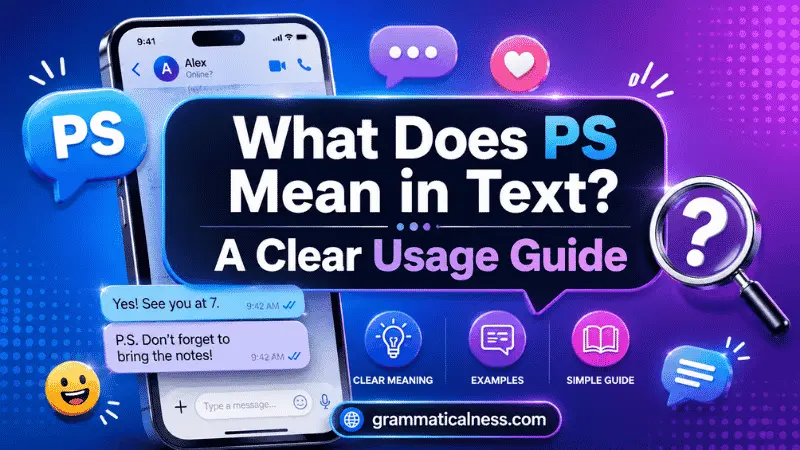
You may see PS at the end of a text, email, letter, caption, or direct message. It usually introduces one last thought after the main message seems complete. That extra line may contain a reminder, joke, personal note, or forgotten detail.
Understanding PS meaning in text helps you read the sender’s intention correctly. It also allows you to use the abbreviation without making your message look confusing or careless. Although the meaning is simple, punctuation and placement can vary.
Context matters because PS may have other meanings in gaming, education, cars, and technical writing. This guide explains what PS stands for, how it works in modern messages, and where to place it. You will also find natural examples, common mistakes, and the difference between PS, P.S., and PPS.
Quick Answer
PS meaning in text is postscript, which means an extra note added after the main message. In everyday communication, it often suggests “one more thing” or “by the way.”
TL;DR
• PS stands for postscript.
• It introduces a final added note.
• Place it near the message’s end.
• PS and P.S. are both accepted.
• PPS introduces another postscript.
• Context may give PS another meaning.
What Does PS Mean in Text?
In a text message, PS usually means postscript. The abbreviation introduces an extra comment after the main thought. This added comment may be useful, funny, warm, or unrelated to the earlier message.
For example:
Dinner starts at 7. I’ll meet you outside.
PS: Bring a jacket because we may sit outdoors.
Here, the second line adds information without changing the main message. In casual texting, PS can feel similar to “by the way” or “one more thing.” Those phrases express a similar idea, but they are not the full form of PS.
PS is a written abbreviation. Most people pronounce it letter by letter as “pee-ess.” Within a message, it works like a label before an added remark rather than a normal verb or adjective.
The word postscript comes from the idea of something written after the main text. Traditionally, writers used a postscript after finishing and signing a handwritten letter. Modern communication now uses it in emails, chats, captions, and online posts.
How PS Works in Text Messages
A postscript separates the final note from the main message. This visual break tells the reader that the sender is adding something extra. Sometimes the writer remembers the detail late; in other cases, the separate line creates emphasis.
People commonly use PS for:
• a forgotten detail
• a short reminder
• a personal comment
• a light joke
• a final request
• information outside the main topic
Consider this example:
I sent the photos to your email.
PS: The last one is my favorite.
The final sentence could appear in the main message. However, placing it after PS gives the comment a separate and more noticeable position.
Short texts often place PS directly after the final sentence because no signature is needed. Traditional letters and formal emails usually position it after the closing and the sender’s name.
How to Write PS Correctly
Write PS in capital letters. You may use PS without periods or P.S. with periods because both forms are widely understood. Different style guides may prefer one version, but consistency matters most in everyday writing.
A clear modern format looks like this:
PS: I left your package with the front desk.
A colon separates the abbreviation neatly from the added message. Another accepted format is:
P.S. I left your package with the front desk.
Choose one style and use it consistently. Mixed forms such as Ps, pS, or P.s. look irregular and should be avoided.
Placement depends on the type of message:
| Context | Best Placement | Reason |
| Text or chat | After the main message | Marks a final added thought |
| Personal email | Usually after the sign-off | Follows traditional postscript use |
| Formal email | Sparingly after the signature | Keeps the main message organized |
| Social caption | At the very end | Adds a final aside or reminder |
Keep the postscript brief. Essential, detailed, or time-sensitive information belongs in the main message instead.
PS Examples in Texts, Emails, and Social Posts
The following examples show how PS can create different tones.
Friendly text
Thanks for helping me move today.
PS: Pizza is on me next time.
Reminder
The study group starts at 4 in the library.
PS: Bring your history notes.
Playful message
I am definitely not buying another plant.
PS: I already bought one.
Personal email
Best,
Jordan
PS: Tell Maya I loved her drawing.
Work email
Regards,
Elena
PS: Please send the final head count by noon.
Social caption
Great weekend with great people.
PS: We are still laughing about the boat ride.
Each postscript contains one short added thought. Normal capitalization and sentence punctuation still apply after the abbreviation.
Tone, Context, and When to Use PS
PS has no fixed emotional tone. The wording after it determines whether the message sounds friendly, playful, warm, serious, or demanding.
Use PS for a brief note that feels separate from the main point. It works well for reminders, light jokes, personal comments, and small afterthoughts.
Professional communication can also include a postscript, but it should be used carefully. A friendly final note may work well between coworkers. Critical deadlines, instructions, and decisions should remain in the main body where readers are less likely to miss them.
Formal reports, academic essays, legal documents, and structured business writing rarely need a postscript. Those formats usually require every important idea to appear in an organized section.
The surrounding subject can also change the meaning of PS. In gaming, it may refer to PlayStation. Automotive discussions may use PS for power steering. Ordinary personal messages, however, usually use PS to mean postscript.
Common PS Mistakes and Misunderstandings
One common mistake is describing PS as modern internet slang. In reality, it is a long-established abbreviation that existed before texting and email. Casual messages may make it feel informal, but its history is much older.
Another misunderstanding is that PS always means “please see.” Some workplaces may create their own internal abbreviations, yet that is not the standard meaning at the end of a message. In that position, PS normally means postscript.
Avoid placing PS in the middle of a paragraph. The abbreviation should introduce a separate final note near the end.
Weak:
PS: The meeting is Tuesday. Please bring the report and call me first.
Better:
PS: The meeting is Tuesday, so bring the report and call me first.
Repeating PS before every sentence makes the message look cluttered. When several added points are important, rewrite the main message instead.
Never hide essential information in a postscript. Payment deadlines, safety warnings, meeting changes, and required actions deserve a clear place in the main body.
PS, P.S., and PPS: What Changes?
PS and P.S. have the same meaning. The only difference is punctuation. PS looks more modern, while P.S. has a traditional appearance.
A colon works well after the version without periods:
PS: I found your keys.
When another note follows the first postscript, PPS may introduce it:
PS: I found your keys.
PPS: They were under the couch.
PPS means an additional postscript. Still, one postscript is usually enough. Several important points should be moved into the main message.
Mini Quiz
- What does PS usually mean at the end of a text?
- Which form is acceptable: PS or P.S.?
- Where should an urgent deadline appear?
- What does PPS introduce?
- Correct this form: Ps: Call me later.
Answer Key
- Postscript, or an added final note.
- Both forms are acceptable.
- In the main message.
- Another postscript.
- PS: Call me later.
FAQs
No. PS is a long-established abbreviation for postscript. It may sound casual in texting, but it is not modern internet slang.
Not usually at the end of a message. In that position, PS normally means postscript. A company may use a private abbreviation system, so context still matters.
Yes, but use it sparingly. A postscript can add a brief reminder or friendly note. Essential instructions and deadlines should remain in the email’s main body.
Traditional usage places PS after the signature. Casual texts often have no signature, so the abbreviation simply appears after the main message.
No. Many people still use it for a final aside, reminder, or playful comment. Digital messages can be edited, but PS remains useful for tone and emphasis.
PPS introduces another note after the first postscript. Use it rarely because too many added notes can make a message harder to follow.
Conclusion
The PS meaning in text is usually postscript, a brief note placed after the main message. It can introduce a reminder, joke, personal comment, or final detail.
Use PS or P.S., position it near the end, and keep the note short. Move essential information into the main message so the reader cannot overlook it.


