
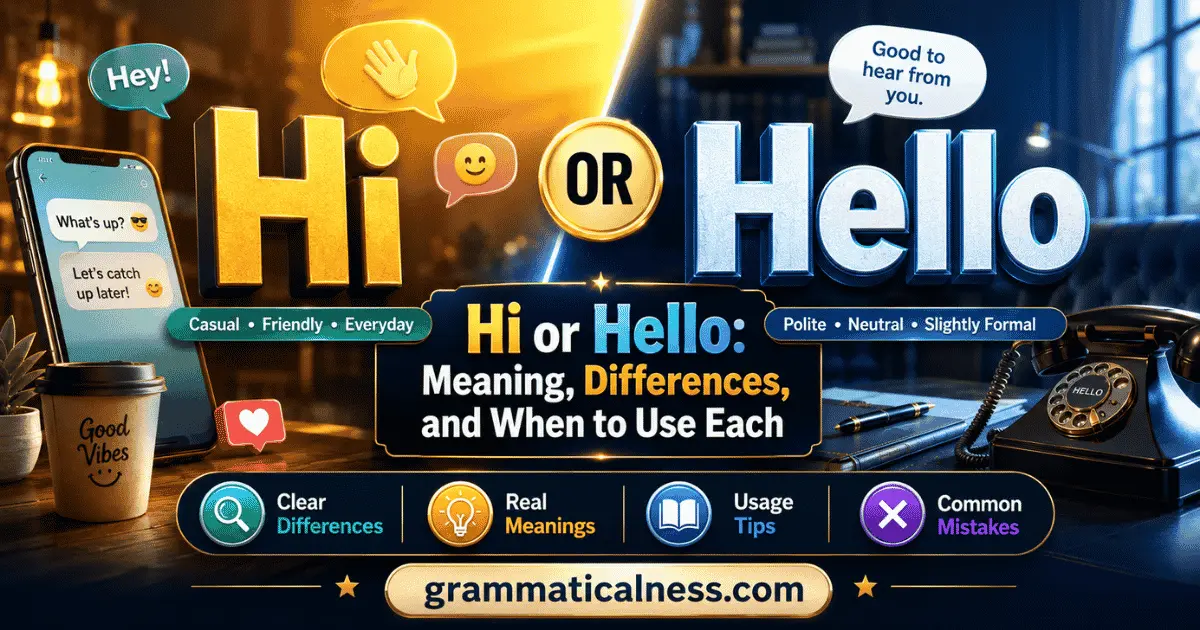
Both hi and hello are correct ways to greet someone. The main difference is usually tone rather than basic meaning.
Hi tends to sound more casual, friendly, and conversational. Hello is more neutral and can feel slightly more formal or deliberate. However, the difference is flexible. Americans regularly use both greetings in everyday conversations, workplaces, messages, introductions, and social situations.
The best choice depends on whom you are greeting, how well you know them, and how formal you want the interaction to feel.
Quick Answer
Use hi for a friendly, relaxed greeting, especially with friends, coworkers, classmates, neighbors, and people you already know.
Use hello when you want a more neutral or slightly more formal greeting. It is especially natural when answering the phone, greeting someone for the first time, beginning a more formal conversation, or getting someone’s attention.
Both are correct. In many everyday situations, either one works.
Why People Confuse Them
The confusion is understandable because hi and hello share the same basic purpose: they acknowledge or greet another person.
For example:
“Hi, Maya. How are you?”
“Hello, Maya. How are you?”
Both sentences are natural. The difference is mostly how they feel.
“Hi” sounds lighter and more conversational. “Hello” can sound a little more neutral, careful, or formal.
The distinction is not a strict rule. A friendly “Hello!” can sound warm and casual, while a brief “Hi.” can sound distant depending on voice, context, and relationship.
Key Differences At A Glance
- Hi: Usually more informal, quick, friendly, and conversational.
- Hello: More neutral and somewhat more formal; also common for phone calls, first contact, and attracting attention.
- Correctness: Both are standard greetings.
- Professional use: Both can work. “Hi” is common in friendly workplace communication, while “hello” can suit a more neutral or formal opening.
- Grammar: “Hello” has clearer established noun use. “Hi” functions mainly as a greeting expression.
Meaning and Usage Difference
Hi is a brief, friendly greeting commonly used to acknowledge someone or start a conversation.
When greeting someone directly:
“Hi, Jordan!”
To open a phone conversation naturally:
“Hi, thanks for calling.”
It is especially natural when the interaction is friendly and relaxed.
Hello also greets someone, but its uses are broader.
“Hello, Ms. Carter. It’s nice to meet you.”
“Hello? Can you hear me?”
“Hello! Is anyone here?”
In the first example, it begins a greeting. The second uses it to open or check a phone conversation, while the third uses it to attract attention.
That broader range is an important difference. You can replace “hello” with “hi” in many greetings, but not naturally in every use.
For instance:
“Hello? Is anybody there?”
sounds more conventional than:
“Hi? Is anybody there?”
Pronunciation does not create meaningful confusion here. Hi sounds like “high,” while hello is commonly pronounced “huh-LOH” or “heh-LOH.” The choice between them is mainly about usage and tone.
Tone, Context, and Formality
Hi usually carries a more informal tone. Still, “informal” does not mean rude.
In modern American workplaces, a greeting such as “Hi, Daniel” is normal in many emails, messages, meetings, and conversations. It can sound approachable without sounding careless.
Hello provides a little more distance and neutrality. It can be useful when you do not know the other person well or want a more deliberate opening.
Compare:
“Hi, Lauren. Do you have a minute?”
“Hello, Dr. Patel. It’s nice to meet you.”
The first sounds relaxed and familiar. The second fits a more formal first meeting.
Still, context matters more than a rigid rule. You do not need to use “hello” every time you speak to a stranger, manager, customer, or older person.
Which One Should You Use?
| Context | Best Choice | Why |
| Greeting a close friend | Hi | Sounds natural, warm, and relaxed |
| Greeting a coworker you know | Hi | Friendly and normal in everyday workplace communication |
| Meeting someone in a casual setting | Hi or Hello | Both work; choose based on the tone you want |
| Formal first introduction | Hello | Gives the greeting a more neutral, deliberate tone |
| Answering an unknown phone call | Hello | Conventional and immediately signals that you are ready to speak |
| Calling out to see whether someone is present | Hello | Naturally works as an attention-getting call |
| Friendly work email | Hi | Common and approachable |
| More formal or unfamiliar contact | Hello | Slightly more reserved and neutral |
When you are unsure, hello is a safe neutral choice. However, using hi is not automatically impolite simply because you have not met someone before.
When One Choice Sounds Wrong
Most greeting situations allow some flexibility, but the words do not work equally well everywhere.
Use hello rather than hi when calling out for an unseen person:
“Hello? Is anyone home?”
Here, “Hi? Is anyone home?” sounds unusual because no person has been identified as the recipient of the greeting.
“Hello” is also more established when answering a phone call:
“Hello?”
“Hi?” is possible in certain familiar situations, especially when you know who is calling, but it is less conventional as a neutral answer to an unknown caller.
On the other hand, “hello” may sound unnecessarily stiff in a very relaxed exchange:
“Hello, Jake. Would you like to play basketball?”
It is not incorrect, but “Hi, Jake” may better match an easygoing conversation.
Common Mistakes (and Quick Fixes)
Mistake: Thinking “hi” is rude.
Fix: Treat it as an informal greeting, not an impolite one. It is widely used in friendly everyday and workplace communication.
Mistake: Thinking “hello” is only formal.
Fix: “Hello” works across a wide range of situations. Friends can say it naturally too.
Mistake: Assuming they can always replace each other.
Fix: Remember that “hello” has additional uses, especially on the phone and when calling for someone’s attention.
Mistake: Using formality as the only factor.
Fix: Consider your relationship with the person, the setting, and the tone you want.
Mistake: Believing one word is more grammatically correct.
Fix: Both are correct greetings. The choice is normally about context and style.
Everyday Examples
Greeting a friend:
“Hi, Emma! How was your weekend?”
Greeting a new neighbor:
“Hello, I’m Chris from next door.”
Speaking to a familiar coworker:
“Hi, Marcus. Did you see the updated schedule?”
Starting a friendly work email:
“Hi, Rachel,
Thanks for sending the information.”
Starting a more neutral message:
“Hello, Mr. Lewis,
I’m contacting you about Thursday’s appointment.”
Answering the phone:
“Hello?”
Calling into an empty-looking office:
“Hello! Is anyone available?”
Introducing yourself casually:
“Hi, I’m Noah. Nice to meet you.”
Introducing yourself in a more formal setting:
“Hello, I’m Noah Bennett. It’s a pleasure to meet you.”
These examples show why there is no universal winner. The right greeting depends on the interaction.
Dictionary-Style Word Details
Verb
Hi: Not commonly used as a verb in standard US English. Normally say “say hi,” “greet,” or “say hi to someone.”
Example: “Please say hi to your sister for me.”
Hello: Not commonly used as an everyday verb in standard US English. The normal construction is “say hello.”
Example: “She stopped to say hello to her neighbors.”
For ordinary writing and conversation, avoid forcing either word into a verb form when “say hi” or “say hello” is clearer.
Noun
Hi: Primarily functions as a greeting expression rather than a regular count noun. It commonly appears after verbs such as “say,” as in “say hi.”
Hello: Has established noun use meaning a greeting or expression of greeting.
Examples:
“She gave us a warm hello.”
“We exchanged hellos before the meeting.”
This is one grammatical area where the two words are not perfectly parallel.
Synonyms
Hi — closest plain alternatives: hello, hey, hi there.
“Hey” is usually more casual, so it is not an exact replacement in every context.
Hello — closest plain alternatives: hi, greetings, hello there, good morning, good afternoon.
“Greetings” often sounds more formal or stylized, while time-based greetings depend on the situation.
For the basic greeting sense, goodbye is a natural opposite because it marks departure rather than arrival or contact.
Example Sentences
Hi:
“Hi, Olivia. Good to see you.”
“Hi, everyone. Thanks for coming.”
“I stopped by to say hi.”
“Hi, Ben. Are you free for lunch?”
For an introduction, you might say:
“Hello, my name is Grace.”
On the phone, a simple greeting may be:
“Hello?”
Who’s calling?”
“She greeted us with a cheerful hello.”
“Hello! Is anybody in the back office?”
Word History
Hi: The word has a long history in English and is connected to the Middle English form hy. Its use as a greeting developed from earlier attention-getting expressions.
Hello: The word developed from an earlier form related to hollo. It was originally associated with attracting attention or expressing surprise before becoming firmly established as a greeting. Its use became especially familiar as a telephone greeting in the nineteenth century.
The two words therefore did not simply begin as formal and informal versions of the same newly created expression. Their histories developed differently even though their greeting functions now overlap.
Phrases Containing
Hi:
- say hi
- say hi to someone
- hi there
- a quick hi
Examples:
“Say hi to your parents for me.”
“Hi there! Can I help you?”
Hello:
- say hello
- say hello to someone
- hello there
- hello again
- a warm hello
Examples:
“Come over and say hello.”
“Hello again. It’s good to see you.”
FAQs
Both hi and hello are correct greetings in standard English. The difference is mainly tone and context. Hi usually sounds more casual and friendly, while hello is more neutral and can feel slightly more formal.
Generally, yes. Hello often sounds a little more formal or neutral than hi. However, it is not strictly formal. Friends, coworkers, and family members can also say “hello” naturally in everyday conversation.
Yes. Hi is common in modern professional emails, especially when writing to coworkers, clients, or people you already know. For a more formal first contact, hello may feel slightly more polished and neutral.
Either can work. Hello is a safe, neutral choice when meeting someone for the first time. Hi is also acceptable and often sounds warmer and more relaxed. Your tone and the situation matter more than a strict rule.
No. Hi is informal, but it is not inherently rude. It is widely used in everyday American English, including many workplaces. It may feel too casual only in highly formal situations where a more reserved greeting is expected.
Hello is the more conventional choice, especially when you do not know who is calling. Hi can sound natural when speaking with someone familiar or when you already know the caller. In general, “Hello?” is the safest neutral phone greeting.
Conclusion
Choosing between hi or hello is usually a matter of tone and context, not right versus wrong.
Use hi when you want a friendly, relaxed, conversational greeting. It works naturally with friends, family, classmates, coworkers, and many everyday professional contacts.
Use hello when you want a neutral or slightly more formal opening. It is also the more natural choice for answering many phone calls, calling for someone’s attention, and certain first introductions.
The simplest rule is this: hi feels more casual; hello has a broader and slightly more neutral range. Both are standard, and many everyday situations comfortably allow either one.