

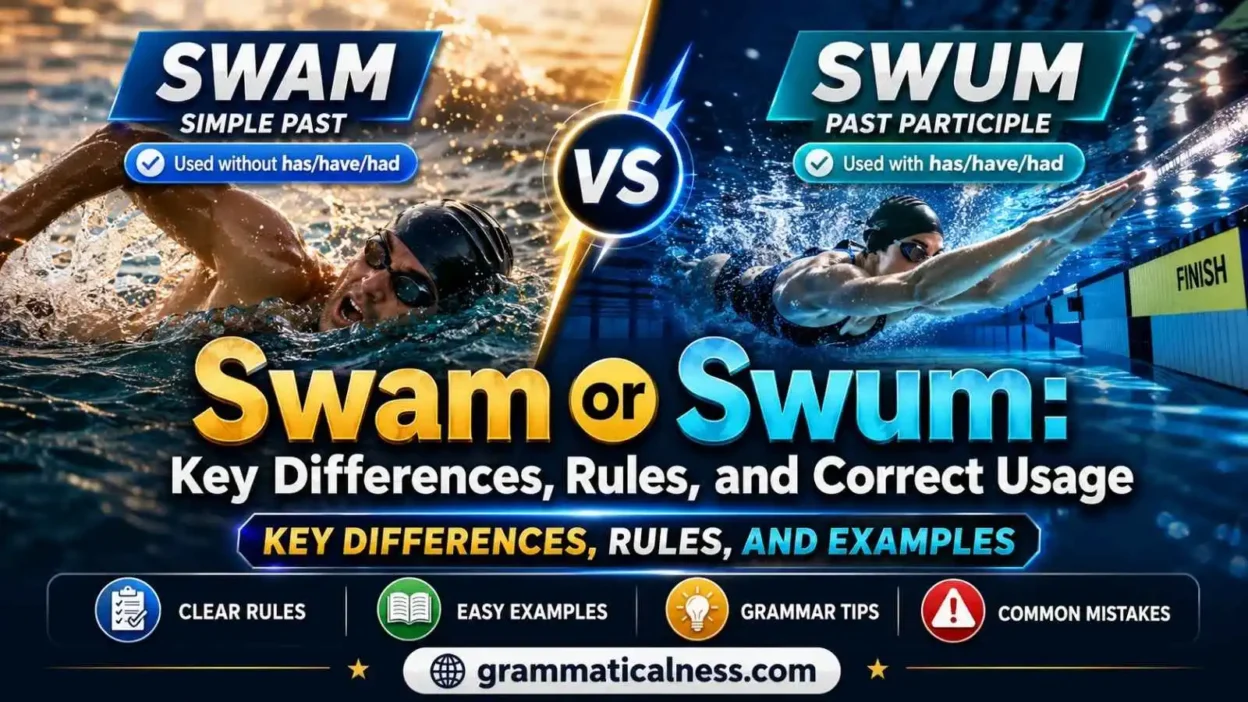
Both swam and swum are correct forms of the verb swim, but they do different jobs. Use swam for a completed action in the simple past. Use swum as the past participle, usually with have, has, or had.
The choice depends on grammar, not formality. Once you spot the sentence pattern, the correct form becomes easy to choose.
Quick Answer
Use swam when the past-tense verb stands on its own:
“ We swam at the community pool yesterday.”
Use swum in a perfect tense:
“We have swum there many times.”
It also appears in passive constructions, such as “The final lap was swum in record time.”
A simple reminder is: Yesterday, I swam; I have swum before.
Why People Confuse Them
The verb swim is irregular. It does not form its past tense by adding -ed. Instead, its vowel changes: swim becomes swam in the simple past and swum as the past participle.
Everyday speech adds confusion because some speakers say “I have swam” or “I swum yesterday.” Standard US English keeps the forms separate.
They also sound similar: swam rhymes with ham, while swum rhymes with hum.
Key Differences At A Glance
| Feature | swam | swum |
| Grammatical form | Simple past tense | Past participle |
| Common pattern | Subject + swam | Have/has/had + swum |
| Can normally stand as the main past verb? | Yes | No |
| Standard example | Maya swam yesterday. | Maya has swum there before. |
| Pronunciation | Rhymes with ham | Rhymes with hum |
The distinction concerns sentence structure, not the basic meaning of swim.
Meaning and Usage Difference
Swam places an action directly in the past. It often appears with a finished time marker, such as yesterday, last night, in June, or after practice.
- Jordan swam ten laps before breakfast.
- The dog swam across the pond.
- We swam after the gym closed.
Swum does not serve as the ordinary simple-past form. It works as the past participle. Perfect tenses combine it with a form of have:
- I have swum in open water.
- She has swum on the varsity team for two years.
- They had swum only one lap when the alarm sounded.
- By Friday, he will have swum twenty miles this month.
Words such as not, never, and already may separate the helper from swum:
“She has never swum in the ocean.”
A passive sentence can also use swum with a form of be:
“The relay was swum in the outdoor pool.”
Tone, Context, and Formality
Both words are neutral and standard in American English. Neither is more formal by itself.
A casual text still needs swum after have:
“I’ve swum there before.”
A formal report still needs swam for the simple past:
“The athlete swam the final leg.”
Forms such as “have swam” may occur in casual or regional speech. Standard usage remains the safest choice for school, business, and edited writing.
Which One Should You Use?
Check the sentence structure before choosing.
| Context | Best Choice | Why |
| A finished past action | swam | Simple past does not use have |
| After have or has | swum | Present perfect needs the past participle |
| After had | swum | Past perfect needs the past participle |
| After will have or could have | swum | Modal perfect forms need the past participle |
| In a passive construction | swum | The passive uses a form of be plus the past participle |
| After did or did not | Neither; use swim | Did already carries the past tense |
Look first for have, has, or had. They point to swum. A direct completed action usually takes swam.
When One Choice Sounds Wrong
Use of swam sounds wrong after a form of have in standard writing:
- Incorrect: I have swam in that lake.
- Correct: I have swum in that lake.
Use of swum sounds wrong as an unsupported simple-past verb:
- Incorrect: We swum after lunch.
- Correct: We swam after lunch.
Questions and negatives with did require the base form rather than either compared form:
- Incorrect: Did you swam yesterday?
- Correct: Did you swim yesterday?
- Incorrect: She did not swum.
- Correct: She did not swim.
Common Mistakes (and Quick Fixes)
Mistake: “She has swam competitively.”
Fix: Write “She has swum competitively.” The word has calls for the past participle.
Mistake: “He swum across the pool last night.”
Fix: Write “He swam across the pool last night.” The sentence describes a finished past event.
Mistake: “I have not swam there.”
Fix: Write “I have not swum there.” The word not does not change the required participle.
Mistake: “Did they swam in the meet?”
Fix: Write “Did they swim in the meet?” The helping verb did carries the past tense.
Mistake: “The race was swam indoors.”
Fix: In carefully edited English, write “The race was swum indoors.” Passive voice requires the past participle.
Everyday Examples
- I swam before work this morning.
- Ava swam for her high school team last year.
- The kids swam until the pool closed.
- Have you ever swum in the Pacific Ocean?
- He has swum that distance several times.
- We had already swum two laps before the coach arrived.
- By the end of the season, Mia will have swum in six meets.
- The opening leg was swum by the team captain.
- I have never swum in water that cold.
- They swam back to shore when the wind picked up.
Dictionary-Style Word Details
Verb
- swam: The simple past-tense form of swim. Example: “Carlos swam after class.”
- swum: The past-participle form of swim. Example: “Carlos has swum after class before.”
Both forms can represent literal movement through water and other established senses of swim.
Noun
- swam: Not commonly used as a noun in standard US English.
- swum: Not commonly used as a noun in standard US English.
The related base word swim can function as a noun, but swam and swum remain verb forms in normal use.
Synonyms
Exact substitutes depend on context because both words are forms of the same verb.
- swam — closest plain alternatives: paddled, moved through the water, crossed by swimming.
- swum — closest plain alternatives: paddled, moved through the water, crossed by swimming, with the replacement shaped as a participle.
No single antonym works in every context. Possible contrasts include sank, stayed ashore, or did not swim.
Example Sentences
- swam: “Nora swam twenty laps on Tuesday.”
- swam: “A turtle swam beside the kayak.”
- swum: “Nora has swum twenty laps every morning this week.”
- swum: “No one had swum beyond the marked area.”
- swum: “The final heat was swum outdoors.”
Word History
Both forms belong to the long-established irregular pattern of the verb swim. English changes the middle vowel rather than adding the regular -ed ending: swam marks the simple past, and swum marks the past participle.
Standard English preserves both forms for separate grammatical roles.
Phrases Containing
- swam: swam across, swam ashore, swam laps, swam upstream, swam yesterday.
- swum: has swum, had swum, never swum, distance swum, was swum, could have swum.
FAQs
Is it correct to say “I have swam”?
No. In standard English, write “I have swum.” The helping verb have requires the past participle swum.
What is the past tense of swim?
The simple past tense of swim is swam.
Example: “We swam in the lake yesterday.”
What is the past participle of swim?
The past participle is swum. Use it with have, has, or had.
Example: “She has swum in several competitions.”
Can swum stand alone in a sentence?
Usually, swum needs a helping verb.
Incorrect: “He swum across the pool.”
Correct: “He swam across the pool.”
Correct: “He has swum across the pool before.”
Is it “had swam” or “had swum”?
Use had swum because had requires the past participle.
Correct: “They had swum two laps before practice ended.”
Is it “did you swim” or “did you swam”?
Use “Did you swim?” The word did already shows past time, so the main verb returns to its base form.
Incorrect: “Did you swam yesterday?”
Correct: “Did you swim yesterday?”
Conclusion
Both swam and swum are correct, but they are not interchangeable. Use swam for the simple past:
“I swam yesterday.”
Use swum as the past participle:
“I have swum before.”
Remember the helping-verb test, but keep one nuance in mind: swum can also appear in passive sentences with a form of be. When you match the form to the sentence structure, the choice becomes clear.
No. In standard English, write “I have swum.” The helping verb have requires the past participle swum.
The simple past tense of swim is swam.
Example: “We swam in the lake yesterday.”
The past participle is swum. Use it with have, has, or had.
Example: “She has swum in several competitions.”
Usually, swum needs a helping verb.
Incorrect: “He swum across the pool.”
Correct: “He swam across the pool.”
Correct: “He has swum across the pool before.”
Use had swum because had requires the past participle.
Correct: “They had swum two laps before practice ended.”
Use “Did you swim?” The word did already shows past time, so the main verb returns to its base form.
Incorrect: “Did you swam yesterday?”
Correct: “Did you swim yesterday?”