

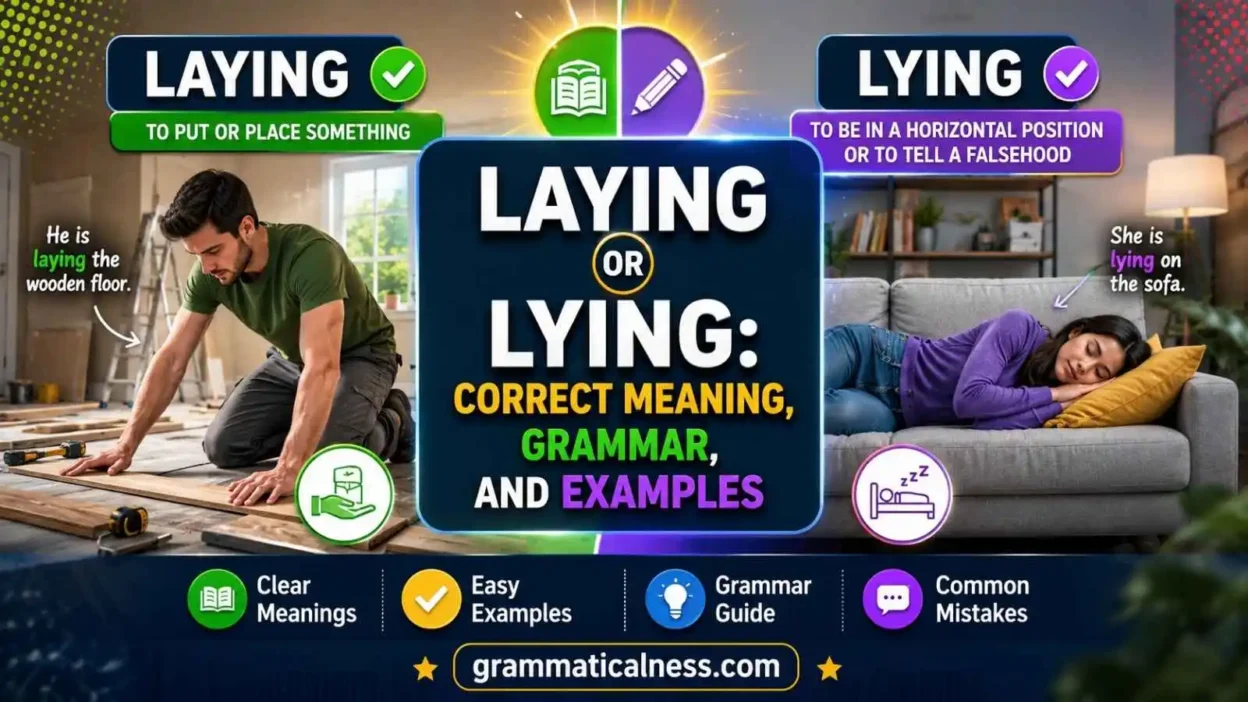
“Laying” and “lying” are both real English words, but they do not work the same way. The correct choice depends on what the subject is doing in the sentence.
Use “laying” when someone or something is placing another thing down. Use “lying” when someone or something is resting, reclining, or already positioned somewhere. This difference matters in school writing, business writing, captions, emails, and everyday grammar.
Quick Answer
Use “laying” when the sentence has a direct object: “She is laying the blanket on the bed.” Use “lying” when the subject is resting or staying in a position by itself: “She is lying on the bed.” In careful standard English, a person is usually “lying down,” not “laying down.”
Why People Confuse Them
People confuse these words because their base verbs, “lay” and “lie,” overlap in meaning. Both can involve a flat position, a bed, a floor, or a surface.
The problem gets worse because “lay” is also the past tense of “lie.” For the -ing forms, though, the choice is clearer: “laying” places something, while “lying” rests or remains somewhere.
Pronunciation also helps. “Laying” sounds like LAY-ing. “Lying” sounds like LYE-ing.
Key Differences At A Glance
| Context | Best Choice | Why |
| Someone is resting on a couch | lying | No object is being placed |
| Someone is putting a book on a desk | laying | The book is the object |
| A phone is on the counter | lying | The phone is resting there |
| A worker is installing tile | laying | Tile is being placed |
| A person is taking a nap | lying | The person is reclining |
| A hen is producing eggs | laying | This is a standard use of “laying” |
| Someone is not telling the truth | lying | This is a separate meaning of “lying” |
Meaning and Usage Difference
“Laying” comes from the verb “lay,” meaning to put or place something down. It normally needs a direct object.
Correct: “I am laying my keys on the counter.”
The object is “my keys.”
“Lying” comes from the verb “lie,” meaning to be in or move into a flat position. It does not take a direct object in this meaning.
Correct: “I am lying on the couch.”
No object is being placed.
“Lying” can also mean not telling the truth. That meaning is separate from the reclining meaning, but it uses the same spelling.
Tone, Context, and Formality
In casual speech, many people say “I’m laying down” when careful standard English would prefer “I’m lying down.” Listeners usually understand the meaning, but in polished writing, “lying down” is the safer choice.
Use “laying” when the action is being done to something else. Use “lying” when the subject is resting, reclining, or located somewhere.
Compact comparison:
- “Laying” = placing something down.
- “Lying” = resting or reclining.
- “Laying” usually needs an object.
- “Lying” does not need an object.
- “Lying” can also mean saying something false.
Which One Should You Use?
Choose “laying” if you can answer “laying what?”
“She is laying the baby in the crib.”
Laying what? The baby.
Choose lying when the sentence describes where someone or something is resting.
Correct: The baby is lying in the crib.
The baby is not placing another object somewhere. The baby is resting, so lying is the correct choice.
This test works in most everyday sentences.
When One Choice Sounds Wrong
“Laying” sounds wrong in careful writing when no object follows it.
Incorrect: “I am laying on the sofa.”
Correct: “I am lying on the sofa.”
“Lying” sounds wrong when someone is placing an object.
Incorrect: “She is lying the folder on my desk.”
Correct: “She is laying the folder on my desk.”
The noun after the verb often tells you the answer. If the noun receives the action, use “laying.”
Common Mistakes (and Quick Fixes)
Mistake: “The dog is laying by the door.”
Fix: “The dog is lying by the door.”
Why: The dog is resting, not placing something.
Mistake: “I was laying in bed all morning.”
Fix: “I was lying in bed all morning.”
Why: The speaker is reclining.
Mistake: “He is lying the tools on the bench.”
Fix: “He is laying the tools on the bench.”
Why: The tools are being placed.
Mistake: “The papers are laying on the floor.”
Fix: “The papers are lying on the floor.”
Why: The papers are simply resting there.
Everyday Examples
I am lying down for twenty minutes before dinner.
She is laying fresh towels on the guest bed.
The cat is lying in the sun near the window.
He is laying the phone beside the charger.
Your jacket is lying on the chair in the hallway.
The contractor is laying new flooring in the kitchen.
The toddler is lying quietly on the rug.
Please stop laying wet gloves on the table.
The receipt was lying under the car seat.
The nurse is laying the patient’s chart on the counter.
Dictionary-Style Word Details
Verb
“Laying” is the present participle of “lay.” It means placing, putting, installing, arranging, or setting something down.
Example: “They are laying new carpet in the office.”
“Lying” is the present participle of “lie.” In this comparison, it means resting, reclining, or being positioned somewhere.
Example: “He is lying on the floor after his workout.”
“Lying” can also mean telling something untrue.
Example: “She is lying about what happened.”
Noun
“Laying” can work as a gerund, which is a verb form used like a noun.
Example: “The laying of the tile took two days.”
“Lying” can also work as a gerund.
Example: “Lying in bed all day made his back stiff.”
For the falsehood meaning, “lying” can also name the act of not telling the truth.
Example: “Lying damaged his reputation.”
Synonyms
“Laying” closest plain alternatives: placing, setting, putting down, positioning, installing.
Helpful opposites: lifting, removing, picking up.
“Lying” closest plain alternatives for resting: reclining, resting, resting flat, being positioned.
Helpful opposites: standing, sitting, rising.
For “lying” as dishonesty, closest alternatives include deceiving and telling an untruth. The clear opposite is telling the truth.
Example Sentences
Laying means placing something down: Maria is laying the baby blanket across the crib.
You can also use laying for putting materials in position: The crew is laying cable along the street.
Avoid using laying when nothing is being placed: Please do not lay your backpack in the walkway.
Lying means resting or reclining: Maria is lying on the couch with a headache.
When something is already resting in a place, lying is also correct: The cable was lying across the sidewalk.
Lying can also mean saying something untrue: He was lying when he said he finished the report.
Word History
“Laying” and “lying” come from older English verbs that have long been easy to confuse because both can involve position and rest. The most useful point for modern readers is not a date or origin story. It is the grammar pattern: “laying” usually acts on an object, while “lying” usually describes the subject’s own position.
Phrases Containing
“Laying”: laying down rules, laying the groundwork, laying bricks, laying tile, laying eggs, laying something aside.
“Lying”: lying down, lying in bed, lying low, lying in wait, lying around, take it lying down.
Be careful with “laying down.” It is correct when something is being placed: “She is laying down the rules.” For resting, careful standard English uses “lying down”: “She is lying down for a nap.”
FAQs
Is it laying or lying down?
“Lying down” is the correct choice in careful standard English when a person or animal is resting or reclining. For example, write, “I am lying down for a few minutes.” Use “laying down” only when someone is placing something down, such as “She is laying down a blanket.”
Is the dog laying or lying on the floor?
The better choice is “lying.” A dog resting on the floor is not placing anything, so the sentence should be, “The dog is lying on the floor.” Many people say “laying” in casual speech, but “lying” is the safer choice in polished writing.
When should I use laying?
Use “laying” when the subject is putting or placing something somewhere. It usually needs a direct object. For example, “He is laying the keys on the counter” is correct because “the keys” are being placed. If you can ask “laying what?” and get an answer, use “laying.”
When should I use lying?
Use “lying” when someone or something is resting, reclining, or already positioned somewhere. For example, “She is lying in bed” and “The papers are lying on the desk” are correct. Nothing is being placed; the subject is simply in a position.
Why do people confuse laying and lying?
People confuse them because “lay” and “lie” are closely related in meaning, and both often involve beds, floors, couches, or flat surfaces. The past tense also adds confusion because “lay” can be the past tense of “lie.” For the -ing forms, remember: “laying” places something, while “lying” rests.
Is lying always about not telling the truth?
No. “Lying” has two common meanings. It can mean resting or reclining, as in “I am lying on the couch.” It can also mean saying something false, as in “He is lying about the mistake.” Context makes the meaning clear.
Conclusion
“Laying” and “lying” are both correct, but they fit different sentence patterns. Use “laying” when someone or something is placing an object. Use “lying” when someone or something is resting, reclining, or staying in a position.
The easiest test is simple: ask “laying what?” If the sentence answers that question, “laying” is probably right. If no object is being placed, “lying” is usually the correct choice.
“Lying down” is the correct choice in careful standard English when a person or animal is resting or reclining. For example, write, “I am lying down for a few minutes.” Use “laying down” only when someone is placing something down, such as “She is laying down a blanket.”
The better choice is “lying.” A dog resting on the floor is not placing anything, so the sentence should be, “The dog is lying on the floor.” Many people say “laying” in casual speech, but “lying” is the safer choice in polished writing.
Use “laying” when the subject is putting or placing something somewhere. It usually needs a direct object. For example, “He is laying the keys on the counter” is correct because “the keys” are being placed. If you can ask “laying what?” and get an answer, use “laying.”
Use “lying” when someone or something is resting, reclining, or already positioned somewhere. For example, “She is lying in bed” and “The papers are lying on the desk” are correct. Nothing is being placed; the subject is simply in a position.
People confuse them because “lay” and “lie” are closely related in meaning, and both often involve beds, floors, couches, or flat surfaces. The past tense also adds confusion because “lay” can be the past tense of “lie.” For the -ing forms, remember: “laying” places something, while “lying” rests.
No. “Lying” has two common meanings. It can mean resting or reclining, as in “I am lying on the couch.” It can also mean saying something false, as in “He is lying about the mistake.” Context makes the meaning clear.