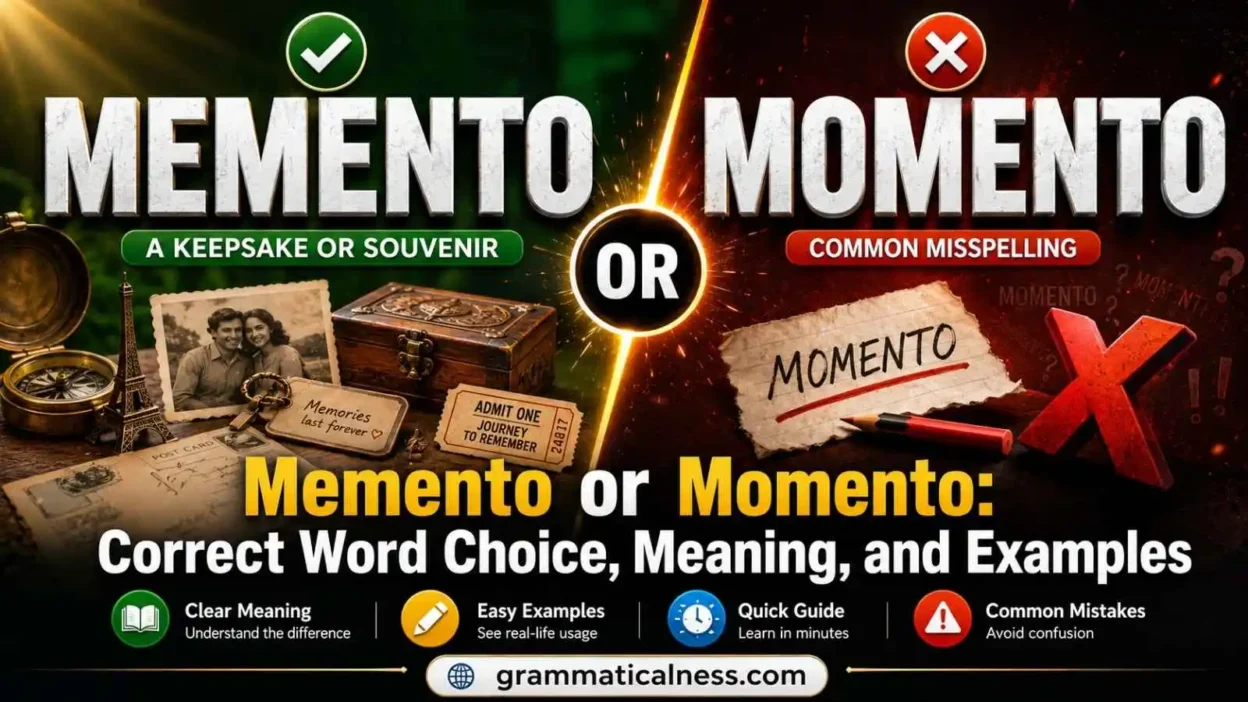
Memento or momento is a common word-choice problem because both spellings look believable. The safer choice in standard US English is memento.
A memento is an object that helps you remember a person, place, event, or time in your life. A concert ticket, a graduation photo, a travel magnet, or a family watch can all be mementos. Momento appears in some dictionaries as a variant spelling, but many readers still see it as a mistake. For clear, polished writing, use memento.
Quick Answer
Use memento when you mean a keepsake, souvenir, or reminder of the past. Momento may appear as a variant spelling, but it is not the best choice for school, business, publishing, or formal writing. In US English, memento is the spelling most readers expect.
Why People Confuse Them
People confuse memento and momento because the word is connected to memory, but it often reminds writers of a moment.
That connection makes momento look logical. A keepsake helps you remember a special moment, so the spelling with mo- feels natural. Still, the standard spelling is memento, with me- at the start.
Pronunciation also plays a role. Memento is commonly said like muh-MEN-toh. If someone hears the first syllable as moh, they may write momento by mistake.
Key Differences At A Glance
| Context | Best Choice | Why |
| A keepsake from a trip | memento | This is the standard spelling. |
| A souvenir from an event | memento | It clearly means a reminder object. |
| Formal writing | memento | It looks polished and expected. |
| School assignments | memento | Teachers and editors are likely to prefer it. |
| Casual texting | memento | Still the safer spelling. |
| Quoting a brand, title, or name using “Momento” | Momento | Keep the official spelling of a proper name. |
| The phrase “memento mori” | memento | This fixed phrase uses the Latin-based spelling. |
Compact comparison:
• Memento: the standard noun for a keepsake or reminder.
• Momento: a variant spelling in some dictionaries, but often treated as a misspelling.
• Best everyday choice: memento.
• Best professional choice: memento.
Meaning and Usage Difference
A memento is something you keep because it reminds you of something important. It is usually a physical object, but it can also be something saved for memory, such as a note, photo, or recording.
Examples include a seashell from a beach trip, a signed baseball, a wedding program, a graduation tassel, or a letter from a loved one.
Momento usually tries to mean the same thing. The issue is not meaning. The issue is acceptance. Some dictionaries record it as a variant, but many careful readers still consider it a spelling error.
So the real difference is simple: memento is the safer standard spelling, while momento is a risky variant.
Tone, Context, and Formality
Memento works in casual, formal, creative, academic, and professional writing. It sounds natural in a personal essay, a museum label, a product description, or a thank-you note.
Momento can make polished writing look less careful. Even if a reader understands your meaning, the spelling may distract them. It can look especially weak in resumes, schoolwork, business copy, invitations, captions for a brand, and edited articles.
There is no strong US versus UK difference to rely on here. For a US audience, the practical rule is clear: choose memento unless you are copying an official title, brand name, username, or quoted text that uses Momento.
Which One Should You Use?
Use memento almost every time.
Write memento when you mean a keepsake, souvenir, reminder, or object saved for memory. This spelling gives your sentence the best chance of sounding correct to the widest group of readers.
Use Momento only when it is part of a proper name or exact title. For example, a company, album, app, restaurant, or project might use Momento as a chosen name. In that case, keep the official spelling because names are copied as written.
When One Choice Sounds Wrong
Momento sounds wrong when the sentence clearly needs the standard English word for a keepsake.
For example, “I kept the ticket as a momento” may be understood, but it can look like an error. “I kept the ticket as a memento” looks cleaner and more standard.
Memento would not be changed in the phrase memento mori. That phrase is fixed, so momento mori looks incorrect.
A proper name is different. If a business is called “Momento Studio,” do not change it to “Memento Studio.” Exact names should keep their official spelling.
Common Mistakes (and Quick Fixes)
Mistake: “She saved the bracelet as a momento.”
Fix: “She saved the bracelet as a memento.”
Mistake: “The plaque was a momento of his service.”
Fix: “The plaque was a memento of his service.”
Mistake: “We bought a momento from the museum gift shop.”
Fix: “We bought a memento from the museum gift shop.”
Mistake: “The photo became a momento mori.”
Fix: “The photo became a memento mori.”
The easiest memory trick is this: memento starts like memory. A memento helps you remember.
Everyday Examples
I kept the train ticket as a memento of my first solo trip.
The framed photo is a memento from their wedding day.
She saved her grandfather’s watch as a family memento.
The coach gave each player a signed ball as a memento of the season.
He brought home a small mug as a memento from Chicago.
The old postcard became a quiet memento of their friendship.
They packed a few mementos before moving out of the house.
The museum shop sells small mementos for visitors.
A dried flower from the ceremony was her favorite memento.
The company gave him a glass award as a memento of his 20 years of service.
Dictionary-Style Word Details
Verb
• memento: Not commonly used as a verb in standard US English. Use it as a noun.
• momento: Not commonly used as a verb in standard US English.
Noun
• memento: A countable noun meaning an object kept as a reminder of a person, place, event, or past experience. The plural can be mementos or mementoes, though mementos is simpler for most US writing.
• momento: A variant spelling of memento in some dictionaries, but often viewed as a misspelling. It is not the best noun form for polished US English.
Synonyms
• memento: closest plain alternatives include keepsake, souvenir, reminder, token, and remembrance.
• momento: because it is mainly a variant spelling of memento, use the same alternatives only when the intended meaning is “keepsake” or “reminder.”
Clear antonyms do not fit well. A memento is an object tied to memory, but there is no simple everyday opposite that works in all contexts.
Example Sentences
• memento: The ticket stub is a memento from our first date.
• memento: She kept the necklace as a memento of her grandmother.
• memento: Each guest received a small memento after the ceremony.
• momento: Some people write momento, but memento is the safer spelling.
• momento: Use Momento only if it is the exact spelling of a title or name.
Word History
• memento: The word comes from Latin and is connected with the idea of remembering. Its spelling reflects that older form, not the English word moment.
• momento: This spelling likely feels natural because keepsakes remind people of moments. It also resembles words in other languages, but that does not make it the best spelling for standard US English.
Phrases Containing
• memento: a memento of, as a memento, family memento, personal memento, memento mori.
• momento: No common fixed English phrases require this spelling. Use memento in the standard phrase memento mori and in normal keepsake uses.
FAQs
Is memento or momento correct?
Memento is the correct and safest spelling in standard US English. It means a keepsake, souvenir, or object that reminds you of a person, place, event, or memory. Momento appears sometimes, but many readers still see it as a misspelling.
What does memento mean?
A memento is something you keep because it helps you remember something important. For example, a concert ticket, family photo, wedding program, travel magnet, or old letter can be a memento.
Is momento a real word?
Momento appears in some dictionaries as a variant spelling, but it is not the best choice for polished writing. In school, business, articles, captions, and formal writing, memento is the better spelling.
Why do people write momento instead of memento?
Many people write momento because a memento often reminds them of a special moment. That connection makes the spelling look natural, but the standard English spelling is still memento.
Can I use momento in casual writing?
You may see momento in casual writing, but it can still look like an error. To avoid confusion, use memento even in texts, captions, emails, and everyday sentences.
What is an example of memento in a sentence?
Here is a natural example: “She kept the seashell as a memento of her beach trip.” Another example is: “The framed photo became a memento of their graduation day.”
Is memento the same as souvenir?
A memento and a souvenir are very close in meaning. A souvenir is usually something brought back from a place or event. A memento can be any object saved because it carries personal memory.
Conclusion
Choose memento when you mean a keepsake, souvenir, or object that helps someone remember the past. It is the clearest and safest spelling for US English.
Momento may appear as a variant, but it can look like a mistake to many readers. For school, work, publishing, captions, and everyday writing, memento is the better choice.
Memento is the correct and safest spelling in standard US English. It means a keepsake, souvenir, or object that reminds you of a person, place, event, or memory. Momento appears sometimes, but many readers still see it as a misspelling.
A memento is something you keep because it helps you remember something important. For example, a concert ticket, family photo, wedding program, travel magnet, or old letter can be a memento.
Momento appears in some dictionaries as a variant spelling, but it is not the best choice for polished writing. In school, business, articles, captions, and formal writing, memento is the better spelling.
Many people write momento because a memento often reminds them of a special moment. That connection makes the spelling look natural, but the standard English spelling is still memento.
You may see momento in casual writing, but it can still look like an error. To avoid confusion, use memento even in texts, captions, emails, and everyday sentences.
Here is a natural example: “She kept the seashell as a memento of her beach trip.” Another example is: “The framed photo became a memento of their graduation day.”
A memento and a souvenir are very close in meaning. A souvenir is usually something brought back from a place or event. A memento can be any object saved because it carries personal memory.