
Breath or breathe is a common word-choice problem because the words look almost the same. However, they do not do the same job in a sentence.
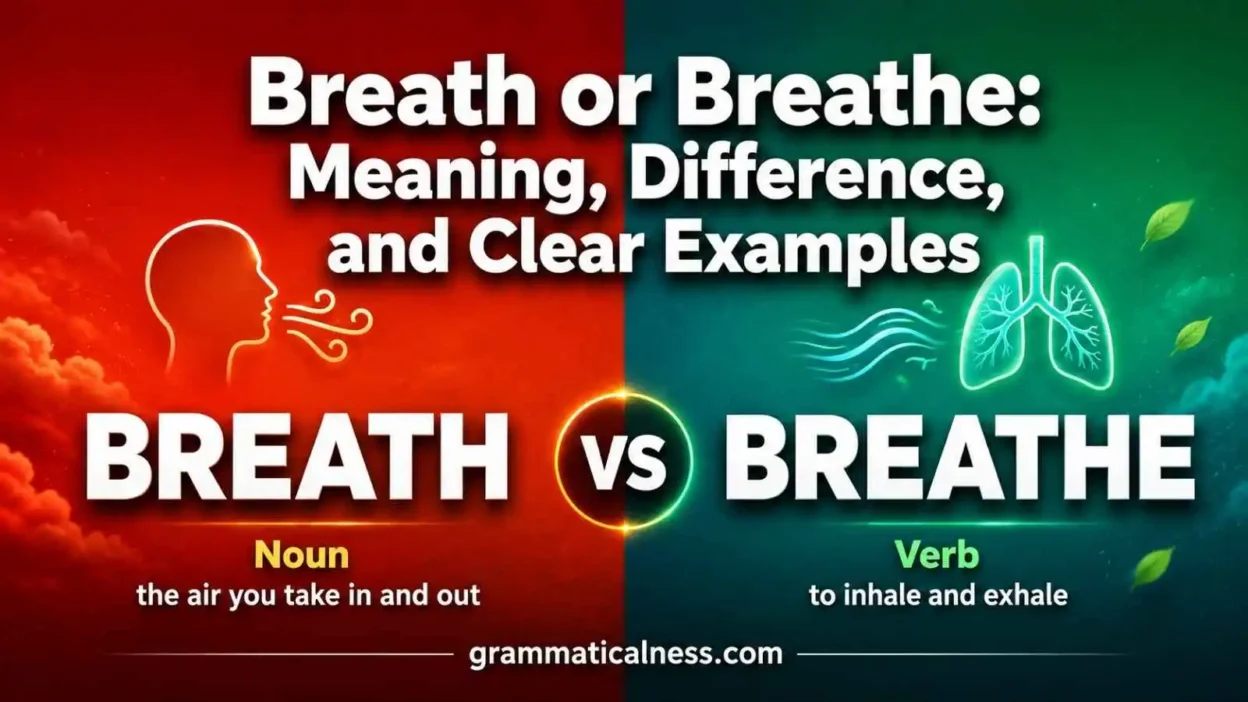
Use breath when you need a noun. Use breathe when you need a verb. In simple terms, a breath is the air or act, while breathe is the action of taking air in and letting it out.
Quick Answer
Breath is a noun. It means the air you take in or let out, or one act of breathing. Breathe is a verb. It means to inhale and exhale. Write take a breath, hold your breath, and out of breath. Write I can’t breathe, breathe deeply, and let the room breathe.
Why People Confuse Them
People confuse breath and breathe because only one letter separates them. They are also closely related in meaning, so the sentence may still seem understandable even when the wrong form appears.
Pronunciation adds another layer. Breath sounds like “breth,” with a short vowel sound. Breathe sounds like “breeth,” with a longer “ee” sound. The final sound also changes: breath ends more sharply, while breathe ends more smoothly.
The easiest memory trick is this: breathe has an extra e, and it has the longer ee sound.
Key Differences At A Glance
| Context | Best Choice | Why |
| Naming the air you inhale or exhale | breath | It is a noun. |
| Describing the action of inhaling and exhaling | breathe | It is a verb. |
| Saying someone needs air | breathe | The sentence needs an action word. |
| Saying someone took one inhale-exhale cycle | breath | The sentence names a thing or act. |
| Using phrases like “hold your ___” | breath | The phrase needs the noun. |
| Using phrases like “___ deeply” | breathe | The phrase needs the verb. |
Meaning and Usage Difference
Breath means a thing, not an action. It can mean the air that comes from your lungs, one act of breathing, or the ability to breathe.
Examples:
- Take a deep breath before you answer.
- I could see my breath in the cold air.
- She was out of breath after the stairs.
Breathe means to do the action. It tells what someone or something does.
Examples:
- Try to breathe slowly.
- I could not breathe through my nose.
- This fabric breathes well in hot weather.
Here is the simple grammar test: if you can place a, the, my, or your before the word, you probably need breath. If the word can follow to, can, will, should, or must, you probably need breathe.
Tone, Context, and Formality
Both words are standard in US English. Neither one is more formal than the other. The difference is grammar, not tone.
Breath appears often in everyday speech, health writing, sports writing, and emotional descriptions. People say bad breath, deep breath, shortness of breath, and breath of fresh air.
Breathe appears when the sentence needs movement or action. It works in literal sentences, such as breathe through your nose, and in figurative sentences, such as let the idea breathe or breathe new life into a project.
In serious or medical contexts, the difference still matters. The patient’s breath names the air, smell, or breathing act. The patient can breathe describes the action or ability.
Which One Should You Use?
Use breath when you are naming something.
Choose breath for:
- a breath
- your breath
- bad breath
- deep breath
- out of breath
- short of breath
- breath of fresh air
Use breathe when someone or something is doing something.
Choose breathe for:
- breathe deeply
- breathe slowly
- can breathe
- hard to breathe
- breathe in
- breathe out
- breathe new life into
- let it breathe
| Feature | breath | breathe |
| Main role | Noun | Verb |
| Plain meaning | Air or one act of breathing | To inhale and exhale |
| Pronunciation | “breth” | “breeth” |
| Common pattern | take a breath | take time to breathe |
| Example | I need a breath. | I need to breathe. |
When One Choice Sounds Wrong
Breath sounds wrong when the sentence needs an action.
Incorrect: I need to breath.
Correct: I need to breathe.
Incorrect: The room needs to breath.
Correct: The room needs to breathe.
Incorrect: She could not breath after the race.
Correct: She could not breathe after the race.
Breathe sounds wrong when the sentence needs a noun.
Incorrect: Take a deep breathe.
Correct: Take a deep breath.
Incorrect: His breathe smelled like coffee.
Correct: His breath smelled like coffee.
Incorrect: I was out of breathe.
Correct: I was out of breath.
Common Mistakes (and Quick Fixes)
One common mistake is writing take a breathe. The correct phrase is take a breath because a comes before a noun.
Another common mistake is writing I can’t breath. The correct sentence is I can’t breathe because can’t needs a base verb after it.
Writers also mix up breath in and breathe in. Use breathe in when you mean “inhale.” Use breath only when you are naming the air or the act.
Correct examples:
- Take a breath before the meeting.
- Breathe in through your nose.
- Please breathe slowly.
- Her breath was steady.
- I was too nervous to breathe.
- He held his breath underwater.
Everyday Examples
- Take one deep breath and start again.
- I need a minute to catch my breath.
- Her breath fogged the window.
- He had coffee breath after lunch.
- The hike left us out of breath.
- That new teacher is a breath of fresh air.
- Try to breathe through your nose.
- I could barely breathe in the crowded room.
- The doctor told him to breathe normally.
- Let the paint breathe before adding another coat.
- This shirt breathes better than the old one.
- The speech helped breathe new energy into the team.
Dictionary-Style Word Details
Verb
breath: Not commonly used as a verb in standard US English. In ordinary modern writing, use breathe for the action.
breathe: A verb meaning to take air into the lungs and let it out. It can also mean to allow air to pass through, to rest, or to bring life or energy into something.
Examples:
- She needs to breathe slowly.
- The jacket breathes well.
- The update helped breathe life into the old design.
Noun
breath: A noun meaning air inhaled or exhaled, one act of breathing, the ability to breathe, a pause, a slight breeze, or a small hint of something.
Examples:
- He took a breath.
- I could feel a breath of cold air.
- There was not a breath of doubt in her voice.
breathe: Not commonly used as a noun in standard US English. Use breath when you need the noun.
Synonyms
breath: No single synonym fits every use. Closest plain alternatives include inhalation, exhalation, gasp, pause, breeze, or hint, depending on the sentence.
breathe: Closest plain alternatives include inhale, exhale, respire, or take in air. Inhale and exhale describe only one direction of the action, so they are not always full replacements.
Clear antonyms are limited. For breathe, a phrase like stop breathing is often clearer than forcing one word. For breath, the opposite depends on the meaning, so there is no one useful antonym for all contexts.
Example Sentences
breath:
- Take a deep breath before you speak.
- I lost my breath during the last lap.
- Her breath was visible in the winter air.
- The news made everyone hold their breath.
breathe:
- Remember to breathe during the exercise.
- He could finally breathe after the test ended.
- Open the windows so the room can breathe.
- The coach told the players to breathe and reset.
Word History
breath: The word has older English roots connected with ideas such as scent, odor, vapor, and exhaled air. Modern usage now centers on air, breathing, and related figurative phrases.
breathe: The verb developed from forms related to breath. Today, the practical difference is clear: breath is the noun, and breathe is the verb.
Phrases Containing
breath:
- take a breath
- hold your breath
- catch your breath
- out of breath
- bad breath
- breath of fresh air
- under your breath
- last breath
breathe:
- breathe deeply
- breathe in
- breathe out
- breathe easy
- breathe a sigh of relief
- breathe new life into
- live and breathe
- let something breathe
FAQs
Is it breath or breathe?
Use breath when you need a noun and breathe when you need a verb. A breath is the air you take in or let out. Breathe means to take air in and let it out. For example, write “Take a deep breath” but “Try to breathe slowly.”
What is the main difference between breath and breathe?
The main difference is grammar. Breath names something, so it works as a noun. Breathe shows action, so it works as a verb. If the sentence talks about “a breath,” “your breath,” or “bad breath,” use breath. If it says someone can, should, or needs to do the action, use breathe.
Do you say take a breath or take a breathe?
The correct phrase is take a breath. The word a usually comes before a noun, and breath is the noun. Take a breathe is incorrect in standard US English.
Do you say I can’t breath or I can’t breathe?
The correct sentence is I can’t breathe. After can’t, you need a verb. Since breathe is the verb, it is the correct choice. I can’t breath is a common mistake.
How do you pronounce breath and breathe?
Breath sounds like “breth,” with a short vowel sound. Breathe sounds like “breeth,” with a longer “ee” sound. The extra e in breathe can help you remember the longer sound.
Is breathe ever a noun?
No, breathe is not commonly used as a noun in standard US English. Use breath when you need the noun, as in “one breath,” “deep breath,” or “out of breath.”
Conclusion
The difference between breath and breathe is not about formality or preference. It is about grammar. Breath is the noun, so use it for the air, the act, or common phrases like take a breath. Breathe is the verb, so use it for the action in sentences like I can’t breathe or breathe slowly. When you are unsure, check the sentence. If you need a thing, choose breath. If you need an action, choose breathe.
Use breath when you need a noun and breathe when you need a verb. A breath is the air you take in or let out. Breathe means to take air in and let it out. For example, write “Take a deep breath” but “Try to breathe slowly.”
The main difference is grammar. Breath names something, so it works as a noun. Breathe shows action, so it works as a verb. If the sentence talks about “a breath,” “your breath,” or “bad breath,” use breath. If it says someone can, should, or needs to do the action, use breathe.
The correct phrase is take a breath. The word a usually comes before a noun, and breath is the noun. Take a breathe is incorrect in standard US English.
The correct sentence is I can’t breathe. After can’t, you need a verb. Since breathe is the verb, it is the correct choice. I can’t breath is a common mistake.
Breath sounds like “breth,” with a short vowel sound. Breathe sounds like “breeth,” with a longer “ee” sound. The extra e in breathe can help you remember the longer sound.
No, breathe is not commonly used as a noun in standard US English. Use breath when you need the noun, as in “one breath,” “deep breath,” or “out of breath.”