
Quit or quite is a common word-choice problem because the words look similar and both start with the same “kw” sound. Still, they do not mean the same thing, and they do not work the same way in a sentence.
Use quit when someone stops doing something or leaves a job, school, activity, app, or place. Use quite when you mean very, fairly, completely, or to a noticeable degree. One letter changes the whole sentence.
Quick Answer
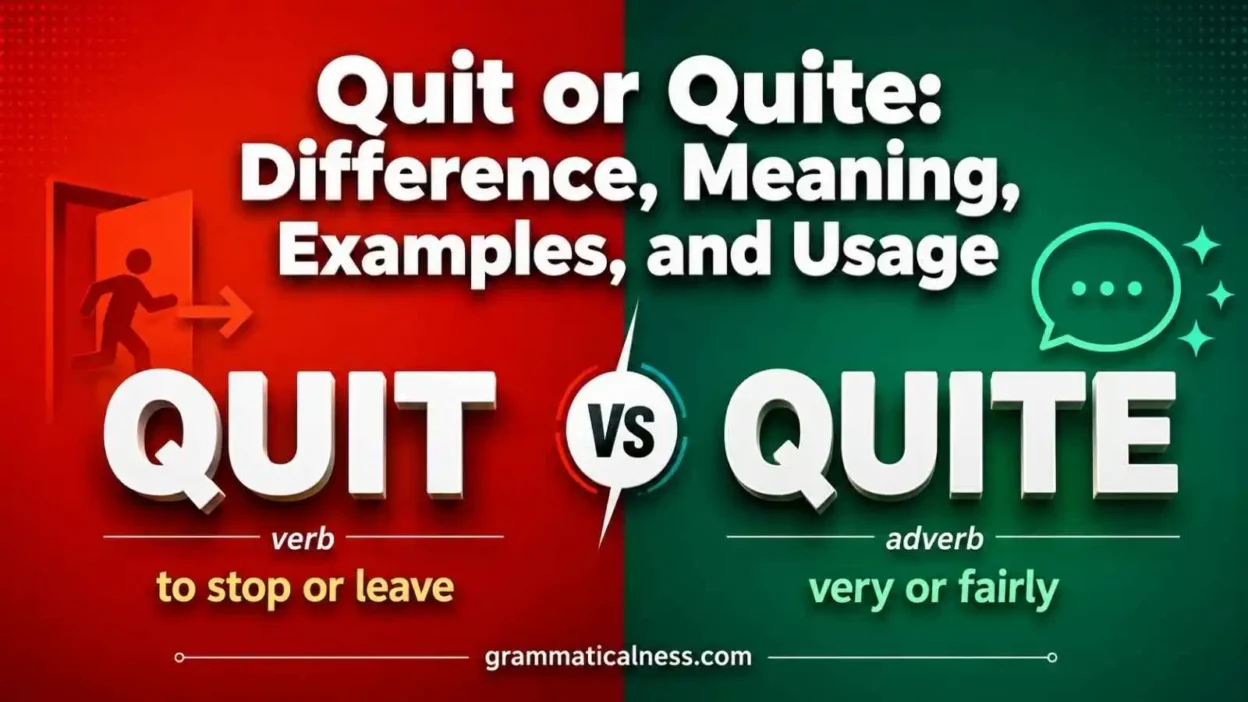
Quit is usually a verb. It means to stop, leave, or give up an activity: “She quit her job.” Quite is an adverb. It changes the strength of another word: “The job was quite hard.” Use quit for an action. Use quite for degree or emphasis.
Why People Confuse Them
People confuse quit and quite because the spelling is close. The only visible difference is the final e in quite.
They are also close in sound, but they are not the same in careful speech. Quit sounds like “kwit” and rhymes with “sit.” Quite sounds like “kwite” and rhymes with “bite.”
The mistake often happens when someone writes fast:
Incorrect: I want to quite my job.
Correct: I want to quit my job.
Incorrect: The movie was quit funny.
Correct: The movie was quite funny.
Key Differences At A Glance
| Feature | quit | quite |
| Main role | Verb | Adverb |
| Main meaning | To stop or leave | Very, fairly, completely, or to a degree |
| Pronunciation | “kwit” | “kwite” |
| Common pattern | quit + activity/job | quite + adjective/adverb |
| Example | I quit smoking. | It was quite cold. |
The easiest memory trick is this: quit is about stopping. quite is about amount, degree, or emphasis.
Meaning and Usage Difference
Quit means to stop doing something, leave a position, or end an action. You can quit a job, quit school, quit a game, quit texting, quit smoking, or quit an app.
Examples:
She quit her retail job last month.
Please quit tapping your pen during the test.
He quit the game after the third round.
Quite means that something has a certain degree or level. In US English, it can mean fairly, pretty, very, or completely, depending on the sentence.
Examples:
The test was quite hard.
I am not quite ready.
That answer is quite right.
With normal adjectives, quite often means “fairly” or “pretty”: “The room is quite small.” With stronger or absolute words, it can mean “completely”: “You are quite correct.”
Tone, Context, and Formality
Quit is direct and common in everyday US English. It works in casual speech, workplace talk, school settings, and instructions.
Examples:
I might quit the team.
Quit leaving your backpack in the hallway.
In formal work writing, resign may sound more professional than quit when talking about leaving a job or office. “She resigned from the board” sounds more formal than “She quit the board.”
Quite is also standard, but in casual US speech, many people use pretty, really, or very instead. Still, quite sounds natural in careful writing and polite speech.
Examples:
That is quite helpful.
The report is not quite finished.
Which One Should You Use?
| Context | Best Choice | Why |
| Leaving a job | quit | It names the action of leaving work |
| Stopping a habit | quit | It means to stop doing something |
| Closing a program or app | quit | It means to exit or stop running it |
| Describing degree | quite | It modifies another word |
| Saying “not completely” | quite | “Not quite” means not fully |
| Emphasizing an adjective | quite | It can mean very or completely |
| Giving a direct command | quit | “Quit talking” means stop talking |
Choose quit when the sentence needs an action word. Choose quite when the sentence needs a word that changes the strength of another word.
When One Choice Sounds Wrong
Quite sounds wrong when the sentence needs a verb.
Wrong: I will quite after lunch.
Right: I will quit after lunch.
Wrong: She wants to quite smoking.
Right: She wants to quit smoking.
Quit sounds wrong when the sentence needs an adverb.
Wrong: The hike was quit long.
Right: The hike was quite long.
Wrong: I am not quit sure.
Right: I am not quite sure.
A simple test helps: if you can replace the word with stop, use quit. If you can replace it with very, fairly, or completely, use quite.
Common Mistakes (and Quick Fixes)
Mistake: Using quite for leaving a job.
Fix: Use quit.
Correct: He quit his job to start a small business.
Mistake: Using quit before an adjective.
Fix: Use quite.
Correct: The class was quite interesting.
Mistake: Writing quit good.
Fix: Write quite good.
Correct: Her presentation was quite good.
Mistake: Writing not quit ready.
Fix: Write not quite ready.
Correct: We are not quite ready to launch.
Mistake: Treating the words as interchangeable.
Fix: Remember that quit shows action, while quite shows degree.
Everyday Examples
I need to quit scrolling and finish my homework.
She quit the club because her schedule changed.
Did you quit the app before restarting your laptop?
Please quit making noise during the call.
He quit drinking soda for a month.
The coffee is quite strong today.
That was quite a smart answer.
I am not quite done with the report.
The apartment is quite close to campus.
Your idea is quite different from mine.
Dictionary-Style Word Details
Verb
quit: Commonly used as a verb. It means to stop doing something, leave a job or place, or give up an activity.
Example: Maya quit her weekend job.
quite: Not used as a verb in standard US English.
Incorrect: I will quite the game.
Correct: I will quit the game.
Noun
quit: Can be used as a noun, but this is much less common than the verb. It can refer to an act or instance of quitting. It also appears in the phrase “call it quits.”
Example: After one final attempt, they called it quits.
quite: Not used as a noun in standard US English. In “quite a surprise,” it helps shape the noun phrase, but it is not the noun.
Synonyms
quit: Closest plain alternatives include stop, leave, resign, give up, drop, and discontinue. Good antonyms include continue, stay, start, and keep going.
quite: Closest plain alternatives depend on context. They include very, fairly, rather, pretty, completely, entirely, and fully. No single antonym works in every use. In some sentences, not quite means not completely.
Example Sentences
quit:
She quit the soccer team after the season ended.
Quit texting during dinner.
I forgot to quit the program before shutting down the computer.
quite:
The new grocery store is quite convenient.
I am not quite sure what he meant.
That answer is quite correct.
Word History
quit: The older sense is connected with being free or released from something. In modern US English, the most useful meaning is much simpler: to stop or leave.
quite: The word has old connections with ideas of being complete or free, but its modern use is mainly about degree. Today, it helps show how much, how strongly, or how completely something is true.
For everyday writing, history is not the main guide. Grammar and meaning are the guide: quit is usually an action word, and quite is a degree word.
Phrases Containing
quit:
quit a job
quit school
quit smoking
quit while you’re ahead
never quit
call it quits
quit on someone
quite:
quite good
quite sure
quite right
quite a bit
quite a few
quite a lot
not quite
quite the opposite
FAQs
Is it “quit good” or “quite good”?
The correct phrase is quite good. Use quite when you mean fairly, pretty, very, or to a noticeable degree. For example, “Her presentation was quite good” means her presentation was good enough to notice or praise. Quit good is incorrect because quit means to stop or leave.
What is the difference between quit and quite?
Quit usually means to stop doing something or leave a job, habit, activity, or place. For example, “He quit his job.” Quite is an adverb that adds degree or emphasis. For example, “The job was quite difficult.” Use quit for an action. Use quite to describe how much or how strongly something is true.
Is “I quite my job” correct?
No. The correct sentence is “I quit my job.” In this sentence, you need a verb that means left or stopped working there. Quit is the correct word. Quite cannot work as a verb in standard English.
How do you pronounce quit and quite?
Quit sounds like kwit and rhymes with sit. Quite sounds like kwite and rhymes with bite. The words look similar, but the final e in quite changes the sound and the meaning.
What is an easy way to remember quit or quite?
Use quit when the sentence is about stopping: “quit smoking,” “quit school,” or “quit the app.” Use quite when the sentence is about degree: “quite funny,” “quite cold,” or “not quite finished.”
Conclusion
The difference between quit and quite is clear once you look at the job each word does. Quit is mainly a verb, and it means to stop, leave, or give up something. Quite is an adverb, and it changes the degree of another word. Write quit in sentences about stopping an action. Write quite in sentences about degree, emphasis, or completeness. They may look close, but they are never interchangeable in standard US English.
The correct phrase is quite good. Use quite when you mean fairly, pretty, very, or to a noticeable degree. For example, “Her presentation was quite good” means her presentation was good enough to notice or praise. Quit good is incorrect because quit means to stop or leave.
Quit usually means to stop doing something or leave a job, habit, activity, or place. For example, “He quit his job.” Quite is an adverb that adds degree or emphasis. For example, “The job was quite difficult.” Use quit for an action. Use quite to describe how much or how strongly something is true.
No. The correct sentence is “I quit my job.” In this sentence, you need a verb that means left or stopped working there. Quit is the correct word. Quite cannot work as a verb in standard English.
Quit sounds like kwit and rhymes with sit. Quite sounds like kwite and rhymes with bite. The words look similar, but the final e in quite changes the sound and the meaning.
Use quit when the sentence is about stopping: “quit smoking,” “quit school,” or “quit the app.” Use quite when the sentence is about degree: “quite funny,” “quite cold,” or “not quite finished.”